How to Deal With a Boss Who Gives You Too Much Work
Track and prioritize tasks, present a clear workload to your manager, request delegation or resources, set boundaries, and create routines to avoid overload.

If your boss keeps piling on work without taking anything off your plate, it can quickly lead to stress and burnout. The key is pushing back in a way that shows responsibility, not resistance. These practical strategies and scripts will help you reset expectations, prioritize effectively, and protect your workload.
If your boss assigns too much work, it can lead to stress, mistakes, and lower productivity. The solution? Start by understanding your workload, identify patterns, and prioritize tasks. Then, communicate effectively with your boss to clarify expectations and set boundaries. Here's a quick breakdown of the steps:
- Track Your Workload: Log daily tasks for a week to identify how your time is spent.
- Prioritize Tasks: Use tools like the Eisenhower Matrix to focus on what matters most.
- Understand Your Boss's Style: Study their patterns to tailor your approach.
- Have a Conversation: Present your workload and ask for clear priorities.
- Request Support: Suggest solutions like delegation, tools, or deadline extensions.
- Set Boundaries: Document agreements and establish routines to prevent overload.
For detailed strategies and scripts, check out MyDifficultBoss.com. Start managing your workload today to protect your productivity and well-being.
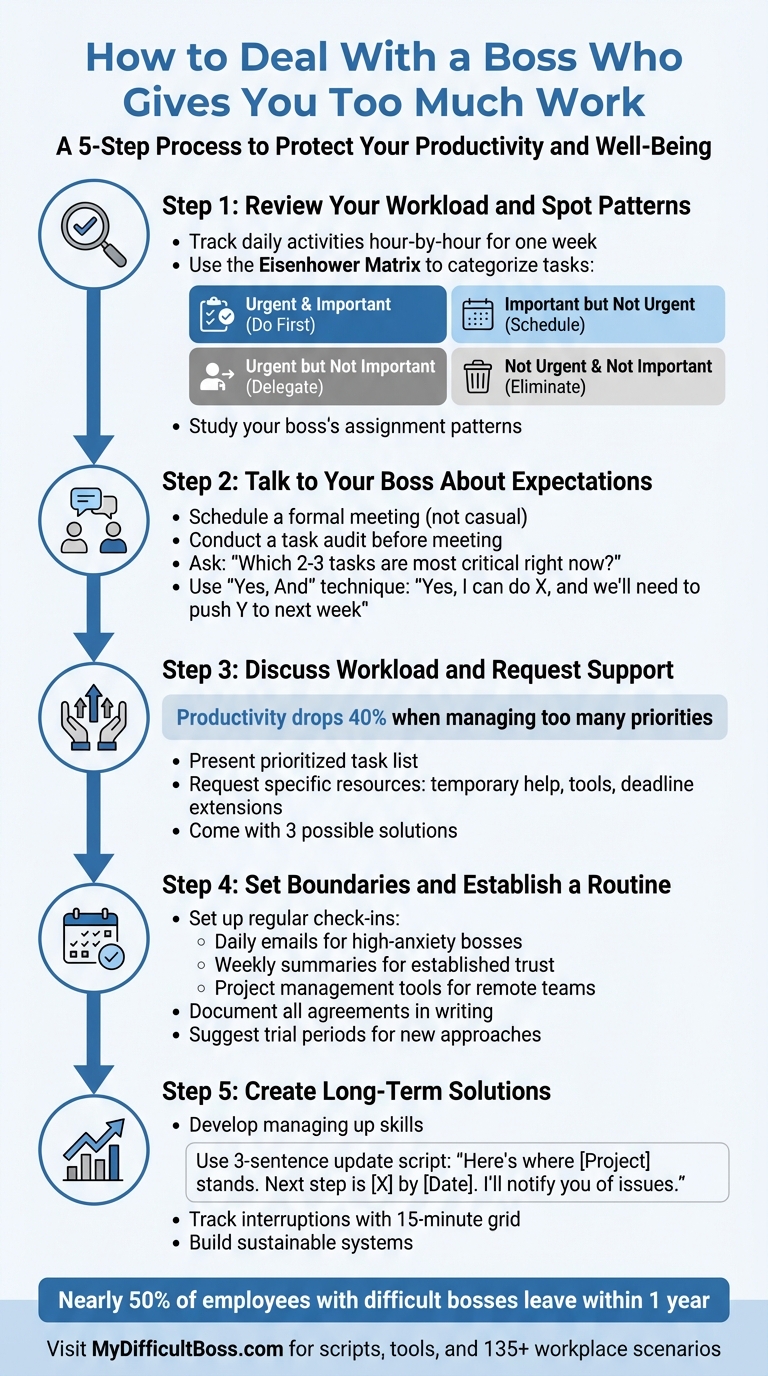
5 Steps to Manage an Overloaded Boss and Reduce Workplace Stress - Infographic © MyDifficultBoss.com
How to deal with a boss who gives you too much work?
Step 1: Review Your Workload and Spot Patterns
Before approaching your boss about workload concerns, it’s crucial to understand exactly how you’re spending your time. Start by tracking your daily activities hour-by-hour for an entire week. This will give you a realistic view of where your time is going. Are certain tasks taking longer than expected? Are you spending too much time on low-priority work? This kind of detailed tracking helps uncover gaps between how you think your time is spent and how it’s actually allocated. Use a simple tracker or spreadsheet to log tasks and create a clear, data-driven picture of your workload. This will be an invaluable tool when discussing priorities with your boss.
For additional support, check out the Boss Decoder Tool to better understand your boss’s management style. You can also explore MyDifficultBoss.com for more strategies and scripts tailored to different workplace dynamics. Combining these insights with your workload analysis will help you prioritize tasks effectively.
Apply Prioritization Methods
Once you’ve documented your workload, it’s time to organize it. One effective method is the Eisenhower Matrix, which helps you divide tasks into four categories:
- Urgent & Important: Focus your energy here. These tasks require immediate attention and directly impact your goals.
- Important but Not Urgent: Plan and schedule these tasks. Protect this time from distractions and less critical work.
- Urgent but Not Important: Delegate these tasks to others whenever possible. They may be interruptions that don’t require your unique skills.
- Not Urgent & Not Important: Eliminate or postpone these tasks. They are the lowest priority.
For instance, if a routine task like updating a spreadsheet consistently takes two days instead of a few hours, it might signal the need for a new approach - or even deprioritization. Similarly, review your calendar to see if recurring meetings are truly necessary or if they could be streamlined.
Beyond categorizing tasks, it’s also helpful to analyze how your boss assigns work. This can give you even more clarity on how to approach your workload.
Study Your Boss's Patterns
Take note of the types of tasks your boss assigns you. Are you being given high-impact projects that align with your role, or are you becoming the go-to person for every challenging or miscellaneous task? Many high performers find themselves overloaded simply because they’re reliable.
Also, observe your boss’s timing and expectations. Do they frequently add tasks right before deadlines? Do they tend to underestimate how long assignments will take? These patterns can reveal important aspects of their management style. For example, a detail-oriented boss might demand perfection, while a hands-off manager might leave you to figure things out on your own. Understanding these tendencies will help you tailor your conversations and set realistic expectations.
Step 2: Talk to Your Boss About Expectations
Now that you've tracked your workload in Step 1, it's time to address expectations with your boss. Armed with a clear understanding of your tasks and any recurring patterns, you can initiate a meaningful conversation. Remember, silence can often be misinterpreted by managers as a sign that everything is running smoothly. The goal here isn’t to complain but to ensure alignment and maintain the quality of your work. Approach the discussion as a way to protect the standards your boss expects while focusing on the team’s most important goals.
Schedule a formal meeting rather than addressing these concerns in passing. A structured, focused conversation will allow for a more professional and productive exchange.
Get Ready for the Discussion
Preparation is key. Before the meeting, conduct a task audit. List out your assignments, deadlines, and estimated time commitments. Focus on the larger deliverables and avoid getting bogged down in minor tasks like checking emails. This detailed overview will provide a solid, data-backed starting point for your discussion.
When you meet with your boss, frame the conversation as a collaborative effort. The idea is to align your daily work with what your boss and the team value most. Instead of simply presenting a problem, come with a proposed solution. For example, draft a prioritized list of your tasks and ask your boss to confirm or adjust it as needed.
Ask Your Boss to Set Priorities
During the conversation, guide the discussion toward clarifying priorities. Open-ended questions such as "Which two or three tasks are the most critical right now?" or "Where should this new assignment fit within my current projects?" can help bring clarity to your workload. This approach not only helps create a more manageable task list but also ensures that the quality of your work remains intact.
If your boss adds a new task to your plate, try using the "Yes, And" technique instead of declining outright. For instance, you could say, "Yes, I can take on Project X, and to do that, we’ll need to push Project Y to next week". This method demonstrates flexibility while setting realistic boundaries. If your concerns are brushed off with a comment like "everyone is busy", respond with something like, "I want to make sure I’m focusing on the tasks that have the greatest impact on the team".
For additional tools and strategies, visit MyDifficultBoss.com. You’ll find conversation scripts, tools, and resources tailored to managing workloads and navigating challenging workplace dynamics, including tips on dealing with a boss who gives you too much work.
Step 3: Discuss Workload and Request Support
Once you've set clear priorities, the next step is managing your workload effectively by having a focused conversation about support. This discussion is crucial - especially since productivity can drop by up to 40% when managing too many priorities at once. Your boss might not fully understand everything on your plate, so this is your chance to align expectations and secure the help you need.
Share a Prioritized Task List
Start by presenting a list of tasks ranked by urgency and impact. Instead of creating this list entirely on your own, involve your boss by asking for confirmation or adjustments to your ranking. Use neutral, fact-based language to keep the conversation productive. For example, instead of saying, "I'm overwhelmed with work", you could say, "I've outlined my current projects and their deadlines. I’d like to ensure I’m focusing on what brings the most value to the team." This keeps the focus on team goals rather than personal challenges.
If a new task comes up during the discussion, try responding with something like, "Let me review my current workload and get back to you later today on how I can fit this in." Once you've finalized your priorities, the next step is to talk about the resources you’ll need to achieve them.
Ask for More Resources
Be specific about what you need, whether it's temporary help, additional team members, better tools, or extended deadlines. Come prepared with three possible solutions to show initiative. For instance, you might suggest:
- Delegating certain tasks to a junior colleague
- Automating repetitive tasks with upgraded software
- Postponing a less critical project to a later date
"Never go to your boss with a problem unless you have a solution." – Julie Morgenstern, Productivity Expert
A great example of this approach in action comes from Lisa Sterling, who, in 2014, was promoted to Chief People Officer at Ceridian while still managing her role as VP of Product Strategy. Feeling stretched too thin, she met with CEO David Ossip to discuss her workload. She presented a detailed breakdown of her responsibilities and proposed hiring a Director of Product Strategy to take on some of her tasks. The CEO not only approved the hire but also provided her with executive coaching on delegation, enabling her to focus on her leadership role.
These strategies build on the foundation of setting expectations while preparing you for long-term solutions. For more tips, including conversation scripts and tailored approaches, check out this guide on dealing with a boss who gives you too much work.
Step 4: Set Boundaries and Establish a Routine
Now that you've reorganized your workload and secured your boss's support, it's time to make sure those improvements stick. The next step is all about keeping your workload in check by setting clear boundaries and establishing a routine. This helps prevent the same issues from creeping back in while protecting your time and energy.
Set Up Regular Check-Ins
Consistent communication is essential to reinforce the priorities you've already discussed. Depending on your situation, you can tailor the check-in format to suit both your needs and your boss's style:
- For high-anxiety bosses, a daily morning email works wonders. It sets expectations early and minimizes interruptions throughout the day.
- For bosses with established trust, a weekly summary is more effective. Focus on big-picture goals and milestones rather than daily updates.
- For remote or hybrid teams, project management tools are your best friend. These tools provide passive visibility into progress, reducing the need for constant meetings while keeping everyone aligned.
The main goal here is to proactively share updates and flag potential issues before they escalate. This not only builds trust but also demonstrates that you're staying on top of your responsibilities. During these check-ins, ask specific questions like, "What does success look like for this task?" or "How does this new assignment affect the priority of my current work?" These questions shift the focus to outcomes, giving you more control over how you manage your time.
Write Down Agreements
Verbal agreements can easily be forgotten, especially when priorities shift. After every discussion about workload or deadlines, send a quick follow-up email to confirm what was decided. For example: "Just to confirm, we agreed that I'll focus on Project A this week and revisit Project B next Monday." This creates a shared reference point and ensures accountability on both sides.
Written agreements also help you spot when old patterns start creeping back in. If your boss begins slipping into habits like late-night texts or over-scheduling, you can gently refer back to your documented conversations.
If your boss hesitates to accept new boundaries or routines, suggest a trial period. For instance, you might say, "I'd like to test this approach for two weeks to see if it helps me deliver higher-quality work." After the trial, review the results together, using your written agreements as evidence. This frames the boundaries as tools for better productivity, rather than personal restrictions.
Step 5: Create Long-Term Solutions
The strategies you've used so far are effective, but they’ll only make a lasting impact if you turn them into habits. By building on your documented workload and clarified priorities, you can develop systems that help you consistently manage expectations. The idea is to move away from constantly putting out fires and instead create processes that prevent workload issues from arising in the first place. This step builds on your earlier efforts to set boundaries and establish priorities.
Improve Your Managing Up Skills
Now that you’ve set up regular check-ins, it’s time to develop habits that ensure your workload stays manageable. Managing up isn’t just about clear communication - it’s about understanding how your boss operates. Take the time to map out their reporting structure, identify their main concerns (like missed deadlines or incomplete preparation), and figure out what they need to succeed. Use this knowledge to shape workload discussions in a way that aligns with their goals.
A great habit to adopt is preemptive communication. For example, you can use a simple three-sentence script to keep your boss informed: “Here is where [Project] stands. Next step is [X] by [Date]. I’ll notify you immediately if any unforeseen issues arise.” This reduces their anxiety and limits unnecessary check-ins. Another helpful tactic is the "Yes, And" response, where you say something like, “Yes, I can do X if we delay Y.” This encourages your boss to help prioritize tasks rather than simply adding more to your plate.
To better understand how interruptions affect your workflow, try using a 15-minute tracking grid. Log what project you’re working on every 15 minutes, and review the data to see how often you’re interrupted. This method is more focused than general time tracking and can help you identify patterns. Additionally, keep a record of moments when you feel frustrated - this can reveal areas where boundaries might need to be reinforced.
Use MyDifficultBoss.com Resources

Take advantage of the resources available there, which offers a library of over 135 scenarios tailored to different boss challenges. Whether your boss is a micromanager, constantly delegates tasks, or struggles with organization, you’ll find scripts and strategies to handle these situations. You’ll find useful tools, conversation templates, and step-by-step strategies designed to build your confidence when managing up.
For even more support, explore their specific guide for dealing with a boss who assigns too much work. Combining these managing-up techniques with the tools provided on the site can help you solidify your long-term approach to workload management.
Conclusion
Taking control of your workload and maintaining high-quality output is achievable, even when dealing with a boss who assigns too much work. It's worth noting that nearly half of employees facing difficult bosses leave their jobs within a year. To tackle this challenge, focus on these five steps: assess your workload, clarify expectations, negotiate priorities, establish boundaries, and create sustainable solutions.
Approaching this as a professional challenge rather than an emotional issue can help preserve your productivity and position you as a problem-solver. By framing workload discussions around maintaining the quality of your work - rather than outright rejecting tasks - you demonstrate a constructive mindset. Workplace overload is a common issue across industries, making these strategies essential for navigating modern professional environments.
For additional support, MyDifficultBoss.com provides a wealth of resources to help you implement these strategies effectively. With over 135 scenarios, tailored scripts, and tools like their boss decoder tool you'll find practical advice to handle even the toughest situations. Whether you're preparing for a critical conversation or reinforcing boundaries, these tools are designed to help you manage workplace stress confidently.
Looking for more detailed guidance? Check out the comprehensive guide on managing a boss who assigns too much work on their website. It's time to take action, protect your productivity, and set yourself up for long-term career success.
FAQs
How do I prove my workload is too high?
To stay on top of your workload, make sure to document all your tasks thoroughly. Include key details like deadlines, time estimates, and any dependencies. This will give you a clear picture of the volume and complexity of what you're handling. Plus, it creates a solid record you can reference if needed.
Consider using tools like the My Difficult Boss website to break down your situation and develop strategies for improvement. Once you've gathered your findings, share them with your boss. This can help you demonstrate that your workload might be exceeding reasonable limits and open up a constructive conversation about how to manage it better.
What should I say when my boss adds 'just one more' task?
When your boss hands you “just one more” task, it’s important to respond thoughtfully while setting clear boundaries. Start by acknowledging the request and then address priorities. For example, you could say: “I can take this on, but to do it well, I’ll need to push back some other tasks. Which should take priority?”
This approach keeps the conversation professional, communicates your limits, and ensures you can maintain the quality of your work without overloading yourself.
When is it time to escalate or consider leaving?
If your attempts to set boundaries, communicate your workload, or find workable solutions aren’t making a difference - and your well-being is taking a hit - it might be time to take more decisive action. Feeling constantly overwhelmed, burned out, or ignored by your boss can signal that the situation isn’t improving. In such cases, escalating the issue through formal channels or even considering a change may be necessary, particularly if the workplace remains toxic or unresponsive to your concerns.