How to Deal With an Angry Boss at Work
Practical strategies to stay calm, communicate clearly, document incidents, and use tools to manage an angry boss or escalate when a workplace becomes toxic.

Dealing with an angry boss at work can make even simple conversations feel tense and unpredictable. If you respond the wrong way, it can quickly escalate — but staying silent isn’t a solution either. These practical strategies and scripts will help you stay calm, defuse the situation, and respond with confidence. Dealing with an angry boss can be stressful, but it’s manageable with the right approach.
Key strategies include:
- Understand Triggers: Identify what causes their anger - tight deadlines, miscommunication, or external pressures. Keep track of patterns to anticipate issues.
- Stay Calm: Control your emotions, breathe deeply, and maintain a neutral tone. Avoid reacting defensively or emotionally.
- Communicate Clearly: Use active listening, acknowledge their concerns, and frame responses with "I" statements to keep discussions constructive.
- Document Incidents: Record details of conflicts to spot patterns or for escalation if needed.
- Use Resources & Tools: Tools like the Boss Decoder Tool provide tailored strategies for handling specific boss behaviors.
Your well-being matters. If the environment remains toxic, consider escalating the issue to HR or exploring other opportunities. For detailed advice, check out resources like MyDifficultBoss.com.
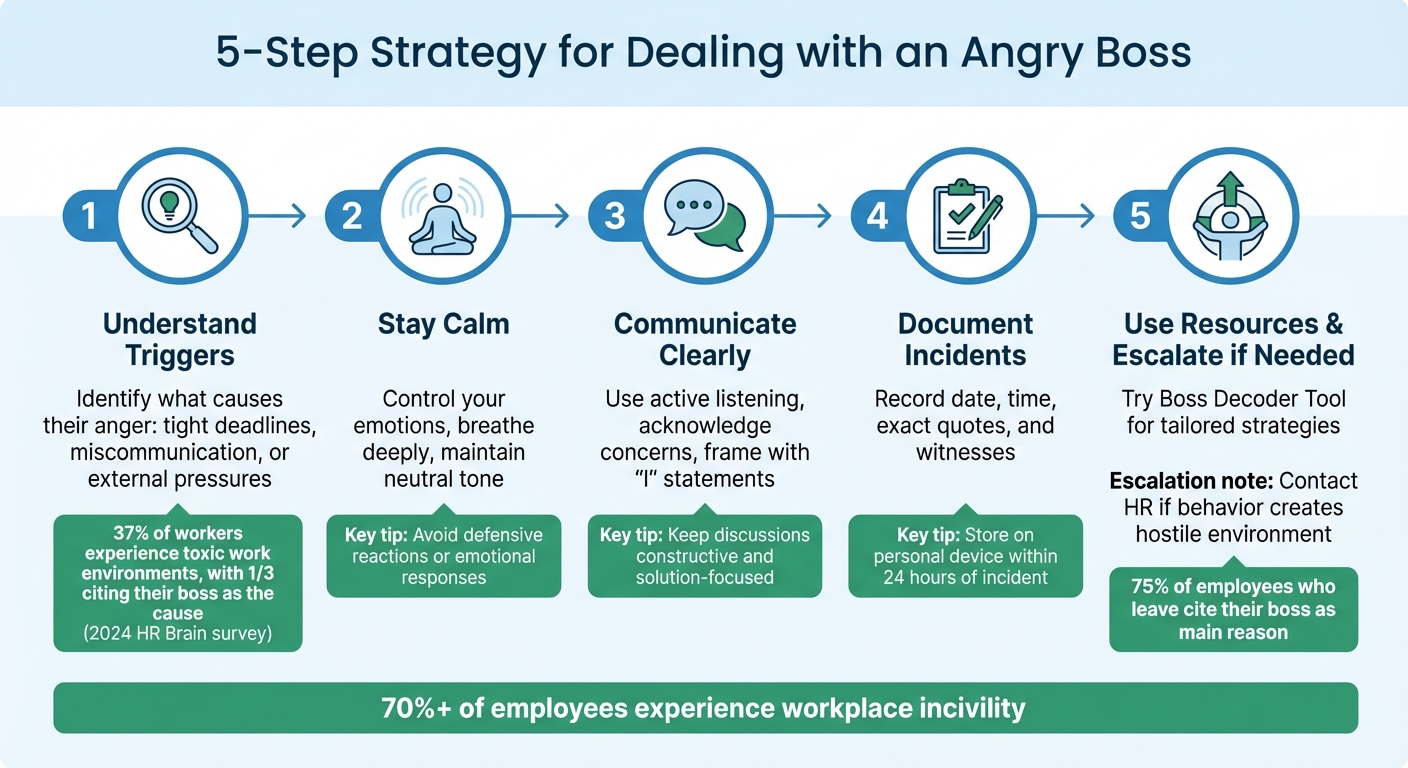
5-Step Strategy for Dealing with an Angry Boss at Work - Infographic © MyDifficultBoss.com
How To Deal With An Angry Boss
Identify What Triggers Your Boss's Anger
Understanding what sets off your boss's anger is just as important as knowing how to handle it. More often than not, their frustration isn't personal - it's a reflection of the stress they're juggling. A 2024 Gallup Poll surveying 142 countries found that workplace anger remains elevated compared to pre-pandemic levels, highlighting the ongoing tension many employees face.
Common Causes of Workplace Anger
There are several reasons why workplace anger flares up. These include overwhelming workloads, pressure from higher-ups, unmet expectations, and situational stressors like last-minute interruptions or pre-meeting jitters. When your boss is buried under tight deadlines, long hours, and relentless productivity demands, their frustration can spill over - and you might find yourself in the crossfire. In fact, a 2024 HR Brain survey of 1,000 workers revealed that 37% experienced a toxic work environment, with one-third of that group specifically citing their boss as the cause.
Perfectionist bosses, in particular, tend to lash out when tasks fall short of their (often unspoken) standards. Miscommunication and mismatched work styles - like a disorganized boss paired with a meticulous employee - can also heighten tension.
External stressors play a role too. As Simon Stapleton, CEO/CTO and author, points out:
Whatever has happened, you did not cause the anger. Your boss might be venting because of stress or the pressure of work... it's just being projected at you.
Even minor issues, like a bad commute, can sour their mood for the day. Recognizing these pressures helps you better understand their reactions and adapt your interactions to avoid unnecessary conflict.
Recognize Patterns in Behavior
Tracking your boss's behavior can be a game-changer. Keep notes on when their outbursts occur - include the date, time, and surrounding circumstances. For example, do they tend to lose their temper on Monday mornings? During budget reviews? Or right before board meetings? Identifying these patterns can help you pinpoint the true triggers behind their anger.
A helpful tool for this is the "5 Whys" method: keep asking "why" until you uncover the root of the problem. If your boss erupts over a minor typo, dig deeper - are they under scrutiny for quality control by their own supervisor? This approach can reveal the bigger picture.
Non-verbal cues also provide valuable insight. Watch for signs like eye-rolling, deep sighs, or physical withdrawal, which often signal an impending outburst. Additionally, inconsistency is worth noting. If your boss praises you for something one day but criticizes the same behavior the next, that unpredictability is a pattern in itself. Alison Green, a columnist at Inc.com, advises:
Simply naming what you're seeing that's unsettling you and asking about it - in an utterly calm and neutral way - can actually defuse a lot of this.
Recognizing these patterns doesn’t justify poor behavior, but it equips you to anticipate triggers and navigate interactions more effectively. For more practical advice, including scripts and strategies tailored to different scenarios, explore this resource: Dealing with an Angry Boss.
With these insights, you're better prepared to manage your own response and stay composed under pressure.
Stay Calm and Professional
When your boss is yelling or visibly frustrated, your ability to remain composed becomes your greatest strength. Reacting emotionally - whether by raising your voice, becoming defensive, or shutting down - only fuels the tension and intensifies the conflict. Staying calm doesn’t mean tolerating poor treatment; it means keeping control of your emotions so you can guide the conversation toward a constructive outcome. This approach not only demonstrates emotional maturity but can also improve how your boss views your leadership potential over time. As Brian de Haaff puts it:
Learning to manage our own response helps us stay in charge of the outcome
. Similarly, Simon Stapleton cautions:
The wrong way is to respond with anger. You'll get into a battle that escalates, likely beyond a point of no return. Your relationship will struggle to survive this hostility!
. For more tailored advice, MyDifficultBoss.com offers specific solutions and scripts for navigating challenging workplace dynamics. Below are effective techniques to help you stay composed and handle high-pressure moments with poise.
Techniques for Managing Your Emotions
Control your breathing. Slow, deliberate breaths can help you stay grounded during tense moments. Pair this with a neutral facial expression and open body language - steer clear of defensive gestures like crossing your arms, rolling your eyes, or grimacing, as these can escalate the situation.
Lower your voice. Speaking softly during your boss’s outburst can encourage a calmer tone. If they’re standing and shouting, try sitting down. This non-threatening posture can subtly shift the dynamic and help de-escalate the situation.
Mentally step back. Visualize a calm setting or imagine observing the situation from the outside. This can remind you that your boss’s anger is often stress-driven - whether it’s tight deadlines, pressure from their superiors, or even external frustrations like a bad commute - and not necessarily a reflection of your performance. Once you’ve managed your emotions, you’ll be better equipped to respond thoughtfully and constructively.
Avoid Reactive Responses
Practice active listening. Let your boss express their frustration without interrupting. Use nonverbal cues like nodding and maintaining eye contact to show you’re paying attention. When they finish, acknowledge their feelings with neutral statements such as, "I can see that you’re frustrated" or "It sounds like this situation has been stressful for you". Catherine Mattice, Founder/CEO of Civility Partners, suggests:
I can see that you are angry about this based on your body language and tone of voice
. Acknowledging their emotions can help defuse the tension by making them aware of how they’re coming across.
Use "I" statements. Frame your responses to express your perspective without assigning blame. For instance, say, "I feel confused by this feedback", instead of "You’re being unfair." This keeps the conversation focused on solutions and avoids putting your boss on the defensive. If emotions are running too high, consider suggesting a follow-up: "I’d like to take some time to think this over - can we revisit this tomorrow?". Stepping away from a heated exchange allows both parties to cool down and approach the issue more rationally later. These strategies not only help you manage the immediate conflict but also create an opening for a more productive and solution-oriented discussion.
Communicate Effectively with Your Angry Boss
Once you've managed to stay calm, the next step is to focus on clear and solution-oriented communication. Dealing with an angry boss isn't about proving who's right - it's about easing the tension, understanding the problem, and working toward a resolution. Tools like the Boss Decoder Tool can help you identify what triggers your boss, giving you valuable insight for navigating these conversations. The strategies below can guide you in addressing your boss's concerns effectively.
Active Listening and Empathy
Let your boss express their frustration without interrupting. Jumping to defend yourself too soon can make things worse. Instead, use non-verbal cues like nodding and maintaining eye contact to show you're engaged. Once they've finished speaking, summarize their concerns to confirm you understand. Catherine Mattice, Founder/CEO of Civility Partners, recommends:
Reiterate the main concerns without repeating negative words that your boss used so that you can move the conversation in a more positive direction
For instance, you could say, "It seems like the report didn’t meet your expectations. Could you point out which sections need improvement?" This approach acknowledges their frustration without mirroring any harsh language they might have used.
Ask follow-up questions to dig deeper into the issue. Often, anger stems from underlying problems like unclear priorities, missed deadlines, or external pressures. Using the "5 Whys Method" can help you address these root causes. For example, calmly ask, "What specific changes would make this align better with your vision?" This shifts the focus from vague complaints to actionable feedback. As Joash Nonis explains:
When someone feels heard, they are less likely to become defensive. Active listening reduces the likelihood of your Angry Boss becoming defensive, making it easier to have a constructive conversation
Once you've clarified the issue through active listening, steer the discussion toward solutions with constructive responses.
Use Positive Language and Solution-Oriented Feedback
Frame your responses in a way that focuses on resolving the issue rather than assigning blame. For example, instead of saying, "That wasn’t my fault", try something like, "I understand your concern. Here’s what I was thinking, but how should I approach it differently next time?" If the frustration stems from a missed deadline, you might respond with, "I want to deliver top-quality work. Can we discuss which project should take priority so I can meet this deadline?"
Here’s a quick comparison of reactive versus professional responses to common situations:
| Situation | Direct Feedback (Reactive) | Indirect Empathy (Professional) |
|---|---|---|
| Addressing Anger | "You shouldn't yell at me." | "I can see you're frustrated by this situation." |
| Handling Deadlines | "This deadline is impossible." | "I want to deliver excellent work; can we discuss priorities?" |
| Clarifying Vague Input | "You're being unclear." | "Could you provide a specific example to help me understand?" |
| Responding to Blame | "That wasn’t my fault." | "I hear your concern. My thinking was [ ], but what’s the best way to handle it next time?" |
For more examples, tailored strategies, and scripts, check out MyDifficultBoss.com, which offers helpful tools for managing challenging workplace dynamics.
Follow Up in Writing
After a tense conversation, it’s a good idea to confirm key points in writing. Sending a short email summarizing the agreed-upon actions ensures both parties are on the same page and shows your commitment to resolving the issue. This step is particularly important if similar incidents happen repeatedly. In fact, over 70% of employees report experiencing incivility or disrespectful behavior at work. Keeping a written record of these exchanges can be useful if patterns begin to emerge over time.
Use the Tools and Resources on MyDifficultBoss.com

Dealing with an angry or toxic boss can feel overwhelming, but having the right resources can make all the difference. Using their resources provides a comprehensive toolkit to help you navigate tricky workplace dynamics. Did you know that 31% of U.S. workers report having a toxic boss?.
Take the Boss Decoder Tool for Personalized Insights
One of the standout tools on the site is the Boss Decoder Tool. This quick quiz helps you identify your boss's behavior type - whether they're an "Exploder", "Bully", or something else entirely. Once you know what you're dealing with, you'll gain access to tailored strategies, including specific dos and don’ts for handling their behavior. Considering that 65% of workplace bullying comes from managers and bosses, understanding their behavioral patterns is a crucial first step toward managing the situation effectively.
With insights from the Boss Decoder Tool, you can approach conversations and conflicts with confidence, using strategies that are designed to work for your specific scenario.
Explore Conversation Scripts and Long-Term Strategies
After identifying your boss's type, you can dive into the Problem Solver Library for detailed, step-by-step solutions. This resource includes Starter Scripts for common workplace challenges, outlining exactly what to say, how your boss might respond, and how to handle their reaction professionally. For example, if you're dealing with an "Exploder", you can find tailored conversation scripts HERE.
The platform currently offers free access to solutions for 11 common boss-related challenges, making it easy to start without any financial commitment. And there’s more to come - soon, the toolkit will include a "Get a Raise" feature and 24/7 interactive role-play sessions. These upcoming tools will further support you in defusing tense situations and fostering better communication with your boss.
Document Incidents and Seek Support When Necessary
After applying effective communication strategies, keeping thorough records becomes essential when dealing with recurring issues. Detailed documentation not only helps you stay organized but also ensures clarity and accountability if tensions escalate.
Why Keeping Records Matters
If your boss's anger becomes a pattern, documentation serves as your strongest safeguard. Detailed records turn isolated moments into credible evidence, which can be crucial if the issue needs to be addressed by HR or even legal channels. As Mahir S. Nisar, Principal at Nisar Law Group, puts it:
"Strong documentation transforms vague memories into compelling evidence."
For each incident, make sure to log the date, time, location, and exact quotes - recording what was said verbatim is far more effective than summarizing. Include the names of any witnesses and describe how the event impacted your work or emotional well-being. Keep your notes factual and focused on observable behavior, steering clear of emotional language.
Store these records securely on a personal device or private cloud account, not on company-owned equipment. Courts tend to value notes written within 24 hours of an incident more highly than those created long after the fact. Additionally, save digital evidence like screenshots of demeaning emails, instant messages, or voicemails, ensuring timestamps and metadata are intact.
Once your documentation is complete, the next step is deciding when and how to escalate the matter.
When to Escalate the Issue
Determining when to involve HR or seek outside help can be tricky. Escalation is generally warranted when the behavior becomes severe or consistent enough to create a hostile work environment. This could include extreme incidents like physical intimidation or verbal abuse, or a pattern of repeated misconduct. Under Title VII of the Civil Rights Act of 1964, harassment must meet a specific legal threshold to be actionable, especially if it targets protected characteristics such as race, religion, sex, or age (40 or older).
If it feels safe, try addressing the issue directly with your boss first. However, if that approach fails or you feel unsafe, skip direct confrontation and proceed with formal reporting. When escalating to HR, present your documentation in a way that highlights its impact on both your productivity and overall team morale. Most companies have anti-retaliation policies to protect employees who report concerns, and whistleblower laws offer additional protections against retaliation like firing or demotion. If internal HR efforts don't resolve the problem, consider consulting an employment lawyer or seeking confidential support through your company's Employee Assistance Program (EAP).
Build Trust and Mutual Respect Long-Term Strategies For Building a Better Relationship
Once you've tackled immediate conflicts and documented key incidents, it's time to focus on creating a professional environment that fosters success. Building a better relationship with an angry boss doesn’t mean becoming best friends - it’s about minimizing friction and ensuring a productive workplace.
Build Trust and Mutual Respect
Trust takes time, especially with a boss prone to losing their temper. The goal is to demonstrate that you're equally committed to achieving success. Some bosses equate mistakes with a threat to their competence, so showing that you care about the project's outcome can help ease their concerns. Executive coach Bonnie Artman Fox suggests using statements like:
"I know getting things done right and on time is important to you. It's important to me too."
This shifts the tone from confrontational to cooperative. After any conflict, take the initiative to discuss what went wrong and how to prevent it from happening again. This reinforces your dedication to improvement and long-term success.
Interestingly, a leadership coaching program designed to replace abrasive behaviors with empathy reported an 82% positive transformation rate. While you can’t change your boss entirely, staying calm, validating their concerns, and maintaining professionalism can influence the relationship over time. Once mutual respect is established, aligning on goals becomes much easier.
Align on Goals and Expectations
Unclear expectations often lead to frustration. To improve your working relationship, focus on being proactive rather than reactive. Start by asking direct questions like, "What does success look like for this project?" or "How would you prioritize these tasks?" This approach helps clarify expectations from the beginning. Following up with an email to confirm your understanding not only avoids misunderstandings but also shows reliability.
Regular, concise updates - such as "Completed", "In Progress", or "Upcoming" - can keep your boss informed without requiring lengthy meetings. This simple habit can help build a smoother workflow. It’s worth noting that 75% of employees who leave their jobs cite their boss as the main reason. As Dominic Monn, CEO of MentorCruise, wisely points out:
"Your boss's behavior is data about them, not a verdict about you."
Every boss values something different - whether it’s meeting deadlines, thorough preparation, or detailed insights. Identifying what they prioritize and consistently delivering on it builds a “trust account” that can act as a buffer during challenging moments.
Conclusion
Dealing with an angry boss can feel overwhelming, but it’s possible to manage effectively with the right mindset and strategies. The first step is understanding what sparks their anger and staying emotionally grounded to respond constructively. Shifting the focus from conflict to collaboration through thoughtful communication is crucial. As Simon Stapleton wisely puts it:
Anger is a choice. Whatever has happened, you did not cause the anger
. This perspective can empower you to respond professionally rather than react impulsively.
For a more tailored approach, tools like the Boss Decoder Tool can be game-changers. By identifying your boss's specific anger style - whether it’s chronic negativity, micromanaging, or explosive behavior - you can craft responses that align with their patterns. Early use of this tool can provide actionable insights to help you navigate these challenges more effectively.
The statistics are telling: over 70% of employees encounter workplace incivility, and more than half report a drop in productivity as a result. If you’re in this boat, know you’re not alone. Resources like MyDifficultBoss.com offer practical solutions, including conversation scripts and long-term strategies tailored to over 135 difficult boss scenarios. These tools can help you handle heated moments with confidence, establish boundaries, and gradually improve your working relationship.
However, your well-being should always come first. If these strategies don’t bring relief and the environment remains toxic, it’s essential to document incidents, escalate the issue to HR, or even consider moving on. An angry boss can significantly impact your mental health, but with the right tools and resources, you can take control and reduce the stress.
For more in-depth guidance, including specific scripts and strategies for dealing with an angry boss, explore the resources available here.
FAQs
Is my boss’s anger ever my fault?
Your boss’s anger is rarely about you. Anger is typically a personal reaction, often triggered by stress or other outside pressures. The best approach? Stay calm and professional. Reacting with anger yourself will only make things worse. Keep in mind, their emotional outburst is more about what they’re dealing with than anything you’ve done.
What should I say when my boss starts yelling?
When your boss yells, staying calm is key. Focus on maintaining your composure, even when emotions are running high. Listen attentively, maintain eye contact, and acknowledge their feelings with a neutral statement like, “I understand you’re upset.” This shows you're engaged without adding fuel to the fire.
Avoid reacting emotionally or arguing back, as this can escalate the situation. Once the tension eases, respond respectfully. You can ask clarifying questions to better understand their concerns or suggest revisiting the topic privately later. For more guidance, consider exploring resources that offer specific strategies for managing challenging workplace dynamics.
When should I escalate an angry boss to HR?
Dealing with an angry boss can be tough, but if informal efforts like direct communication don’t work and their behavior - like harassment, threats, or bullying - continues, it might be time to involve HR. Persistent actions that harm your well-being or create a toxic work environment shouldn't be ignored. Before escalating, make sure you’ve documented specific incidents, including dates, details, and any witnesses. This documentation can be crucial when addressing the issue with HR.
If their actions violate company policies or make the workplace feel unsafe or hostile, HR intervention is not just appropriate - it’s necessary.