Most common boss-related questions (and answers)
If your boss undermines or ignores you, learn why they act that way and concrete steps to manage, get credit, escalate, or leave to protect your career.

If you’re struggling with a difficult boss, you’re not alone. Common challenges include micromanagement, lack of feedback, and even credit-stealing. Here's what you need to know:
- Micromanaging bosses often act out of anxiety or a need for control. Regular updates and transparency can help ease their concerns.
- Bosses who avoid feedback may lack confidence or training. Be specific when asking for input and propose regular check-ins.
- Credit-stealing bosses often act out of insecurity. Document your contributions and share updates to ensure your work gets recognized.
- Toxic behavior like verbal abuse or harassment should never be tolerated. Escalate to HR or consider leaving if the environment is harmful.
Understanding your boss’s behavior is the first step to improving your work dynamic. If the situation doesn’t improve, it might be time to escalate or move on. Your well-being and career growth should always come first.
Manage Up to These 3 Types of Bad Bosses
Is Your Boss Actually Difficult, or Is It You?
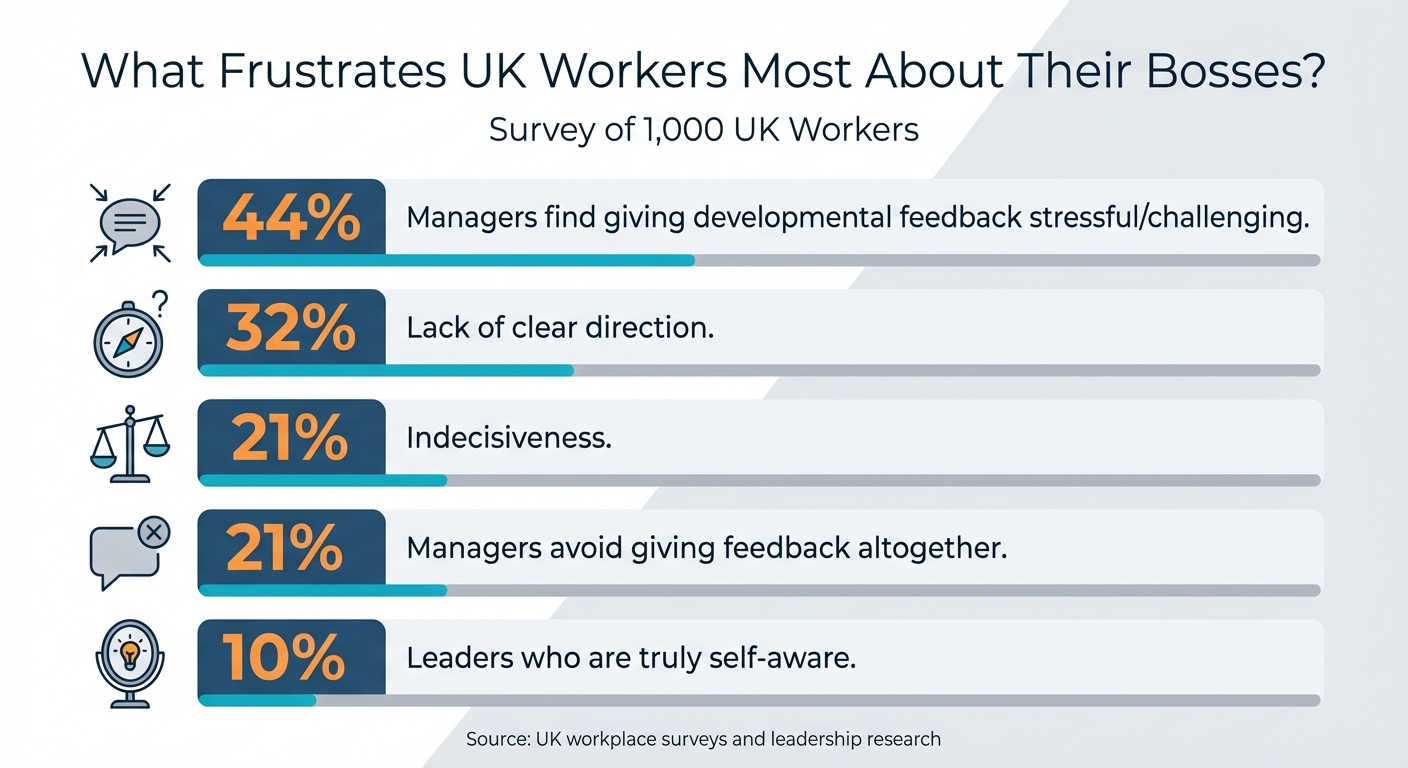
UK Worker Frustrations with Boss Behaviors Survey Results
Before jumping to conclusions, it’s worth asking yourself: is the tension with your boss entirely their fault, or could your own actions and habits be contributing? Sometimes, the problem is a challenging boss. Other times, it’s a mix of mismatched expectations, differing communication styles, or even personal stress affecting your perspective.
What a Difficult Boss Looks Like
A truly difficult boss goes beyond the usual workplace challenges. They might belittle employees, take credit for successes, blame others for failures, or constantly shift priorities without explanation. Unrealistic goals with no clear direction are another hallmark of this behavior.
For example, a survey of 1,000 UK workers found that 32% were most frustrated by bosses who lacked clear direction, while 21% cited indecisiveness as a major issue. These aren’t just minor annoyances - they can lead to a dysfunctional work environment. If you feel your confidence is being undermined or you’re left in a state of constant confusion, it’s likely more than just a tough day at work.
The difference between a demanding boss and a difficult one often comes down to intent and consistency. A demanding boss might push you hard, but their goal is to help you grow. A difficult boss, on the other hand, creates an environment where success feels nearly impossible, thanks to unclear expectations and poor communication. While these behaviors are clear signs of a problem, it’s also worth reflecting on your own contributions to the dynamic.
When You Might Be Part of the Problem
Sometimes, the friction isn’t entirely on your boss. If you’re missing deadlines, overlooking details, or delivering work that needs constant revisions, your boss may feel the need to step in more often. What feels like micromanagement to you might actually be necessary oversight.
Think about whether your actions have given your boss reasons to doubt your reliability. For instance, pushing back on requests for updates can make them feel out of the loop, increasing their anxiety and leading to more frequent check-ins.
"The moment you label someone as difficult you've just made them more difficult to work with because you're not going to give this person the benefit of the doubt anymore." – Jean-François Manzoni, President of IMD Business School
Another common misstep is reacting defensively to feedback or shutting down entirely. This kind of response can strain your professional relationship and make collaboration harder. Research shows that only 10% of people are genuinely self-aware, which means most of us have blind spots about how our behavior impacts others.
Ask yourself: when you’re feeling stressed, do you communicate openly about challenges, or do you expect your boss to read between the lines? Do you offer solutions when reporting problems, or just highlight issues without suggesting ways forward? These gaps in communication can lead to misunderstandings, making it seem like your boss is the issue when it’s actually a two-way problem. Recognizing this can help you take steps toward a better working relationship.
Use the Boss Type Quiz to Find Out
Still unsure whether the problem lies with your boss or your own reactions? A quick assessment might help. The Boss Type Quiz can pinpoint specific patterns, such as whether you’re dealing with a micromanager driven by anxiety, a ghost boss who avoids giving feedback, or a narcissist who shifts blame onto others.
Why Does My Boss Micromanage Everything?
Dealing with a boss who scrutinizes every email, questions every decision, and demands constant updates can be exhausting. If this sounds familiar, you're far from alone.
What Drives Micromanagement
Micromanagement often stems from anxiety. Your boss might fear mistakes, feel immense pressure from their own superiors, or struggle with a deep need for control.
"The key to working with micromanagers is understanding that anxiety is the driving force behind this behaviour" – Marie G. McIntyre, author and workplace coach
Sometimes, the behavior is situational. A newly promoted manager may find it hard to delegate, or managing a remote team for the first time might stir fears about productivity. If you're the only one being micromanaged, it could signal dissatisfaction with your performance or a lack of trust in your judgment. While frustrating, this can often be addressed by consistently proving your reliability.
Recognizing these underlying causes is the first step toward finding solutions.
How to Deal with a Micromanaging Boss
To navigate a micromanaging boss, focus on strategies that address their concerns and reduce their need for constant oversight.
Proactive communication can make a big difference. For example, if a project is due Friday, send a progress update by Wednesday. This shows you're on top of things and can help ease their worries.
Pinpoint what bothers them most and tackle it head-on. If they’re fixated on avoiding mistakes, double-check your work. If they stress over deadlines, flag potential delays early and offer solutions. Sending early drafts can also demonstrate that you're paying attention to details.
Consider setting up a regular check-in meeting to review progress and agree on how often updates are necessary. This creates a structured routine and can minimize ad-hoc interruptions. Using shared tools to track progress in real time can further build trust.
Above all, be transparent. If your boss suspects you're withholding information, it could worsen the micromanagement. Open communication fosters trust and can gradually lead to more autonomy.
What If My Boss Never Gives Me Feedback?
When feedback is absent, it’s easy to feel adrift - uncertain whether you’re excelling, struggling, or simply going unnoticed. If your boss rarely offers input or recognition, you’re not alone in facing this frustrating situation.
Why Some Bosses Don't Give Feedback
It’s often not about you. Studies reveal that 44% of managers find giving developmental feedback stressful or challenging, and 21% avoid it altogether . Many simply lack the training or confidence to navigate these conversations effectively.
"The number one reason that managers don't want to give their employees feedback is because they lack the confidence to do so." – Elizabeth Heron, HR Manager
Some managers shy away from feedback to avoid conflict or mistakenly think withholding criticism will spare you discomfort . Others might be overwhelmed with their workload, using busyness as an excuse to neglect their responsibility to support and develop their team .
The type of boss you have can also play a role. A Ghost Boss is disengaged and rarely available for meaningful check-ins. On the other hand, a pushover boss avoids tough conversations entirely, prioritizing harmony over honesty. Identifying your boss’s tendencies can help you tailor your approach to get the feedback you need.
How to Get Feedback When Your Boss Won't Offer It
Be proactive. Instead of asking broad questions like "How am I doing?" focus on specifics. Try asking, "What’s one thing I could have done differently on the Johnson project?" or "Are these priorities aligned with what you need?" . Specific questions make it easier for your boss to provide actionable insights.
Establish a routine. Propose regular check-ins - bi-weekly or monthly - and frame them around business goals. For instance, you could say, "I want to make sure I’m on track to meet our projections" . When feedback becomes part of a predictable schedule, it feels less like an interruption and more like a natural part of your workflow.
If you sense your boss avoids conflict, ask directly for constructive feedback. Phrasing it as a request for "tough feedback" shows you’re open to honest input. For bosses who are busy or disconnected, streamline your questions to respect their time. You might also draft your own quarterly priorities and share them for review - this can help establish a much-needed feedback loop .
Still unsure about your boss’s style? Take the free Boss Type Quiz to uncover patterns in their behavior and get tailored strategies to navigate your specific situation.
What If My Boss Takes Credit for My Work?
Having your boss take credit for your hard work can be a tough pill to swallow. Just like micromanagement or a lack of feedback, this behavior can damage your morale and potentially stall your career growth. If it happens repeatedly, it’s more than just a one-time frustration - it’s a pattern that needs addressing.
Why Bosses Take Credit
When a boss claims your ideas as their own, it often stems from insecurity rather than a reflection of your abilities. Wendy Behary, author of Disarming the Narcissist, explains, "Underneath all the bluster, boasting, bullying and controlling is someone who has a lot of insecurity and, ironically, a great sense of inadequacy that they are trying desperately to not expose". This behavior is especially common in leadership styles that lean toward narcissism or megalomania, where self-promotion overshadows team accomplishments.
Sometimes, overly outgoing leaders might unintentionally take credit. They may view team interactions as a stage to perform rather than as opportunities for genuine collaboration. Interestingly, research shows that only about 10% of leaders have a clear understanding of how their actions affect others. Recognizing that their insecurity drives this behavior can help you focus on ensuring your contributions are acknowledged.
How to Make Sure You Get Credit
To safeguard your recognition, documentation is key. Dana Brownlee, President of Professionalism Matters, suggests, "You have to take the lead and pull the information out of them by asking very pointed questions and documenting their responses". Here are some practical steps to help you:
- Create a paper trail: Share drafts or completed work via email before deadlines to establish a timestamped record.
- Use collaborative tools: Platforms like Trello or shared spreadsheets provide real-time visibility into your tasks.
- Summarize responsibilities: After meetings, send a quick email detailing your contributions and next steps.
- Break down projects: Divide larger tasks into smaller, actionable steps that clearly show your role.
- Regular updates: Proactively check in with your boss to outline your progress and deliverables.
If your boss continues to withhold credit, seek out mentors within your organization. They can advocate for your work and help you navigate these challenges. Additionally, staying ahead of requests and offering updates proactively can help establish your value.
Still unsure about your boss’s behavior? Explore the various tools at MyDifficultBoss.com to identify patterns and find strategies tailored to your situation.
Should You Confront Your Boss or Just Adapt?
Figuring out whether to confront your boss or adjust to their behavior is no easy task. You've likely spent time reflecting, maybe even venting to friends, but now it's time to decide: should you speak up or adapt?
The answer depends on the situation. Your boss's behavior and the severity of the issue will guide your approach. Eric Charran, author of Managing Your Manager, offers this perspective:
"The first thing to do is to try to overcome an overwhelming urge to say 'Why are they doing this to me? It must be that I'm deficient in some way.' It's not necessarily that individual's personality is a mismatch [for yours] or that they don't like you. It's just that they're using a hammer when they really need a screwdriver."
In many cases, the problem isn't personal - it’s a clash in work styles that might be manageable.
When adapting makes sense: Work style differences often call for adjustment. For example, if your boss micromanages, try sending regular updates to stay ahead of their questions. If they procrastinate, build in extra time for approvals and set incremental deadlines. Mary Abbajay offers some practical advice:
"Stop waiting for the unicorn and start succeeding with the boss you actually have".
When a conversation is necessary: If adapting doesn’t resolve the issue, and it’s hindering your growth, it’s time to have a direct conversation. For example, if your boss is absent and you lack the feedback needed to move forward, request regular check-ins. If they’re crossing boundaries or demanding unreasonable hours, calmly discuss limits. Use softer phrases like "Could we consider" to keep the tone constructive, especially with more authoritarian managers.
When it’s time to leave: Some situations simply can’t be fixed. If your boss is abusive or harassing, no strategy will make the environment safe. Career coach Dr. Marie G. McIntyre puts it plainly:
"Never stay in a job where you are verbally abused, physically touched in any harmful way, or sexually harassed. No paycheck is worth that kind of treatment".
In such cases, the healthiest choice is to move on.
When Should You Escalate or Leave?
If your efforts to address issues with your boss haven’t led to improvement, it might be time to consider more decisive steps. Just like different boss behaviors call for specific strategies, serious problems may require escalation or even leaving.
Warning Signs It's Time to Act
Some behaviors go beyond personality clashes or work style differences. If your boss engages in verbal abuse, physical threats, or sexual harassment, escalate immediately. These actions are not only unacceptable but also jeopardize your safety and well-being.
Other concerning behaviors include chronic hostility that persists regardless of external stressors. This often signals deeper character flaws. A boss who publicly humiliates employees, perhaps by calling ideas "stupid" in front of others, creates a toxic work environment that rarely improves without intervention. Additionally, patterns of unethical behavior or constant blame-shifting are red flags that may indicate irreparable issues.
Studies have shown that working under a toxic boss can have psychological effects similar to post-traumatic stress disorder (PTSD). If your job is causing ongoing anxiety, harming your mental health, or eroding your self-confidence, it’s a sign that the situation may be taking a serious toll.
What to Do Before You Escalate
Before taking formal action, document everything. Keep a detailed record of incidents, including dates, times, specific behaviors, and any witnesses. This evidence not only protects you but also strengthens your case if you need to escalate the issue.
Seek advice from a trusted mentor or impartial professional outside your team. Their perspective can help you determine whether your concerns are valid and whether escalation is the best course of action. The American Psychological Association offers this guidance:
"If your boss' behavior seems to reflect a chronically hostile, abusive style of interacting regardless of the amount of stress in the worksite... you may want to consider seeking counsel from a trusted mentor or human resources professional to evaluate your options".
Make sure you’ve tried to address the issue through constructive dialogue first. Career coach Eloïse Eonnet emphasizes the importance of giving your boss a chance to adapt:
"If we've done the work to identify what is not working for us, tried to constructively engage our manager about our needs, and given them the opportunity to learn and adapt, but things are still not looking better, it may be time to change teams or organizations".
When you approach HR or senior management, stay calm and present your documentation in a clear, factual manner. This professional approach reduces the risk of retaliation. If these steps fail to create change, it may be time to consider leaving.
When Leaving Is the Right Choice
Sometimes, the healthiest decision is to move on. If you’ve pinpointed the issues, tried constructive conversations, and given your boss time to improve without success, leaving might be the best option. This is especially true if you find yourself constantly walking on eggshells or spending more energy managing your boss than doing your actual job.
Another valid reason to leave is career stagnation. If your boss is consistently unavailable or fails to provide meaningful feedback, you’re unlikely to receive the guidance you need to grow. Research suggests that only about 10% of leaders are self-aware enough to recognize and change their behavior, so the chances of your boss suddenly improving are slim.
Before resigning, explore whether transferring to a different team within the company is an option. If you decide to leave, take the time to research potential managers and their leadership styles during the interview process. Ask thoughtful questions about their management approach and workplace culture to avoid ending up in a similar situation again. Finding the right fit in your next role is just as important as addressing the challenges in your current one.
Conclusion
From the strategies outlined above, one thing is clear: there’s no one-size-fits-all solution to dealing with a difficult boss. The key lies in understanding who your boss is and why they act the way they do. Once you identify their behavior patterns, you can adjust your approach to suit their style. For instance, a micromanager thrives on detailed updates, while a ghost boss responds better to proactive communication.
Interestingly, research shows that only 10% of people are truly self-aware. This means your boss is unlikely to recognize their own behavior without some thoughtful adaptation on your part. Instead of waiting for them to change, focus on how you can work more effectively with them. As psychologists Tomas Chamorro-Premuzic and Reece Akhtar put it:
"If we can better understand how our managers think, we will be better positioned to work with them and meet them where they are, as opposed to expecting them to change".
If you’re unsure about your boss’s style, tools like the Boss Type Quiz can help. This quick and free resource identifies your boss’s archetype and offers specific strategies to handle them.
Above all, prioritize your well-being. While some boss relationships can improve with the right tactics, others may require escalation or even an exit plan. Trust your instincts, document important interactions, and remember: no job is worth sacrificing your mental health. You deserve a workplace where you can thrive and feel confident in your abilities.