How to Deal With a Bully Boss at Work
Learn to spot a bully boss, document incidents, set boundaries, involve HR when needed, and plan an exit or recovery to protect your health and career.

A bully boss doesn’t just make work stressful; they chip away at your confidence, one interaction at a time. The hardest part is knowing what to say in the moment without making things worse. Here are clear, practical strategies and scripts to help you respond calmly, protect yourself, and take back control.
Yes, dealing with a bully boss can feel overwhelming, but there are clear steps to protect yourself and take control. A bully boss often uses intimidation, humiliation, or subtle tactics like exclusion or gaslighting. These behaviors can harm your health, career, and confidence. Here’s what you can do:
- Spot the Signs: Look for patterns of verbal abuse, work sabotage, social isolation, or psychological manipulation. Use tools like the Boss Decoder Tool to identify their bullying style.
- Document Everything: Keep detailed records of incidents, including dates, quotes, witnesses, and impacts. Save digital evidence and summarize verbal instructions in emails.
- Set Boundaries: Assertively communicate your limits. Use scripts like, “I’ll be available until 6:00 p.m., but I won’t check emails until tomorrow morning.”
- Report to HR: Present your documentation with a focus on how the behavior affects your work. Be clear about the resolution you’re seeking.
- Plan Your Long-Term Strategy: Consider whether to stay, transfer internally, or leave. If leaving, prepare your exit by updating your resume, networking, and building a financial safety net.
For tailored advice, scripts, and tools, visit MyDifficultBoss.com. Taking action is crucial - don’t let workplace bullying derail your well-being or career.
How to Deal With a Bully Boss: Surviving and Healing From Toxic Workplaces
How to Recognize a Bully Boss
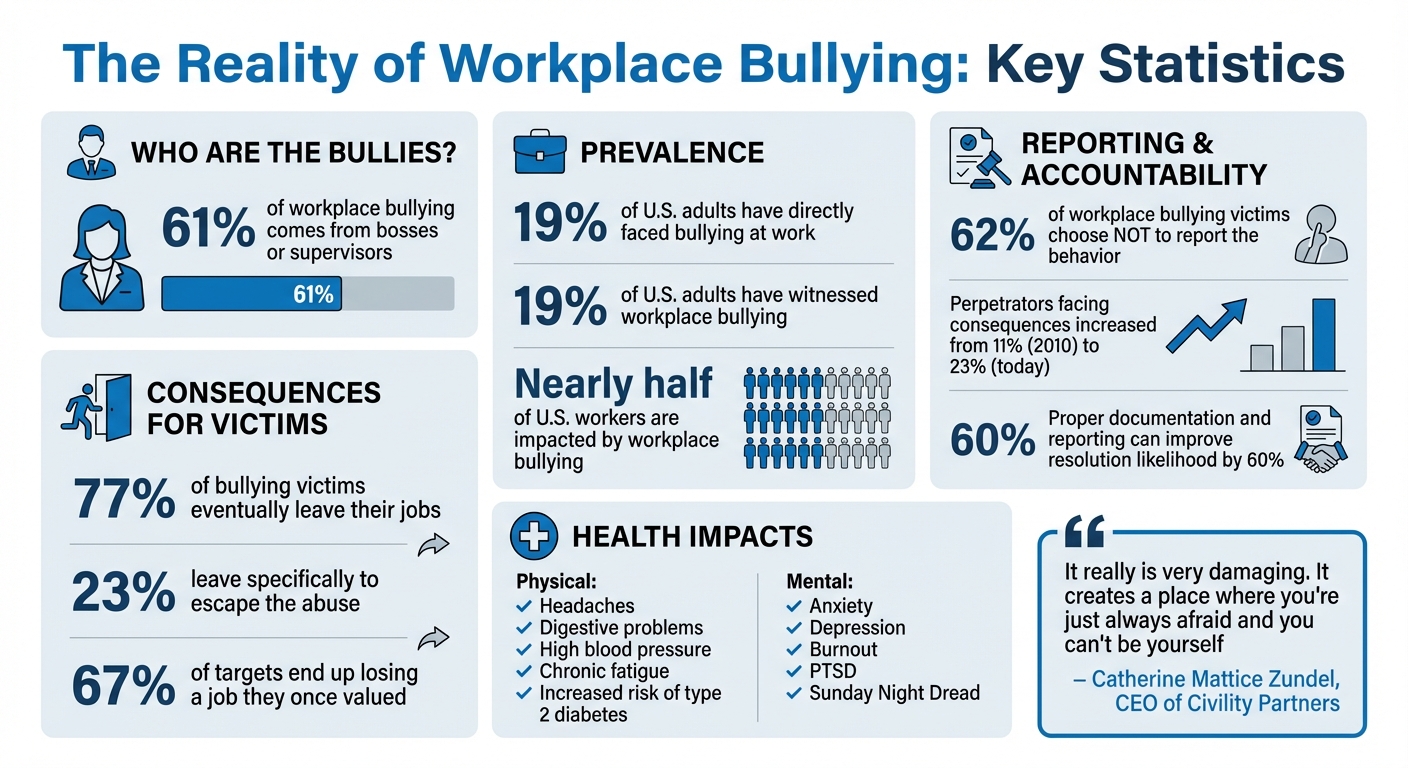
Workplace Bullying Statistics and Impact on Employees - Infographic © MyDifficultBoss.com
Common Bully Boss Behaviors
It's important to distinguish between a demanding boss and a bully. While a tough boss challenges you to meet high standards in a professional way, a bully boss uses intimidation, humiliation, or undermining tactics repeatedly. If you're unsure, try the Boss Decoder Tool to identify your boss type.
Some key behaviors to watch for include verbal abuse and public humiliation. This could mean yelling, cursing, or making degrading remarks, often in front of your coworkers. Some bullies prefer a subtler approach, using sarcasm or passive-aggressive comments to embarrass you without clearly breaking workplace rules.
Another warning sign is work sabotage. A bully boss might give you unmanageable workloads, set impossible deadlines, or withhold crucial information. They may even claim credit for your achievements or change expectations at the last minute, setting you up to fail.
Social isolation is another tactic. Bullies might exclude you from key meetings, leave you out of important email chains, or intentionally ignore you - methods that are difficult to prove but deeply damaging.
Then there’s psychological manipulation, like gaslighting. This happens when your boss denies making certain requests or insists you misunderstood clear instructions, causing you to question your own judgment. Other behaviors, like spreading rumors or micromanaging excessively, can further chip away at your confidence.
The numbers paint a stark picture: 61% of workplace bullying comes from bosses or supervisors. Around 19% of U.S. adults have directly faced bullying at work, with another 19% having witnessed it.
The Impact of Bullying on Your Work and Well-Being
The effects of bullying extend far beyond the workplace. Physically, it can lead to headaches, digestive problems, high blood pressure, and chronic fatigue. Long-term exposure may even increase the risk of developing type 2 diabetes. Mentally, the constant stress can trigger anxiety, depression, burnout, and in severe cases, PTSD. Many people describe feeling persistent anxiety on weekends, often called "Sunday Night Dread", as they anticipate another week of mistreatment. Over time, self-doubt can creep in, leaving you second-guessing your abilities and walking on eggshells.
Bullying also damages your professional growth. It undermines the trust and safety needed for creativity, collaboration, and taking risks. As your confidence and productivity decline, career advancement becomes harder. In fact, 77% of bullying victims eventually leave their jobs, with 23% leaving specifically to escape the abuse.
Catherine Mattice Zundel, CEO of Civility Partners, puts it plainly:
"It really is very damaging. It creates a place where you're just always afraid and you can't be yourself".
Organizations aren't spared either. Bullying often leads to lower productivity, higher absenteeism, frequent turnover, and legal expenses. Spotting these behaviors early is key to protecting yourself and your career. For practical advice, including conversation scripts and strategies about dealing with a bully boss, have a look here.
How to Assess Your Situation
Review Your Workplace and Your Options
Start by taking a close look at your work environment. Dive into your employee handbook, particularly the sections on "code of conduct" or "harassment." Look for policies that address mistreatment, verbal abuse, and intimidation - not just outright discrimination. A workplace that values respect will have clear, written guidelines about how employees should treat one another.
Pay attention to patterns in promotions. If you notice that bullies are rewarded or protected, it’s a warning sign. Social psychologist Gary Namie, Director of the Workplace Bullying Institute, emphasizes this point:
"Without the work environment giving the green light, providing the license to unbridled mistreatment, bullying wouldn't happen".
Also, observe how your company handles high-performing yet toxic employees, like a top salesperson or engineer who mistreats others. If they’re allowed to behave poorly without repercussions, it’s a clue that your workplace culture might not have your back.
Next, explore the resources available to you. Does your company offer an Employee Assistance Program (EAP)? Are there multiple reporting channels, such as compliance hotlines or skip-level reporting options? Understanding whether your HR department is more focused on legal compliance (protecting the company) or fostering a positive workplace culture can help you manage your expectations. Encouragingly, the percentage of bullying perpetrators facing consequences has risen from 11% in 2010 to 23% today. This shift suggests that accountability is improving in some organizations.
Finally, take stock of your personal situation. Think about your finances, health, and long-term career goals. Are you prepared for potential risks like retaliation or even losing your job if the situation doesn’t improve? Labor economist Grace Lordan points out that HR often focuses on middle managers, leaving senior executives unchecked. If your bully is in a high-ranking position, your internal options might be limited.
By thoroughly evaluating your environment and resources now, you’ll be better equipped to choose the right strategies later. Once you have a clear understanding of your situation, the next step is to analyze your boss’s behavior.
Use the Boss Decoder Tool

After reviewing your workplace and assessing your readiness, it’s time to zero in on your boss’s behavior. Different types of bullying require different tactics. For instance, dealing with a boss who publicly humiliates you calls for a different approach than handling one who isolates you by exclusion.
The Boss Decoder Tool is designed to help you identify your boss’s specific management style and bullying style. Once you’ve identified the type, you’ll gain access to tailored scripts, strategies, and long-term solutions suited to your unique situation.
How to Document Bully Boss Behaviors
Once you've evaluated your situation and gained an understanding of your boss's behavior, it's time to start documenting incidents. Keeping detailed and accurate records is essential for addressing inappropriate conduct effectively. Tools like the Boss Decoder Tool, mentioned earlier, can also be helpful in this process.
What to Include in Your Records
Stick to the facts when documenting. Each entry should cover the date, time, location, exact quotes, names (including witnesses), your response, and the impact of the incident.
Here’s an example:
"March 18, 2026, 2:15 PM, Conference Room B: Boss said, 'You're completely incompetent and I don't know why we hired you' (witnesses: Sarah Chen, Mike Rodriguez, Jennifer Park). I responded, 'Let's discuss this privately.' Afterward, I experienced a headache and missed my 4:00 PM deadline."
If there’s digital evidence, secure it immediately. Take full screenshots of message threads and save emails as files with date-specific names. For verbal instructions, follow up with an email summary to create a timestamped record. Store all evidence in personal or private cloud storage to ensure your employer doesn’t have access.
Jan Kircher, a workplace expert and author, highlights the value of documentation:
"Documentation isn't just about reporting - it's a powerful tool for clarity, self-protection, and strategy".
By maintaining detailed records, you not only track events but also create a solid foundation for addressing the issue later.
Why Documentation Is Important
Your records serve purposes beyond filing complaints. They can help you uncover patterns, such as specific triggers or situations that escalate bullying. Recognizing these trends can validate your experience and help you regain some control.
When presenting your case to HR or leadership, thorough documentation shifts the discussion away from "he-said/she-said" arguments. Studies show that proper documentation and reporting can improve the likelihood of resolution by 60%. Additionally, these records can protect you if your boss later tries to justify their behavior by claiming poor performance on your part.
It’s recommended to document incidents for at least two weeks to establish clear patterns. The more detailed your records, the stronger your case. For more help with handling specific tactics used by bully bosses - including conversation scripts and tailored strategies - visit MyDifficultBoss.com. Comprehensive documentation is also crucial step before involving HR or other support systems.
How to Set Boundaries and Communicate Clearly
If you’ve documented instances of bullying, the next step is protecting yourself in daily interactions. Setting clear boundaries and communicating assertively are your best tools against a boss who thrives on pushing limits and provoking reactions.
How to Set and Maintain Boundaries
First, identify the key areas where you need boundaries. These typically fall into four categories: mental (protecting your focus time), time (defining your work hours), emotional (detaching your feelings from your boss’s stress), and role (clarifying your specific responsibilities). A great way to pinpoint these is by doing a "resentment audit" - reflect on situations where you felt frustrated or angry. These moments often reveal where your boundaries are being crossed.
When framing boundaries, focus on how they improve productivity rather than making them sound personal. For instance, instead of saying, “I don’t want to work late,” you could say, “I’m most effective when I have uninterrupted focus between 9:00 a.m. and 11:00 a.m.” This shifts the conversation to how these limits help you perform better. If your boss makes an unreasonable request, try using the "buffer" technique: “Let me check my calendar and get back to you.” This gives you time to assess without immediate confrontation.
Consistency is key. If you let a boundary slide even once, it can signal to a bully that your limits are flexible. Always follow up verbal discussions with a written summary to reinforce accountability. For example: “Per our conversation, I’ll be available until 6:00 p.m., but I won’t check emails until tomorrow morning.” Tools like Slack’s “away” messages or email auto-replies can also help communicate your availability without needing direct confrontation.
Here’s a quick reference for setting boundaries:
| Boundary Type | Example Script/Action |
|---|---|
| Time | "I’ll be available until 6:00 p.m., but after that, I won’t be checking emails until tomorrow morning." |
| Workload | "I’m interested in that, but my plate is full. I can’t add it without compromising my work on Project X." |
| Mental/Focus | "I’m in the middle of deep work until 2:00 p.m. Let’s reconnect after that." |
| Role | "I can’t take on the entire project, but I’d be happy to attend the initial strategy meeting to help outline the plan." |
Using these scripts consistently can help reinforce your boundaries over time, making them a natural part of your interactions.
How to Communicate Assertively
Bullies often exploit emotional reactions, so staying calm and using a steady, neutral tone is essential. "I" statements are particularly effective for expressing how certain behaviors impact you without sounding accusatory. For example: “I feel undermined when my work is criticized in front of the team,” or “I’m most productive when I have uninterrupted focus from 9:00 a.m. to 11:00 a.m.”
If your boss tries to provoke you, respond with calm, neutral phrases like, “I hear what you’re saying” or “Let me think about that.” These responses can diffuse tension and give you time to collect yourself. Using your boss’s name during conversations and maintaining steady eye contact also signals that you’re serious about your boundaries. If things escalate, excuse yourself politely: “I just realized I missed an important call. I’ll need to step out and follow up later.”
The COIN Model is a practical framework for addressing boundary violations. It stands for Connection, Observation, Impact, and Next Steps. Here’s how it works:
- Connection: Start with a neutral tone to establish rapport.
- Observation: State the facts without judgment. For instance, “I’ve noticed messages coming in after 7:00 p.m.”
- Impact: Explain how it affects you. “This makes it hard to recharge.”
- Next Steps: Suggest a solution. “Can we agree that non-critical issues wait until morning?”
This approach keeps the conversation focused on facts, making it harder for your concerns to be dismissed.
For more detailed strategies, scripts, and tips tailored to different situations including bully or other difficult bosses, explore this resource.
How to Report Bullying and Get Support
Once you've documented the incidents and tried setting boundaries, the next step is reporting the issue to HR if the bullying continues. Escalating the matter requires preparation and a clear approach. Interestingly, 62% of workplace bullying victims choose not to report the behavior. Having a solid plan can help you feel more confident about taking this step.
How to Approach HR
Before reaching out to HR, take a moment to review your employee handbook. This document often outlines specific anti-bullying or grievance procedures, which may include formal policies like "Dignity at Work" or "Bullying & Harassment". Understanding these procedures shows HR that you're informed and serious about addressing the issue.
When meeting with HR, bring your incident log. This should include detailed notes such as dates, times, locations, direct quotes, and the names of any witnesses. Focus on how the bullying impacts your work rather than solely emphasizing emotional distress. For example, you might say:
"Since these incidents began in January 2026, I've missed three project deadlines and had to take two sick days due to stress-related headaches."
Clearly outline what resolution you’re seeking, whether it’s mediation, a transfer, or a formal investigation. Rachael Saunders, Deputy Director at the Institute of Business Ethics, emphasizes this point:
"It's crucial to listen to the victim and ask what outcome they seek. HR or senior leaders should then decide on the appropriate action".
Being specific about the solution you want makes it easier for HR to take action.
After the meeting, send an email summarizing the discussion and any agreed next steps. This creates a written record and ensures accountability. Keep all related documentation in a secure, personal location.
It’s important to note that workplace bullying isn’t always illegal unless it targets a protected characteristic such as race, sex, age, or disability. In those cases, it qualifies as legal harassment.
For additional guidance, including conversation scripts and more, visit this resource on dealing with difficult bosses, including bullies:
Tools and Resources
If you need more support after speaking with HR, MyDifficultBoss.com offers tools to help you handle many kinds of difficult bosses, including a bully boss. The platform includes over 135 scenarios, step-by-step solutions, starter scripts, and response strategies to help you approach these tough conversations with confidence.
Once you've reported the bullying and explored external support, you can focus on strategies to protect your career and overall well-being.
Long-Term Strategies for Managing a Bully Boss
Once you've reported a toxic boss to HR and documented the issues, the next step is to think about protecting your career and well-being in the long run. Unfortunately, many people dealing with workplace bullying eventually decide to leave their jobs to escape the situation. Planning for the future is crucial, especially since a significant number of victims find that leaving is their only real solution. As mentioned earlier, resources like those at My Difficult Boss offer tools and advice to help you navigate these challenges effectively.
How to Build Emotional Resilience
Dealing with a bully boss requires mental preparation. Ronald E. Riggio, Ph.D., a professor of Leadership and Organizational Psychology, advises treating interactions with a toxic boss like a strategic game:
"Think of it as a chess match, and be prepared several 'moves' in advance."
If your boss has predictable patterns, anticipate their behavior and prepare your responses. For instance, if they often lash out, you might rehearse a calm exit line like: "I'll come back when you're calmer." Adopting an observer mindset can also help you detach emotionally from their criticisms, allowing you to stay composed under pressure.
Don’t let their words define your self-worth. Recognize that a bully’s behavior often stems from their own insecurities, not your abilities. Remind yourself: "This is their baggage, not mine." This mental shift can help you deflect their negativity and maintain your confidence.
Outside of work, lean on a support network of friends and family to gain perspective. Professional counseling can also equip you with specific techniques to handle chronic stress. Activities like exercise and hobbies can provide a much-needed mental break, reminding you that your life isn’t limited to your job. Setting boundaries - such as avoiding work emails after hours or declining unreasonable demands - can further protect your mental health.
Other Career Options to Consider
While resilience can help you manage daily challenges, it’s important to evaluate whether staying in a toxic environment is worth it. Ask yourself: "Can my boss’s behavior realistically change? Is this impacting my health and personal life?". If fear is the only thing keeping you in your position, it may be time to explore other options.
Internal transfers could offer a solution if the overall company culture is positive. Speak with HR about moving to a different department, which allows you to keep your benefits and tenure while avoiding your current boss.
If leaving feels like the right move, plan your exit carefully. Update your LinkedIn profile and network discreetly outside of work hours - never use company resources for job searches. Build a financial safety net to ease the transition, giving you the freedom to find a role that truly suits you. When resigning, keep your letter professional and avoid airing grievances. This helps safeguard your reputation.
Executive coach Dana Theus highlights the importance of taking control of your decisions:
"Choice is power and the moment you start making more choices is the moment you become more powerful."
Compare Your Strategy Options
Weighing your options is key to choosing the best path forward. Here’s a breakdown of strategies to consider:
| Strategy | Pros | Cons | When to Use |
|---|---|---|---|
| Minimizing Exposure | Reduces immediate stress; avoids confrontations. | May lead to isolation; could be seen as submission. | Useful as a short-term response to sudden or severe incidents. |
| Confronting | Might shift the power dynamic; holds the bully accountable. | High risk of retaliation or job loss. | Best when you feel secure and have strong documentation. |
| Leaving (Exit Strategy) | Offers a fresh start and long-term relief. | Financial uncertainty; stress of job hunting. | Ideal when improvement seems unlikely or HR fails to intervene. |
Even if you succeed in an HR or legal complaint, you might still end up in a workplace where relationships are strained. Sometimes, the healthiest choice is to move on and start fresh elsewhere.
For additional resources, including detailed scripts and strategies tailored to specific situations, visit My Difficult Boss.
Get Tailored Resources for Bully Bosses
Facing a bully boss can feel overwhelming, but having the right strategies and tools makes a world of difference. The bully boss section at My Difficult Boss offers a wealth of resources specifically designed to help you navigate these challenging situations. From communication templates to step-by-step frameworks, you'll find actionable tools that go beyond the basics. For example, the site provides conversation scripts tailored for addressing intimidating managers, helping you approach tough situations with confidence.
One standout feature is the collection of templates aimed at simplifying your responses to bullying behavior. With over 135 scenarios and detailed solutions, the platform equips you with strategies to counter tactics like gaslighting or public humiliation. These starter scripts are especially helpful for keeping your focus on facts instead of emotions, making it easier to address inappropriate behavior effectively.
Another useful tool is the "mirroring" technique. This involves calmly repeating your boss's last words to encourage clarification and gain deeper insights. Additionally, the site offers "I" statement templates, such as: "I feel undermined when my work is criticized in front of the team." These statements help you express your feelings clearly and professionally.
These resources also help you differentiate between a demanding boss - who pushes for excellence - and a bully boss, who relies on intimidation and humiliation. Whether you need to set boundaries, prepare for an HR meeting, or even plan your next career move, the tools available can guide you toward the best course of action. They’re designed to help you take back control and make thoughtful decisions about your work environment.
Conclusion
This guide has walked you through various strategies - from documenting incidents to using assertive communication - to help you take control of challenging workplace dynamics. The key takeaway? Don’t ignore or accept bullying. Facing it head-on is the first step toward change. As James Baldwin rightly said:
"Not everything that is faced can be changed, but nothing can be changed until it is faced".
Recognizing behaviors like intimidation, humiliation, or unfair treatment is a powerful act of reclaiming control.
One of the most effective tools at your disposal is documentation. Coupled with setting clear boundaries, this can help you regain a sense of authority over the situation. Workplace bullying impacts nearly half of U.S. workers, and statistics show that 67% of targets end up losing a job they once valued. But you don’t have to face this alone. MyDifficultBoss.com provides resources tailored to your specific challenges, including conversation scripts and step-by-step frameworks. These tools can guide you from reactive responses to deliberate, empowered decisions.
By applying these strategies, you can shift your work environment from one of constant struggle to a place of growth. Whether you decide to confront the behavior directly, report it through formal channels, or plan an exit strategy, taking action is essential. Structured approaches can help you build confidence, assertiveness, and a stronger sense of engagement. You deserve a workplace where you can thrive, not just endure.
For more actionable advice, including detailed conversation scripts and strategies for handling specific scenarios, visit MyDifficultBoss.com - Bully Boss Resources. The tools and solutions available there are designed to help you put these strategies into practice.
Take the first step today - prioritize your well-being and take back control of your career.
FAQs
Is my boss demanding or bullying?
A boss who sets high standards and expects a lot from their team isn't automatically a bully. The difference lies in how they treat people. A demanding boss challenges you to meet expectations, while a bully boss crosses the line by repeatedly intimidating, humiliating, or harming you, leading to a toxic workplace.
If you're dealing with unfair criticism, being publicly humiliated, or facing threats to your job security, these are clear indicators of bullying. To get a clearer picture of what you're experiencing, you might find it helpful to use tools like the Boss Decoder Tool. This can help you pinpoint the behavior and come up with strategies specifically designed to handle bullying bosses.
What proof should I document?
To deal with a bully boss, start by keeping a detailed record of their behavior. Note specific incidents such as unfair criticism, public shaming, threats, or gaslighting. Include the date, time, location, exact words or actions, and the names of any witnesses. This log helps you identify a pattern of misconduct and provides solid evidence if you decide to report the issue. Having thorough documentation not only supports your case but also adds weight to your concerns, making it harder to dismiss them.
What if HR won’t help?
If HR isn't stepping in to address a bully boss, start by documenting every incident carefully. Include dates, times, locations, and specific details of what happened. This detailed record could be crucial if you decide to escalate the situation later.
You might also want to seek support outside of HR. For instance, consider reaching out to a trusted mentor for advice or using resources like the Boss Decoder Tool to gain insight into your boss’s behavior. Taking these steps can help you safeguard yourself and find ways to handle the situation more effectively.