How to Deal With a Boss Who Doesn’t Appreciate Your Work
Practical steps to handle a boss who overlooks your work: track achievements, communicate clearly, request feedback, and know when to escalate or leave.

When your boss doesn’t recognize your work, it can feel frustrating and demotivating — especially when you know you’re delivering real results. The challenge is speaking up in a way that earns respect without sounding defensive or needy. Here are practical, professional strategies and scripts to help you get the recognition you deserve.
You’re not alone if you feel undervalued at work - over 50% of employees share this frustration. An unappreciative boss can harm your confidence, career growth, and emotional well-being. To address this, focus on three key actions:
- Track Your Achievements: Keep a detailed record of measurable results tied to company goals. Share success stories through emails or updates.
- Communicate Effectively: Use “I” statements to discuss your contributions and propose regular check-ins to ensure alignment.
- Request Feedback: Ask for clear expectations and document agreements to create accountability.
If these steps don’t improve the situation, consider escalating to HR or planning an exit strategy. Always prioritize your mental health and career growth. For tools and tailored solutions, check out resources like the Boss Decoder Quiz.
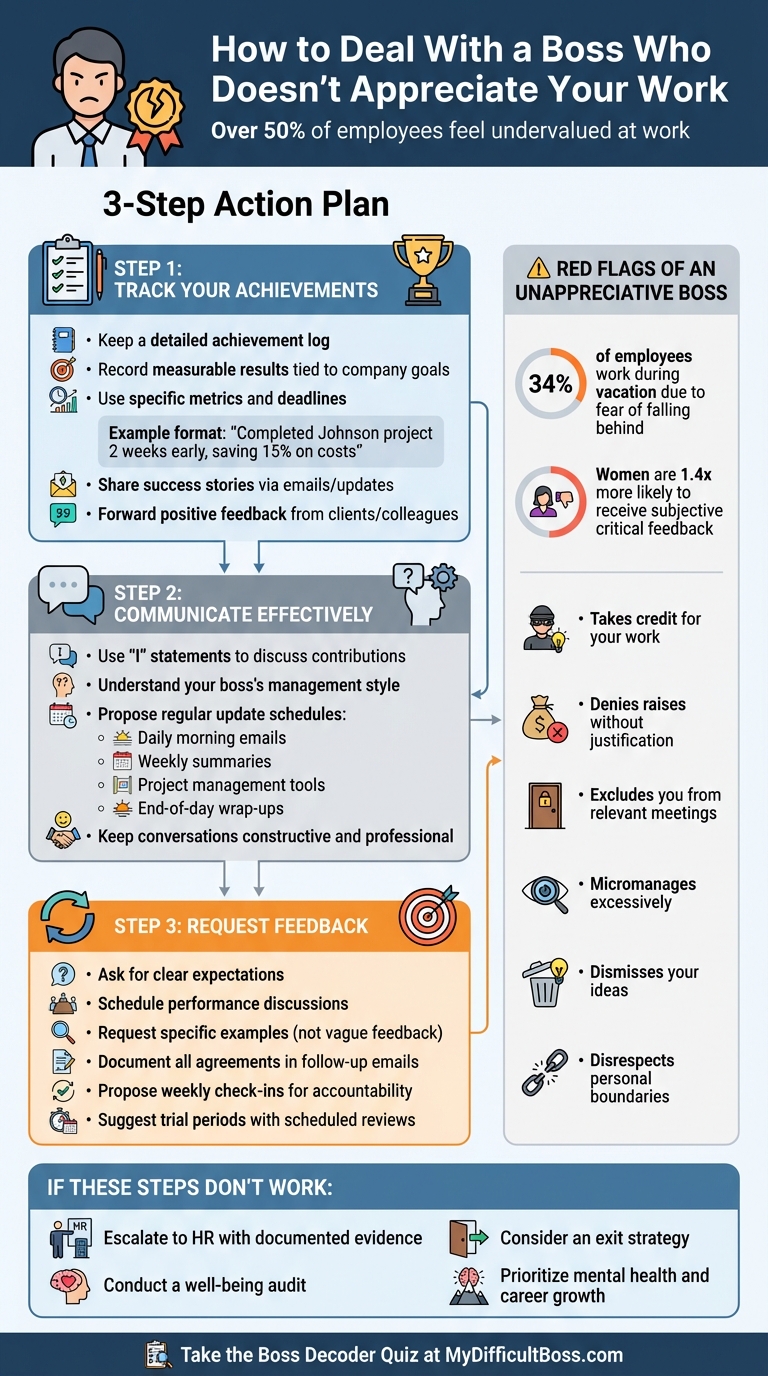
3-Step Strategy for Dealing with an Unappreciative Boss - Infographic © MyDifficultBoss.com
How to Recognize an Unappreciative Boss
Subtle and Obvious Warning Signs
Unappreciative bosses tend to follow certain patterns, whether their behavior is blatant or more under the radar.
Some red flags are hard to miss. For example, a boss who takes credit for your work without acknowledgment, denies raises or promotions without clear justification, or frequently uses job security as a threat is showing obvious signs of poor leadership. Another glaring issue is a lack of respect for your personal boundaries - like refusing time-off requests or expecting you to work during vacations. In fact, about 34% of employees report working while on vacation due to fear of falling behind. These behaviors don’t just reflect bad management; they can also chip away at your confidence and sense of job security.
Then there are the more subtle signs, which can be just as harmful. Maybe you’re left out of meetings or email threads that are directly tied to your responsibilities. Or perhaps your ideas are dismissed in meetings, only to be praised when someone else repeats them. Excessive micromanagement - like having your work reviewed before it’s even due or being given overly detailed instructions - can signal a lack of trust in your abilities. And if your boss seems indifferent when you mention exploring other opportunities, it’s a clear indicator that they don’t value your contributions.
One key question to ask yourself is whether this behavior is directed at you specifically or if it’s part of a larger pattern affecting the team. If everyone is being treated the same way, it could point to broader organizational issues. However, if you’re the only one consistently overlooked, excluded, or denied resources, it’s a strong sign your boss doesn’t appreciate your work.
It’s worth noting that women often face additional hurdles in these situations. Studies show that women are 1.4 times more likely to receive subjective, critical feedback rather than constructive, skill-based input. Additionally, their performance is more often linked to personal traits rather than professional skills.
These behaviors don’t just harm workplace dynamics - they can also have a lasting impact on your confidence and career, as explored in the next section.
How It Affects Your Confidence and Career
Spotting these signs is crucial because they can slowly erode your self-esteem and stall your career growth. A lack of recognition often leads to self-doubt, lower motivation, and a growing sense of being undervalued.
This can create a vicious cycle. When your boss doesn’t trust you and resorts to micromanagement, it can disrupt your workflow and hurt your performance. In turn, diminished confidence can make it even harder to succeed, perpetuating the cycle.
The career implications are equally concerning. Without acknowledgment for your efforts, you’re less likely to be chosen for high-profile assignments, mentoring opportunities, or access to training that could help you grow. Over time, this lack of advancement can make your role feel stagnant and leave you vulnerable to layoffs - especially if your contributions aren’t documented or advocated for.
The stress of working in this kind of environment can also take a toll on your physical health. You might find yourself dreading meetings, losing sleep, or feeling a sense of dread as Monday approaches.
Recognizing these patterns is the first step to addressing them and finding ways to navigate the situation effectively.
How to Deal With a Difficult Boss: 4 Strategies for Survival and Success
How to Improve the Situation
If you feel like your boss doesn’t recognize your efforts, it’s time to take charge. By focusing on strategic documentation, clear communication, and feedback, you can create a more positive work dynamic.
Track and Document Your Achievements
One of the best ways to ensure your work gets noticed is by keeping a detailed record of your accomplishments. In fast-paced workplaces, it’s easy for contributions to be overlooked. Think of documenting your achievements as a professional habit, not just a task.
Maintain an achievement log and update it regularly. Be specific and focus on measurable outcomes. For example, instead of saying, "Worked on the Johnson project", write: "Completed the Johnson project two weeks early, saving 15% on costs and receiving positive feedback from three stakeholders."
Align your achievements with your company’s goals and your boss’s priorities. If the focus is on customer retention, highlight how your work improved client satisfaction. If efficiency is the target, emphasize time or cost savings. Use metrics, deadlines, and tangible results to show your impact.
Feedback from others can also strengthen your case. If a client or colleague sends a positive email, forward it to your boss with a brief note. Building a reputation within your organization and maintaining visibility can help counter any subjective biases.
Start Better Conversations with Your Boss
While documenting your achievements is crucial, communicating them effectively is just as important. Start by understanding your boss’s management style. Tools like the Boss Decoder Quiz can help you identify their preferences and provide tailored communication tips.
When discussing your work, use "I" statements to keep the focus on your experience. For instance, say, "I feel I can contribute more when I have autonomy on certain tasks", or "I’d like to take on projects that align with my career goals."
Propose a regular update schedule that suits both you and your boss. Options include:
- Daily Morning Email: Ideal for bosses who like frequent updates. It sets expectations early and reduces constant check-ins.
- Weekly Summary: Great for established trust, focusing on major milestones and goals.
- Project Management Tools: Useful for remote or hybrid teams, offering visibility without lengthy meetings.
- End-of-Day Wrap-up: Helps in fast-paced settings by summarizing progress and addressing concerns before the next day.
These methods keep your boss informed without waiting for formal reviews, where details might be forgotten.
Interestingly, recognizing your boss or peers can also shift the dynamic. A simple acknowledgment can foster a culture of appreciation, encouraging a more positive feedback loop.
Ask for Feedback Directly
If recognition is lacking, it might be due to unclear expectations. Requesting feedback directly can clarify what success looks like and show your commitment to growth.
Schedule a meeting to discuss your performance. You might say, "I’d like to understand how my work aligns with team goals and where I can add more value."
If the feedback is vague, ask for specifics. This encourages your boss to provide examples and helps you understand their expectations better.
Document any agreements in a follow-up email. For example: "Thanks for our discussion today. To confirm, my top priorities for this quarter are X, Y, and Z, and we’ll review progress during our monthly check-ins." This creates a shared record and ensures accountability.
Consider proposing weekly check-ins to review progress and make adjustments as needed. As Allison Elias, Assistant Professor at the University of Virginia, points out:
"An unsupportive boss is presenting you with a record of what you've done wrong with no plan".
Regular touchpoints allow you to address issues early and ensure your contributions are acknowledged before major deadlines or evaluations.
If you’re aiming for more independence or recognition, suggest a trial period with a scheduled review. This demonstrates initiative while giving your boss a structured way to evaluate your performance.
For more tips and conversation scripts, check out the resources on dealing with a boss who doesn’t appreciate your work.
What to Do When Your Efforts Don't Work
When your accomplishments, clear communication, and direct feedback requests still aren't acknowledged, it might be time to rethink your approach and plan your next steps.
Start by considering whether the issue lies deeper, possibly within your boss’s behavior or the workplace culture. Melody Wilding, an Author and Executive Coach, offers this perspective:
"Effective communication isn't about changing who you are, but adapting your style to be better understood."
If you haven't already, try using the Boss Decoder Tool which will help you identify your boss's management style - whether they're a "Commander" (focused on results and direct), a "Cheerleader" (big-picture thinker), or a "Caretaker" (peacekeeper but indecisive). Knowing how your boss operates under normal circumstances can help you interpret their verbal and nonverbal cues more effectively. This understanding is key to deciding whether to escalate the issue.
When to Involve HR or Upper Management
If your attempts at direct communication haven't worked and the lack of recognition is starting to affect your performance reviews, salary, or career growth, it might be time to take the matter higher.
Before escalating, try one last direct conversation. Use "I" statements to keep the tone constructive. For example:
"I've consistently delivered results on the Anderson account, but I haven't received acknowledgment in team meetings. I'd like to understand how my contributions fit into our team's success metrics."
This approach communicates your expectations clearly without sounding confrontational.
If this doesn't lead to change, consider meeting with HR or a neutral mediator. Present your case calmly, focusing on how the situation impacts your work and the team's goals. Stick to facts and patterns - avoid emotional language. HR is more likely to act when you can demonstrate how the issue affects productivity or morale.
If resolution still feels out of reach, follow these structured steps:
| Escalation Step | Action to Take | Purpose |
|---|---|---|
| Documentation | Keep a log of dates, times, and specific incidents. | Provides a clear record for HR or management to review. |
| Direct Re-statement | Use "I" statements to reinforce your boundaries. | Restates expectations without escalating conflict. |
| Mediation | Arrange a meeting with HR or a neutral mediator. | Addresses ongoing issues unresolved by direct communication. |
| Well-being Audit | Evaluate physical and mental health impacts. | Helps determine if the environment is too damaging to continue working. |
| Exit Strategy | Assess career growth versus mental health costs. | Prepares you for a transition if your boss remains unwilling to change. |
For more detailed advice, including conversation examples and tailored strategies, explore the resources on dealing with a boss who doesn't appreciate your work. These steps can help you safeguard your career while maintaining professionalism.
Assess Whether to Stay or Leave
If your boss's lack of recognition continues, take a step back and conduct a well-being check. Are you dealing with constant headaches, insomnia, or fatigue? Do you dread Sunday evenings or feel anxious about checking your inbox? These could be signs that the work environment is harming your health.
Weigh the pros and cons of staying. If your boss is blocking your career growth, limiting your visibility, or taking credit for your work, staying might hurt your long-term prospects. However, if you're gaining valuable skills, building key relationships, or working toward a specific milestone - like stock vesting or completing a certification - you might decide to stick it out for a set period.
To make the decision clearer, start developing an exit plan. Update your resume, expand your professional network, and explore new opportunities. Sometimes, just preparing to leave can help you decide whether to stay or move on to a healthier workplace.
Conclusion and Additional Resources
Dealing with a boss who doesn’t value your work requires a mix of clear communication, professionalism, and strategic action. To better understand your boss’s style, you can explore additional tools on MyDifficultBoss.com. As Liane Davey, Author and Team Effectiveness Advisor, puts it:
"Managing up is not slimy or manipulative; it's simply getting what you need to do the job you're paid to do."
Key strategies to remember include tracking your achievements with measurable outcomes, proactively highlighting your contributions, and maintaining professionalism - even in the face of unfair criticism. Statistics show that 35% of American workers value recognition through perks, formal programs, or bonuses, while 30% prefer professional development opportunities or wellness stipends. If these aren’t being offered, advocating for yourself becomes even more critical.
When direct communication and documentation fail to improve the situation, it’s essential to know when to escalate the issue or consider other opportunities. Techniques like mirroring vague feedback, requesting specific examples of criticism, and seeking input from trusted colleagues can help you determine whether the problem stems from your performance or potential bias from your boss.
The My Difficult Boss website offers over 135 challenging boss scenarios, starter scripts, response strategies, and expert advice to help you navigate workplace challenges with confidence. Whether you’re preparing for a tough conversation or planning your next career step, these resources are designed to support your professional growth.
FAQs
How do I prove my impact quickly?
To make an impression fast, focus on delivering tangible, measurable results. Share specific updates and outcomes with your boss regularly to emphasize the value you're adding. Tools like the Boss Decoder Tool can help you better understand your boss's preferences and adjust your communication style accordingly. For more tips, check out resources on demonstrating impact, which include practical conversation scripts and tailored solutions.
What should I say in a feedback meeting?
In a feedback meeting, it's important to communicate your contributions clearly and professionally. Begin by expressing gratitude to your boss for taking the time to meet. Then, share specific examples of your recent achievements or efforts that demonstrate your value.
If you feel your work hasn't been fully acknowledged, approach the topic constructively. Mention your eagerness to receive feedback and discuss opportunities for growth. This shows that you're proactive and invested in improving. Use this opportunity to seek advice or support, emphasizing your commitment to doing your best.
For additional strategies, you can explore resources like MyDifficultBoss.com to navigate these conversations effectively.
When is it time to go to HR or leave?
If your hard work continues to go unnoticed, your concerns are brushed aside, or the situation starts to take a toll on your well-being or career progress, it might be time to rethink your options. When open conversations and efforts to showcase your contributions don’t lead to improvement, or if the workplace turns toxic or abusive, reaching out to HR or exploring new opportunities could be essential for protecting your mental health and advancing your career.