How to Deal With an Indecisive Boss (When They Can't Make Decisions)
Help an indecisive boss by asking targeted questions, offering clear options, running small tests, and documenting decisions to reduce delays.

Working for an indecisive boss can feel like you’re constantly stuck in limbo; waiting for approvals, second-guessing priorities, and redoing work. When your manager struggles to make decisions, it impacts your performance and confidence. In this guide, you’ll learn exactly how to deal with an indecisive boss and keep projects moving forward.
Indecisive bosses can be frustrating, but there are ways to make the process smoother. Indecision often stems from fear of mistakes, information overload, or external pressures. This behavior can delay projects, disrupt workflows, and harm team morale. To navigate this, focus on resolving unclear instructions, simplifying choices, and reducing risks in decision-making.
Key strategies include:
- Asking targeted questions to uncover the root cause of hesitation.
- Presenting clear options with pros, cons, and risk levels.
- Suggesting small tests instead of large commitments.
- Documenting decisions to ensure clarity and accountability.
- Acknowledging decisions to build confidence over time.
::: @figure 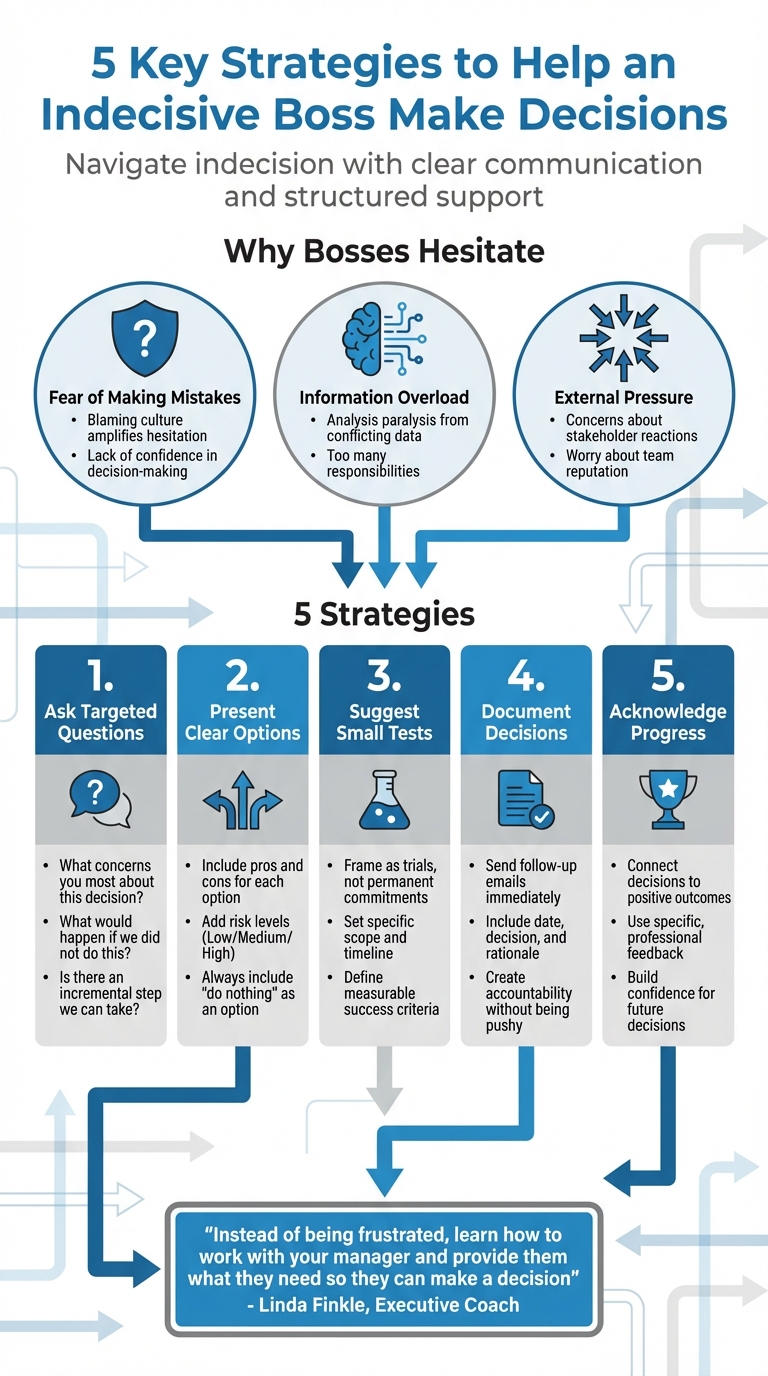 {5 Key Strategies to Help an Indecisive Boss Make Decisions
Infographic © MyDifficultBoss.com} :::
Why You Shouldn’t Put Up With An Indecisive Leader (And What to Do About It)
Understanding Why Your Boss Can't Decide
If your boss is struggling to make a decision, it often stems from deeper concerns like fear, being overwhelmed, or external pressures. Let’s break down these issues to better understand why indecision happens.
Fear of Making Mistakes
One of the most common reasons for hesitation is the fear of making the wrong choice. This can lead to delays as managers ask for more data, time, or input from others.
"No one wants to make a wrong decision, you or your manager"
This fear is amplified in workplaces with a "blaming culture", where mistakes are met with criticism from higher-ups. In such environments, some managers may lack confidence in their ability to make decisions or feel uneasy about taking on the responsibility, causing them to avoid it altogether.
Too Much Information or Responsibility
Indecision isn’t always about fear - it can also result from being overwhelmed. When managers are swamped with tasks or buried under conflicting data, they may experience "analysis paralysis", where having too much information makes it impossible to act.
Take the example of a first-time CEO who was so inundated with conflicting data that he kept reversing his decisions. The turning point came when a data-driven graph clearly highlighted the costs of delays. This clarity allowed him to delegate tasks more effectively and move forward.
"Giving your boss more data to pore over will not necessarily help him move forward. You need to help your boss sort through the information and then offer a clear rationale for your recommendation"
Pressure From Others in the Organization
Another factor complicating decision-making is pressure from leadership and stakeholders. Even if a manager supports your proposal, they may worry about how it will be received by executives or how it could impact the team’s reputation within the company.
"It's much easier for your manager to choose between Door Number One or Door Number Two than it is to take action versus do nothing"
In 2017, Alexi Robichaux (now CEO of BetterUp) worked under a manager named "Frank", who struggled with indecision due to inexperience and perfectionism. To help, Robichaux provided detailed updates after every engineering meeting, laying out the pros and cons of different options. By showing that the team was operating within the best technical limits, Robichaux gave Frank the confidence to move forward and bring the product to market.
For more practical advice, including scripts and strategies, check out the full guide on dealing with an indecisive boss.
How to Help Your Boss Make Decisions
When your boss seems stuck, the best way to assist is by helping them think through the issue rather than waiting for them to figure it out alone. This involves asking insightful questions, presenting clear options, and reducing the perceived risks tied to the decision.
Ask Questions That Identify the Problem
Asking the right questions can uncover what’s really holding your boss back. It might be fear of risk, lack of data, or concerns about how others will react. The goal is to pinpoint the root cause of their hesitation.
Here are seven questions that can help clarify the issue:
- "What concerns you most about this decision?" – This identifies their biggest fear or hesitation.
- "How will we know later that this was the right decision?" – This encourages them to define success.
- "What could make us regret this decision?" – This helps foresee potential challenges.
- "What would happen if we did not do this?" – This tests whether the decision is truly necessary.
- "What was the second-best option we considered?" – This sheds light on why they’re hesitating.
- "Is there an incremental step we can take that will give us better insight?" – This lowers the stakes by suggesting a smaller commitment.
- "Does this decision really need to be made now, or can it be deferred?" – This clarifies the urgency.
"A common trap is to think that a decision involves choosing which of two options to pursue. There is always a third option: doing nothing." – Mike Cohn, Founder of Mountain Goat Software
Frame these conversations as a collaborative effort. Instead of pushing for action, focus on exploring the pros and cons together. Use follow-up "why" and "how" questions to dig deeper, which can reveal insights that aren’t immediately obvious. Once the real issue is clear, you can present concise options to guide the decision.
Give Clear Choices With Pros and Cons
When managers face too much information or unclear alternatives, they often struggle to decide. Your job is to simplify the process by organizing the data and presenting clear, actionable options.
Here’s an example of how to lay out options:
| Option | Pros | Cons | Risk Level |
|---|---|---|---|
| Option A: Pilot Program | Low cost, quick to implement, reversible | Limited long-term impact | Low |
| Option B: Full Rollout | High ROI, scalable solution | Requires more resources, harder to reverse | Medium |
| Option C: Do Nothing | No immediate cost or effort | Problem persists, potential missed opportunity | Medium |
Including "do nothing" as an option is important - it reminds decision-makers that inaction also has consequences. Many managers find it easier to choose from a set of well-defined options rather than face the uncertainty of leaving things unresolved.
Suggest Small Tests Instead of Big Commitments
If your boss is still hesitant, suggesting small tests can ease their concerns. Framing a decision as a trial rather than a permanent move lowers the stakes and makes it easier for them to agree.
For instance, you could say: "I’ve been thinking about a couple of ways we could approach this. Could I test one or two of these ideas and report back on how they work?" This approach shifts the focus to progress and results rather than finality.
The "trial and report" method works well because it creates a natural checkpoint for feedback. Your boss doesn’t have to commit fully - they just need to approve testing an idea. If the test succeeds, you can expand on it. If it doesn’t, you can tweak the plan and try again.
When proposing a trial, be specific about the scope, timeline, and how success will be measured. For example: "Let’s try this new process with the marketing team for two weeks and see if response times improve by at least 20%. If it works, we can think about expanding it to other departments." This level of detail makes the decision feel manageable rather than overwhelming.
For more tips, including scripts and strategies tailored to different scenarios, visit the My Difficult Boss website’s dealing with an indecisive leader section.
Supporting Better Decision-Making Over Time
As mentioned earlier with tools like the Boss Decoder Tool, clear communication can combat indecision effectively. These follow-up strategies take that clarity a step further, ensuring decisions stick and encouraging more decisive behavior over time. The key is reinforcing confidence after a decision has been made and creating a system that supports long-term decisiveness.
Document Decisions in Writing
One of the simplest yet most effective strategies is documenting decisions immediately after they’re made. A follow-up email after a meeting ensures that everyone remembers the rationale and details, preventing second-guessing or changes down the line.
Your message should be clear and factual, focusing on the decision itself, the date, and any key details. For instance:
"To confirm our discussion on March 24, 2026, we will move forward with Option A - the pilot program for the marketing team. This will run for two weeks with a target of improving response times by 20%."
This approach not only creates a clear record but also establishes accountability without coming across as pushy. Including the reasoning behind the decision is equally important. For example:
"We selected this approach because it allows us to test the concept with minimal risk while gathering data for the next phase."
For major decisions, consider asking for a "confirmed" reply or signature to ensure alignment. Additionally, setting a deadline - such as a "weigh-in" period - can help finalize decisions and avoid last-minute changes.
Take Alexi Robichaux’s experience as an example. Early in his career, he worked with an indecisive boss named Frank during a product launch. Alexi sent detailed updates after every engineering meeting, outlining the pros and cons of various scenarios. By documenting technical limitations and expert opinions, he built a strong case that the product was ready. This written trail gave Frank the confidence to move forward, leading to a successful launch.
Acknowledge When Decisions Are Made
Once a decision is documented, it’s equally important to reinforce it through acknowledgment. When your boss makes a choice, connect it to positive outcomes. This not only boosts their confidence but also encourages quicker decision-making in the future.
Keep your feedback specific and professional. Instead of saying something like, "Glad you finally picked one", opt for:
"Thank you for the clear direction on Project X. It allows the team to move forward and hit our Friday deadline."
This type of acknowledgment highlights progress and reinforces the act of deciding without sounding sarcastic or frustrated. On the other hand, ineffective acknowledgment - like focusing on delays or expressing relief - can undermine the effort.
Kyle Libra’s story illustrates this well. He worked with Charlie, a first-time CEO at a startup, who often changed his mind about design and hiring decisions. To address this, Kyle began using data to show the negative effects of indecision, such as slowed engineering output. He also highlighted customer feedback to reassure Charlie. This factual approach helped Charlie trust the team more and eventually delegate decision-making authority.
"Accountability means owning results, not just completing tasks." – Monica Contreras, SinglePoint
Find More Help on MyDifficultBoss.com
If managing an indecisive boss feels like an uphill battle, remember you’re not alone. MyDifficultBoss.com offers a wealth of tools, scripts, and solutions tailored to this specific challenge.
For more actionable advice, including conversation scripts and strategies for different scenarios, visit here. The site provides step-by-step guidance on handling difficult conversations, managing expectations, and building a stronger working relationship with your boss.
You’ll also find strategies for aligning goals, improving communication, and documenting decisions effectively. Whether your boss struggles with fear of mistakes or information overload, these resources can help you navigate the situation with greater ease and confidence.
Conclusion: Managing Indecision With Understanding and Clear Communication
Handling an indecisive boss doesn’t have to derail your projects. The strategies discussed here focus on understanding the reasons behind their hesitation and using communication techniques that encourage decision-making. Whether your boss struggles with a fear of mistakes, information overload, or simply needs more time to process, your goal should be to ease their uncertainty while keeping progress steady.
Providing clear options with pros and cons, setting feedback deadlines, and documenting decisions can help minimize last-minute changes. As executive coach Linda Finkle wisely puts it:
"Instead of being frustrated, learn how to work with your manager and provide them what they need so they can make a decision"
By replacing frustration with empathy, you can create a more collaborative dynamic. These strategies can gradually turn indecision into productive teamwork.
Additionally, recognizing and celebrating small wins - such as quick decisions - can help build your boss's confidence. Linking decisions to positive results reinforces the idea that taking action leads to success, creating momentum for future choices.
If you’re looking for more targeted guidance, MyDifficultBoss.com offers a wealth of tools, scripts, and resources tailored to handling an indecisive boss. With over 135 scenarios, starter scripts, and practical strategies - like risk-free pilot initiatives and the Boss Decoder Tool - you’ll find actionable solutions for a variety of challenges.
FAQs
How do I push for a decision without sounding pushy?
To help nudge a decision without seeming overbearing, start by giving your boss a quick recap of the project's background and objectives. This helps frame the conversation in a constructive way. Then, present clear choices or recommendations, highlighting that your goal is to assist them in making the best decision. For additional tips and tools, check out the resources on our website, including advice tailored for working with indecisive bosses.
What should I do if my boss keeps changing their mind?
If your boss tends to frequently change their mind, the key is to stay focused on moving forward while navigating the uncertainty. Gently remind them of the broader project goals and context to help keep them on track. Make sure to clarify priorities and present clear, actionable options to guide their decision-making process. For more specific strategies, conversation tips, and tools like the Boss Decoder Tool, check out the resources available on our website.
When should I escalate an urgent decision past my boss?
When a critical decision is delayed by your boss’s indecisiveness, and immediate action is needed to avoid major risks or missed deadlines, escalating the issue might be the best course of action. However, make sure the situation genuinely demands escalation and cannot be resolved within the scope of your role.
For specific strategies and tools to navigate situations with indecisive bosses, check out resources like the Boss Decoder Tool and other solutions available on the website. These can help you address challenges effectively while maintaining professionalism.