How to Deal With a Toxic Boss: Smart Strategies That Protect Your Career
Spot toxic behaviors, document incidents, set boundaries, get support or escalate to HR, and decide when to transfer or leave to protect your career.

A toxic boss can drain your energy, damage your confidence, and even put your job at risk if not handled carefully. The goal isn’t just to cope — it’s to protect your reputation and long-term career. These smart strategies and scripts will help you respond professionally while minimizing the impact on your work and well-being.
From micromanagement to public humiliation, these behaviors create stress, anxiety, and even physical health issues. If you're stuck in this situation, here’s how to regain control:
- Identify toxic behaviors: Look for patterns like micromanagement, unreasonable demands, or taking credit for your work.
- Document incidents: Keep detailed records of dates, actions, and outcomes to protect yourself.
- Set boundaries: Use professional, clear communication to manage expectations and protect your time.
- Seek support: Build a network of trusted colleagues or mentors and involve HR if necessary.
- Know when to leave: If the situation doesn’t improve, explore internal transfers or external opportunities.
Visit MyDifficultBoss.com for tools, scripts, and strategies tailored to specific boss types. Protect your mental health and career by taking proactive steps today.
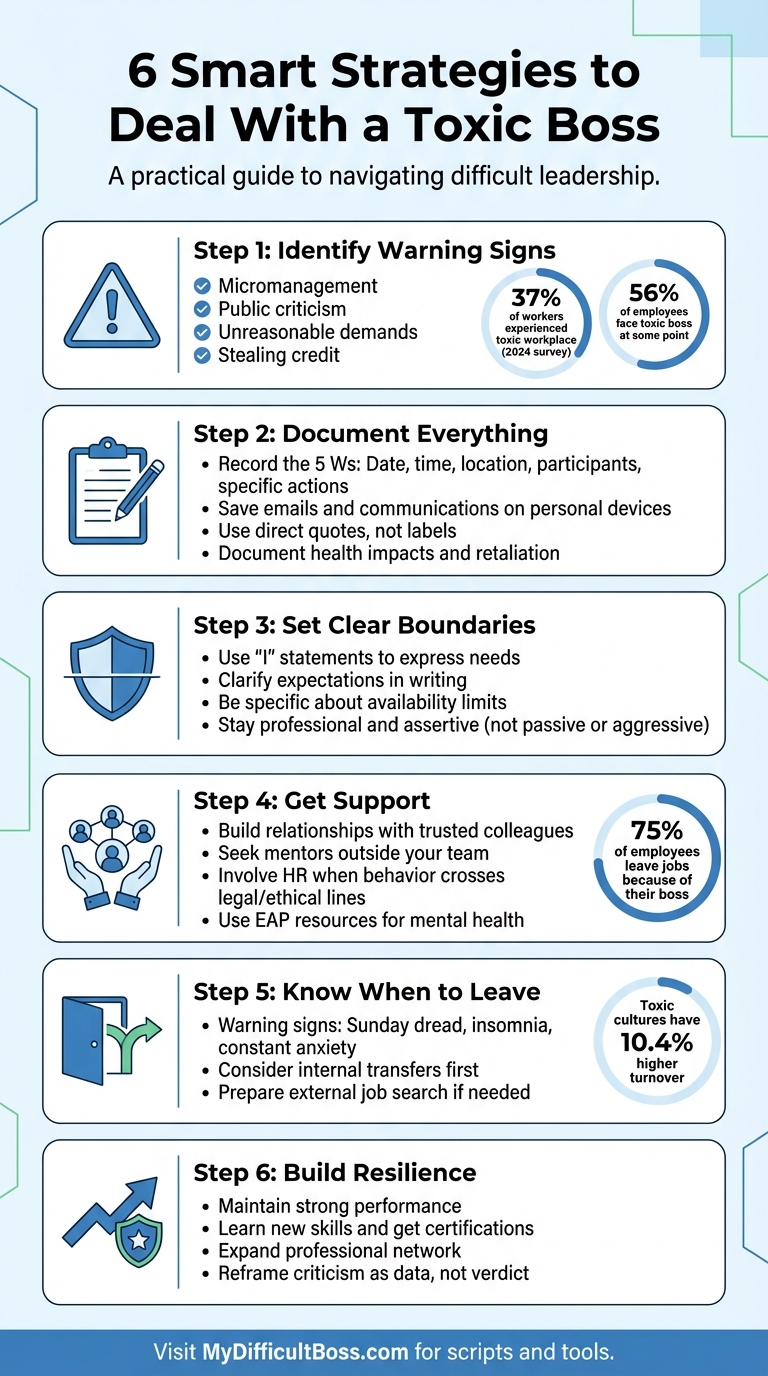
6-Step Guide to Dealing With a Toxic Boss - Infographic © MyDifficultBoss.com
How to Handle a Toxic Boss (Without Quitting Your Job)
sbb-itb-1bb7cb4
Step 1: Identify the Warning Signs of a Toxic Boss
Spotting the behaviors of a toxic boss is the first step in protecting your well-being and career. This isn’t about a manager having an occasional bad day - it’s about consistent patterns that harm your growth and mental health. Once you recognize these signs, you can plan your next steps with purpose.
Common Toxic Boss Behaviors
One of the most obvious signs? Micromanagement. Dr. Paul Losoff explains that micromanagement erodes trust, reduces autonomy, and creates an environment of constant scrutiny. These bosses hover over every detail, demand frequent updates, and leave little room for independent work.
Another red flag is public criticism or humiliation. Instead of offering constructive feedback in private, toxic bosses may embarrass employees during meetings, interrupt presentations, or mock their ideas. As Dr. Losoff points out:
Toxic bosses do not consider the well-being or the professional growth of their employees.
A 2024 survey of 1,000 workers revealed that 37% had experienced a toxic workplace, with one-third directly attributing the problem to their boss.
Be wary of unreasonable expectations as well. These might include excessive workloads, demands for immediate after-hours responses, or rigid deadlines that disregard personal time. Other warning signs include manipulative tactics, stealing credit for work, emotional outbursts, and blocking opportunities for advancement.
The 2022 Gallup State of the Global Workplace report found that only 33% of employees in the U.S. and Canada feel engaged in their work, with toxic leadership being a significant factor in this disengagement.
Recognizing these behaviors is the first step in choosing how to address them.
Use the Boss Decoder Tool to Identify Your Boss Type

Once you’ve identified the toxic behaviors, the Boss Decoder Tool can help you pinpoint your boss’s specific type and provide tailored strategies. Different toxic traits require different approaches - what works for a micromanager won’t necessarily help with a boss who steals credit.
For example, a micromanaging "Boss Hawk" might respond to over-communication that eases their need for control, while an "Idea Thief" requires detailed documentation to protect your contributions. With 56% of employees experiencing a toxic boss at some point in their careers, understanding the type of boss you’re dealing with is crucial for creating an effective plan.
For more tools and strategies - including conversation scripts and advice tailored to specific scenarios - visit MyDifficultBoss.com. Whether your boss is a bully or prone to explosive outbursts, these resources can help you take control.
Recognizing these behaviors sets the foundation for establishing boundaries and safeguarding your career.
Step 2: Evaluate Your Situation and Document Everything
Once you've identified toxic behaviors, it's time to take a step back and objectively assess your situation. This is where documenting incidents becomes critical - not only to protect yourself but also to gain a clearer understanding of the dynamics at play. Research shows that 1 in 4 employees dread going to work due to toxic leadership, which highlights just how pervasive this issue can be. By combining careful observation with thorough documentation, you lay the groundwork for meaningful communication and potential action.
Keep a Detailed Record of Incidents
Start by logging incidents as soon as they happen. Mahir S. Nisar, Principal at Nisar Law Group, P.C., emphasizes the importance of documentation:
"Strong documentation transforms unclear recollections into compelling evidence."
For each incident, make sure to capture the "Five Ws": date, time, location, participants (including their job titles), and the specific words or actions involved [21, 24]. Whenever possible, use direct quotes. For example, writing "My manager said, 'Women don't belong in technical roles'" is far more impactful than simply noting "sexist comments were made".
Your records should stick to the facts. Focus on describing behaviors rather than labeling them. For instance, instead of writing, "The manager is a bigot," say, "The manager used a slur." The former is a subjective conclusion and weakens your case, while the latter provides clear evidence [21, 22]. Also, document your immediate response - did you address the behavior, leave the room, or take another action?
It's equally important to safeguard communications. Save emails, texts, and voicemails on personal devices, especially since access to company systems could be restricted later [21, 24]. If you receive vague or impractical verbal instructions, follow up with an email to clarify:
"I want to ensure I understood your instructions from our hallway conversation; you requested [X] by [Y] time. Please confirm if this is correct."
If workplace events are affecting your health, include that in your records too. Note any physical symptoms (like headaches or sleep issues) and emotional distress (such as anxiety or therapy sessions) [21, 25]. Should you notice signs of retaliation - such as sudden poor performance reviews or reduced responsibilities - document those changes as well [21, 24].
Get Input from Trusted Colleagues
While your detailed notes are invaluable, input from colleagues can help confirm whether the behavior you're experiencing is part of a larger pattern. Pay attention to how your boss treats others. If their rude or dismissive behavior extends to everyone, it might point to a generally unhealthy work environment rather than a personal issue.
When seeking input, maintain professionalism to avoid unnecessary exposure. Instead of venting or complaining, frame your conversations around broader topics like "workplace dynamics" or "navigating leadership styles".
You might also consider reaching out to mentors, either within the company at your boss's level or higher, or outside the organization for a more neutral perspective. Employee Assistance Programs (EAPs) can also provide confidential advice. If you're exploring the possibility of an internal transfer, focus on showcasing your strengths and accomplishments rather than criticizing your manager.
Executive Coach D.R. Weber offers a powerful reminder:
"Documentation turns vague frustration into clear facts. Bullies rely on denial and manipulation. A factual record exposes the pattern."
Step 3: Set Clear Boundaries and Communicate Effectively
Once you've documented your experiences, the next step is to establish boundaries and communicate them clearly. This isn't about confrontation - it's about using assertive language to protect your career while keeping interactions professional and calm. The idea is to express your needs with confidence, steering clear of being overly passive (avoiding conflict altogether) or aggressive (coming across as combative). Below are practical examples to help you navigate these conversations effectively.
Clarify Expectations Through Direct Communication
Using "I" statements can shift the focus from blaming your boss to expressing your own feelings and needs. For instance, instead of saying, "You don't trust me with new projects," you might say, "When I was passed over for the project, it made me feel undermined. I felt like you didn't trust me to handle competing priorities". This approach reduces defensiveness and fosters a more constructive dialogue.
If your boss provides vague or rushed instructions - perhaps during a quick hallway chat - send a follow-up email to ensure clarity and accountability. For example: "To ensure I meet your expectations, here is what I took away from our conversation... Please confirm if this is correct". This not only clarifies expectations but also creates a record that can protect you if priorities shift later.
Feeling overwhelmed with work? Instead of outright refusing a task, acknowledge the request while being honest about your workload. For example: "I'm interested in doing that, but my plate is full right now. I don't think I can make room for it without compromising the work I'm doing on X, Y, and Z." When setting availability boundaries, be specific: "I'll be available until 7:00 p.m., but after that, I won't be checking emails until tomorrow morning so I can recharge."
Here’s a quick comparison of how to reframe your words for better results:
| Instead of Saying... | Try Saying... |
|---|---|
| "You always embarrass me in meetings." | "It affects my confidence when you point out my mistakes in front of others. I value your feedback, but I would appreciate it if you could give it to me in private." |
| "I can't do this extra work." | "I'm interested in that, but my plate is full. I don't think I can make room for it without compromising the quality of Project X." |
| "Stop calling me on weekends." | "I'll be available until 7:00 p.m., but after that, I won't be checking emails until tomorrow morning so I can recharge." |
These examples show how reframing your language can set boundaries while maintaining professionalism. For a quick summary, check out the accompanying infographic on effective communication tips.
Access Ready-to-Use Conversation Scripts
Finding the right words in a tense situation can be tough, but ready-to-use scripts can make a huge difference. For more practical advice, including detailed scripts and strategies tailored to specific scenarios, visit MyDifficultBoss.com. Whether you're dealing with a bullying boss or one prone to angry outbursts, you'll find resources designed to help.
The site offers solutions for over 135 challenging boss scenarios, complete with step-by-step guidance, starter scripts, and strategies to handle difficult situations. Whether it's a micromanager demanding constant updates or an unpredictable boss with a short fuse, these tools provide clear, professional responses to help you maintain your boundaries without escalating conflict. With these resources, you can turn frustration into actionable steps that protect your well-being and career.
Step 4: Get Support and Escalate When Needed
Once you've set boundaries and documented your experiences, it's time to focus on building a support network and recognizing when to escalate the situation. Dealing with a toxic boss can feel isolating, but the right approach can help you navigate the challenge while staying professional and focused on solutions.
Build Relationships with Supportive Colleagues
Having a network of trusted coworkers can make a world of difference. These colleagues can offer emotional support and practical advice, especially if they're dealing with similar challenges. For example, you can work together to develop coping strategies or even use subtle signals during meetings to indicate when someone needs immediate support.
You might also consider seeking mentorship from someone outside your direct team. A mentor in another department can provide an unbiased perspective, advocate for you, and help you grow your reputation beyond your boss's influence. Participating in cross-departmental projects or attending industry events can also boost your visibility and showcase your skills. As Dominic Monn, CEO of MentorCruise, wisely points out:
The goal is support, not office gossip.
If your boss is frequently absent or disorganized, consider collaborating with your team to create a self-managed structure that keeps productivity on track. A strong support network will give you the confidence to address issues more formally if needed.
When and How to Involve HR
If your boss's behavior crosses ethical or legal boundaries - such as harassment, discrimination, or retaliation - or severely affects your mental health or job performance, it may be time to involve HR. Having a detailed record of incidents will strengthen your case. Remember, studies show that 75% of employees leave their jobs because of their boss.
When reaching out to HR, focus on presenting facts rather than venting frustrations. Share specific, well-documented incidents, including dates, times, descriptions of behavior, and any witnesses. Highlight how the behavior impacts team performance and business outcomes. Clearly outline what you'd like to achieve, whether that's mediation, a transfer, or improved communication processes. Stay professional during these discussions and ensure all documentation is stored securely on a personal device. If illegal activity is involved, you may need to seek legal advice or contact the appropriate authorities.
Protect Your Mental Health
Your well-being is crucial. Set boundaries by disconnecting from work emails after hours and take small steps to manage stress, like taking short breaks or staying hydrated. If your company offers an Employee Assistance Program (EAP), use it for confidential counseling and stress management resources.
Remember, your boss's behavior reflects on them, not on your worth. Stay composed, and give yourself time to recover after difficult interactions. Simple actions, like speaking up in meetings or taking an uninterrupted lunch break, can help you regain a sense of control and build resilience over time.
Step 5: Know When to Look for Other Opportunities
There are times when the best course of action is to step away before things get worse. If you’re feeling constant dread on Sundays, struggling with insomnia, or noticing that your anxiety only eases during your days off, your body might be signaling that something is wrong. Similarly, if you find yourself hesitating to speak in meetings, second-guessing your ideas, or apologizing unnecessarily, it might be time to consider new opportunities.
It’s also important to determine whether the toxicity is limited to your immediate manager or if it’s a systemic issue supported by higher leadership. If the problem is isolated to your boss, exploring an internal transfer could be a good option. On the other hand, if the issues are deeply rooted in the company culture, it might be time to look elsewhere. As Benson Fechter from Legacy Paint Holdings wisely notes:
People don't leave companies; they leave leadership.
Once you’ve carefully evaluated your situation, the next step is deciding whether to stay and seek alternatives within the company or start planning your exit.
Look for Internal Transfer Options
If you appreciate your company but are dealing with a toxic manager, consider looking into lateral moves. Start by reviewing your company’s internal transfer policies. Many organizations require employees to stay in their current roles for at least a year before transferring, and some may also require notifying your current manager.
A good approach is to wait until after your first interview for the new role before informing your manager. This helps you avoid catching them off guard while maintaining professionalism. When networking internally, focus on the opportunities and growth potential of the new role rather than dwelling on your current challenges. For example, you can say, "This is about growing toward something, not running away from anything."
During the process, continue delivering strong work to uphold your reputation. In smaller companies, it’s wise to assume your boss might already know about your application, so being upfront can often work in your favor.
If an internal transfer isn’t an option, it may be time to shift your focus to external opportunities.
Prepare for a Job Search Outside Your Company
If moving within the company isn’t feasible, start planning your exit while still employed. Begin by updating your LinkedIn profile and discreetly reaching out to your professional network. Secure references from trusted colleagues, as a toxic boss might not provide an unbiased recommendation.
Take a moment to weigh the costs of staying - such as its impact on your health, confidence, or personal relationships - against the potential benefits of a fresh start. A helpful strategy is the "three-month test": if you can’t see yourself staying in the company for another three months under the current circumstances, it’s likely time to plan your departure.
Make sure to gather important documents like performance reviews, commendations, and records of your contributions to protect your professional reputation. Update your resume with specific achievements and measurable results to showcase your value. When considering future employers, use your network to learn about their leadership styles. Remember, workplaces with toxic cultures have a 10.4% higher turnover rate than healthier environments. You deserve a better environment where you can thrive.
For additional tips, including scripts for handling a bully boss or one with a big temper, visit MyDifficultBoss.com.
Every step you take toward prioritizing your well-being and career growth brings you closer to a healthier and more fulfilling work environment. Check out the infographic for a quick guide on when to consider internal transfers versus external job searches.
Step 6: Develop Skills and Resilience for Future Success
Maintain Strong Performance and Learn New Skills
Once you've established boundaries and sought support, it's time to focus on strengthening your career by building your skills and resilience. Even when working under a toxic boss, delivering consistently high-quality work safeguards your career trajectory. Your performance speaks volumes, and maintaining excellence helps build a reputation that extends beyond your current role. Aim to become a "solutions machine" - someone who not only identifies problems but also suggests practical solutions.
Expand your professional brand and skill set by participating in cross-functional projects, pursuing certifications, attending workshops, and engaging in industry events. Volunteering for initiatives beyond your immediate team can increase your visibility with other leaders and offer a reprieve from negative workplace dynamics. This helps you establish a professional identity that isn’t solely tied to your current manager. Keep in mind that 75% of employees who resign name their boss as the main reason for leaving, but the skills you develop now will stay with you wherever your career takes you.
When dealing with difficult interactions, approach them like business transactions to stay objective. Executive coach Dominic Monn offers a helpful perspective:
Your boss's behavior is data about them, not a verdict about you.
Instead of internalizing criticism, reframe it. For example, if you're told, "You're sloppy", break it down into specifics: "I left two typos in a 2,000-word report". This mindset shift keeps you grounded in facts rather than allowing negativity to define you.
Use Outside Resources for Long-Term Strategies
To maintain progress and protect your career over the long term, consider leveraging online resources like MyDifficultBoss.com. This platform offers a library of over 135 scenarios complete with step-by-step solutions, conversation scripts, and response strategies tailored to various types of challenging bosses and workplace situations. Whether you're facing micromanagement, public criticism, or constantly shifting expectations, the site provides expert advice to help you navigate these challenges effectively.
The platform includes ready-to-use scripts for tough conversations, strategies for staying composed during high-pressure meetings, and methods for building a "concentric" support network. This network starts with positive self-talk, extends to trusted colleagues for reality checks, and reaches out to mentors and professional contacts. Additionally, the tools provided can help you master "strategic overcommunication" - a skill that counters the "information vacuum" often created by toxic bosses. These strategies also reinforce professional boundaries, safeguarding your well-being.
Conclusion: Take Control and Protect Your Career
Facing a toxic boss is tough, but you have the power to navigate this challenge. Start by identifying red flags like micromanagement, constant blame-shifting, or belittling comments. Once you spot these warning signs, adopt a strategic approach. Set clear boundaries - whether it’s limiting after-hours communication or pushing back on unreasonable workloads - to protect both your mental well-being and professional standing. For a quick overview, check out the infographic below.
Having a solid support network makes a big difference. Turn to trusted colleagues for perspective, seek advice from mentors outside your team, and involve HR only after you’ve documented consistent toxic behavior. As Christopher Hall from IT Leadership Hub puts it:
Boundaries are not about confrontation; they're about self-preservation.
To protect yourself further, use "I" statements during discussions and confirm important conversations in writing to create a reliable record.
FAQs
How do I know if my boss is truly toxic or just stressed?
A boss who consistently belittles employees, micromanages, or behaves disrespectfully often falls into the "toxic" category. On the other hand, a stressed boss might temporarily avoid giving feedback or struggle to manage their workload, but these behaviors are usually short-lived. The key difference lies in consistency - if the behavior is ongoing and demoralizing, you're likely dealing with toxicity. Identifying these patterns can help you take the next steps. For specific strategies and tools to manage challenging bosses, check out the resources at the My Difficult Boss website.
What should I document, and where should I store it safely?
Document any troubling behaviors, incidents, or communications thoroughly. Be sure to include specific details like dates, times, and descriptions for each event. This could range from promises made, critical feedback received, to inappropriate comments or actions.
To keep your records secure, store them in a password-protected digital folder or on an external drive. This helps prevent tampering or accidental loss, ensuring the information is safe and readily available if needed for HR discussions, legal purposes, or your own reference.
When should I involve HR versus start planning to leave?
If your boss's toxic behavior crosses the line - violating workplace policies, creating a hostile environment, or persisting despite efforts to address it - it's time to involve HR. Severe or ongoing issues that can't be resolved through communication or setting boundaries may require formal intervention.
If the situation continues to affect your mental health or career growth, even after taking these steps, it might be time to consider leaving.