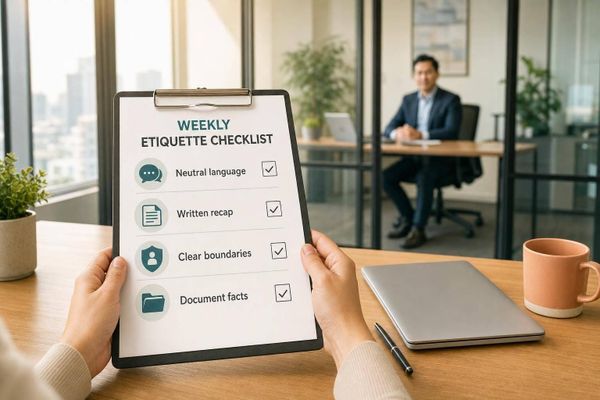
How to Set Boundaries Without Emotional Overload
Identify emotional triggers, set clear work boundaries, and handle pushback to avoid burnout and improve focus.

Setting boundaries at work isn’t about saying “no” to everything - it’s about protecting your energy and mental health while improving your performance. Without boundaries, constant demands can lead to burnout, anxiety, and exhaustion. Here’s what you need to know:
- Burnout is on the rise: By 2025, 82% of employees are expected to face burnout, costing businesses $322 billion annually.
- Boundaries boost productivity: Employees who set clear work-life limits report 20% higher productivity.
- Simple strategies work: Techniques like scheduling focused work sessions, using "Yes, and..." responses, and tracking emotional triggers can help you regain control. You can use websites like MyDifficultBoss.com to find tricks and scripts for helping to lower stress and set boudaries.
Setting limits doesn’t make you uncooperative - it helps you focus on quality work and maintain your well-being. In this article, learn how to spot emotional overload, communicate boundaries effectively, and handle pushback with confidence.
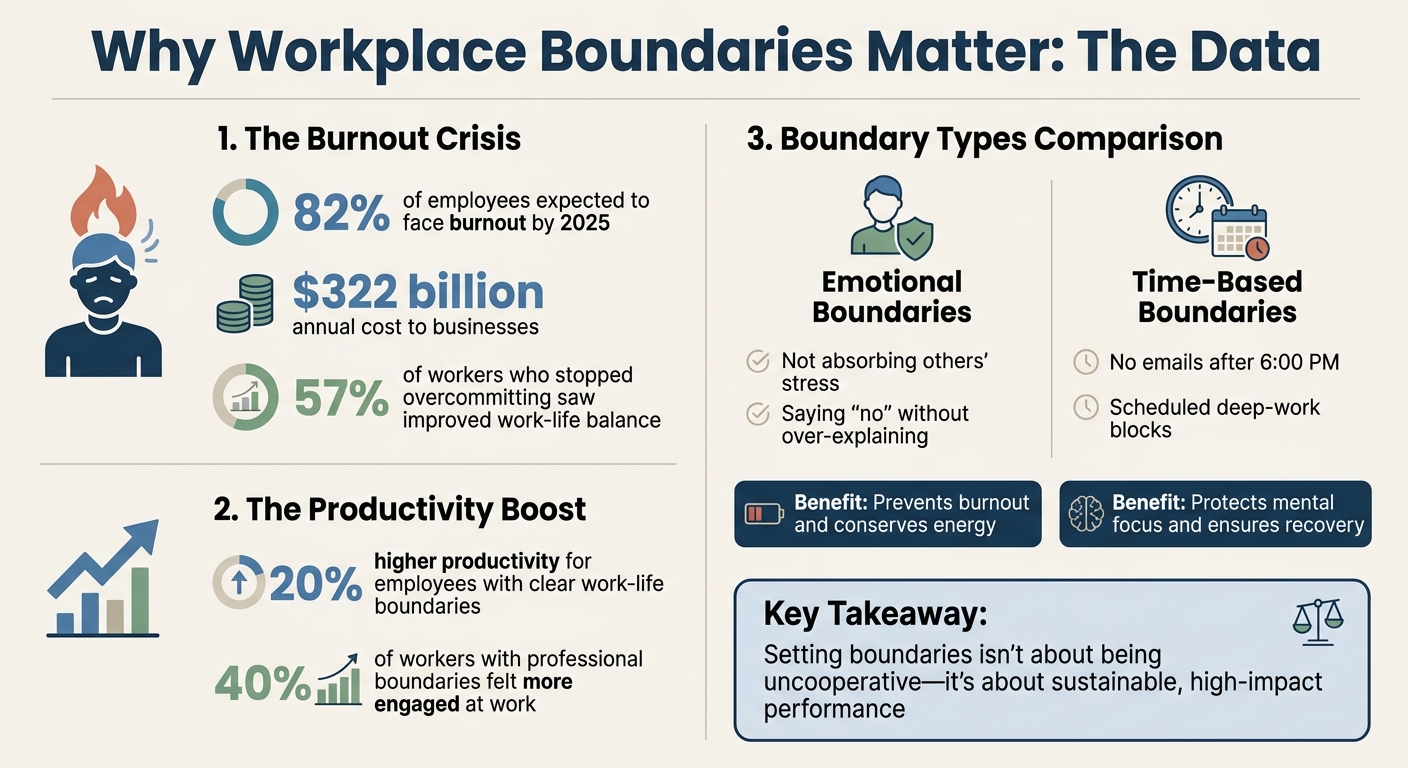
Workplace Boundaries Statistics: Burnout Costs and Productivity Benefits - Infographic © MyDifficultBoss.com
What Emotional Overload and Professional Boundaries Mean
What Emotional Overload Looks Like
Emotional overload at work goes beyond just being busy - it’s a full-blown nervous system response that interprets constant pressure as a physical threat. If you find yourself glued to your email or constantly saying "yes" to every request, you’re likely dealing with this kind of overload.
The symptoms are hard to miss: burnout from being "always on", persistent anxiety that leaves your team tiptoeing around an exploder boss, and the mental exhaustion that comes from juggling too many tasks without ever focusing deeply. It’s not just about working hard; it’s about an environment that demands more than anyone can realistically handle.
"The cost of blurred boundaries goes beyond tiredness. Work that seeps into personal life increases mental load and reduces sustained focus." - Fluidwave
Recognizing these red flags is the first step toward building the boundaries that can protect your well-being.
What Professional Boundaries Are
In response to emotional overload, setting clear professional boundaries becomes essential. These boundaries act as guidelines to safeguard your time, energy, and mental health. Picture them as a fence - not to shut others out, but to create a space where sustainable collaboration can thrive.
Boundaries shift your focus from being endlessly "available" to delivering quality work. Strategies like scheduling "Deep Work" sessions or establishing "Office Hours" can help reduce interruptions. Another effective approach is the "Yes, and..." technique, where you agree to new tasks only if resources or priorities are adjusted (e.g., "Yes, we can take on X, but we’ll need to pause Y"). These measures directly address the chaos of overload, allowing for more focused and manageable work. In fact, a 2023 study revealed that 57% of workers who stopped overcommitting saw improvements in work-life balance, and 40% reported feeling more engaged at their jobs.
"The goal is not to build walls. The goal is to create agreements. Agreements produce clarity. Clarity removes guesswork, especially when dealing with unclear instructions. And clarity is the foundation of healthy professional relationships." - Aden Leadership
sbb-itb-1bb7cb4
How to Spot Your Emotional Triggers
Common Workplace Triggers
Your body often senses emotional triggers before your mind fully catches up. Think about those physical cues - like a clenched jaw, warmth rising in your chest or face, shallow breaths, or a knot in your stomach. These signs can surface just seconds before you consciously recognize your emotions.
In the workplace, certain scenarios can set these triggers off. For example, interpersonal triggers might include being interrupted while speaking, receiving unexpected criticism in front of others, feeling excluded from key decisions, or dealing with colleagues who frequently shift extra tasks your way. On the other hand, triggers tied to workload and time management could stem from micromanaging bosses, impossible deadlines, constant urgency with no recovery time, or a packed schedule with back-to-back meetings.
Add to that the stress of overflowing inboxes and after-hours work demands, and it’s easy to see how quickly tension can build.
"The workplace bombards us with potential stressors daily, but the real danger isn't the stress itself - it's missing the patterns that show when you're approaching your limit." - Sarah Thompson, Ahead App
Recognizing these patterns is the first step toward understanding your limits and protecting your well-being.
Finding Your Personal Limits
Once you identify your triggers, you can begin to pinpoint your boundaries. A good starting point is the "Drains vs. Restores" tracking method. For one week, create two columns: one for activities or interactions that drain your energy and another for those that recharge you. Over time, clear patterns will emerge.
During your workday, take a moment to tune into your body. Are your hands clenched? Is your chest tight? These physical sensations can serve as real-time alerts, helping you catch triggers before they drain your energy completely.
Another helpful tool is a "Red Flag" log. Use it to jot down moments when you feel lingering resentment, stress that sticks around after a conversation, or even dread before certain meetings. These feelings often signal that your boundaries are being pushed. Unlike minor annoyances, these deeper triggers tend to follow a pattern and can leave you feeling disproportionately drained.
You can also set up visual cues - like a sticky note on your desk or a reminder on your phone - to prompt regular emotional check-ins. For recurring triggers, try creating if-then plans. For instance: If my manager questions my timeline in front of the team, then I’ll take three deep breaths before replying. These small strategies can make a big difference.
Table: Emotional vs. Time-Based Boundaries
| Boundary Type | Examples | Advantages | Disadvantages |
|---|---|---|---|
| Emotional | Not absorbing others' stress; saying "no" without over-explaining | Conserves emotional energy; prevents burnout; reduces stress | Can feel awkward or socially uncomfortable at first |
| Time-Based | No emails after 6:00 PM; scheduled deep-work blocks | Protects mental focus; ensures recovery time; reduces fatigue | May require negotiation with leadership; tough in "always-on" cultures |
Understanding the difference between emotional and time-based boundaries gives you the tools to manage your energy and avoid burnout. By setting these limits, you can create a healthier, more sustainable approach to work and life.
How to Communicate Your Boundaries
Using Direct Language
The best boundaries are straightforward statements of what can work, rather than defensive justifications. For example, if you're handed an urgent task at 5:45 PM, try saying: "I can prioritize this first thing tomorrow. If it must be done tonight, which task should we set aside?" This frames your boundary as a practical decision rather than a personal issue.
Skip the over-explaining. Long-winded justifications can dilute your message and create unnecessary confusion. Instead of saying, "I'm sorry, I can't take that on right now because I have so much going on", try: "Here's what I can commit to based on current priorities".
"An effective boundary is not a defensive excuse. It is a clear statement of what is workable." - Aden Leadership
If you're unsure about your capacity, lean on the "Power of the Pause" technique. Say something like: "Let me check my capacity and get back to you with a realistic timeline". This allows you to avoid impulsive "yes" responses that can lead to over-commitment and burnout. Pairing clear statements with empathetic language can make even tough conversations more manageable.
Using Empathy and I-Statements
While direct language sets clear boundaries, empathy adds a layer of understanding. Being empathetic doesn't mean giving up your boundaries - it means recognizing the other person's needs while protecting your own limits. The 3-Step Pushback Process can help you navigate these conversations effectively. Start by acknowledging the urgency ("I understand this launch is critical and the timeline is tight"). Next, use I-statements to explain your capacity ("My team is fully allocated at the moment, and we don’t have the bandwidth to take this on without deprioritizing something else"). Finally, collaborate on a solution ("How can we address this together? Should we pause the current project to focus on this instead?").
I-statements are especially useful because they focus on your actions and limits without trying to control others. For example, instead of saying, "You can’t call me after 7:00 PM", say, "I don’t check email after 7:00 PM, but I’ll respond first thing in the morning".
The "Yes, and..." technique is another helpful tool for maintaining boundaries while showing flexibility. If you're asked to take on more work, respond with: "Yes, I can prioritize this, and to do so, we will need to pause the current audit". This approach highlights your willingness to help while making the hidden workload visible, enabling your manager to make better decisions about priorities. It’s an effective way to conserve your energy while reinforcing the boundaries needed for healthy, productive workplace relationships.
It’s also also helpful to use tools at websites like MyDifficultBoss.com which provides scripts and strategies for dealing with all kinds of difficult bosses, including those who overload workers with too much word, and need some boundary setting.
How to Maintain Boundaries Without Getting Emotional
Staying Consistent Through Your Actions
Consistency turns a boundary into a non-negotiable reality. If you bend your limit even once, it sends the message that it’s open to negotiation. This isn’t about being inflexible - it’s about showing that your limits are to be respected every time you enforce them.
Sometimes, being efficient can lead to more demands, making it seem like enforcing boundaries is a failure rather than a smart choice. But here’s the truth: setting boundaries protects your work quality and helps you maintain long-term, effective performance. When you notice a "Boundary Echo" - a sudden change in tone - it’s a sign that your limit is being acknowledged. A 2023 study found that 57% of workers who stopped over-committing enjoyed a better work-life balance, while 40% who set professional boundaries felt more engaged at work. The discomfort of enforcing a boundary is temporary, but the stress of having none can linger indefinitely.
By sitting with any discomfort and resisting the urge to apologize, you reinforce your boundary. The next step? Learning how to deal with pushback when others test your limits.
How to Handle Pushback
Even with consistent boundary-setting, resistance is almost inevitable. Pushback can trigger a survival response in your nervous system, as the brain often associates disagreement with danger. To stay composed, try grounding techniques like controlled breathing.
One powerful tool for managing resistance is the "Broken Record" technique. This approach involves calmly repeating your boundary in the exact same words, avoiding new explanations that could invite negotiation. For instance, if a coworker questions your after-hours availability, you might say: "I don’t check email after 7:00 PM. I’ll respond first thing in the morning." If they press further, repeat the same statement verbatim. This reinforces that your boundary is a fact, not up for debate.
Avoid over-explaining. It’s tempting to justify your boundary with long-winded reasons, especially when feeling anxious. But doing so weakens your message and opens the door for pushback. Instead, stick to simple responses like, "I’m not available for that right now", or "I’ve made my decision." If the conversation becomes repetitive or the other person gets aggressive, it’s okay to disengage. You can say, "I’ve shared my capacity. Let’s revisit this when we can talk calmly", and step away.
"Discomfort doesn’t automatically mean harm. Disagreement doesn’t automatically mean you’re wrong." - Dr. Aretha Steele
Table: Enforcement Strategies and Associated Emotional Pitfalls
| Enforcement Strategy | Emotional Pitfall to Avoid | When to Use |
|---|---|---|
| Calm Repetition | Over-explaining: Giving lengthy justifications that invite negotiation. | Use when someone repeatedly ignores your boundary or keeps asking "Why?". |
| Offering Alternatives | Guilt-tripping yourself: Feeling like a "bad team player" for saying no. | Use when you want to help but can’t sacrifice your own limits. |
| Disengaging/Pausing | Reactive Defensiveness: Responding with anger or losing composure. | Use when the conversation becomes circular or turns aggressive. |
| Naming the Feeling | Numbing Out: Suppressing emotions to avoid conflict. | Use internally to recognize "old habit guilt" versus actual danger. |
Here’s a final thought: if you feel guilty after setting a boundary, it’s likely a sign of old habits rather than a reflection of your decision. Acknowledging this feeling as guilt - not danger - can help you stay grounded and reduce its intensity.
Building Emotional Strength for Long-Term Success
Self-Care After Difficult Interactions
Setting boundaries is just the beginning - the real challenge lies in how you recover afterward. Difficult interactions can trigger your amygdala, activating a "fight-or-flight" response that keeps your nervous system on edge. Rebuilding emotional strength involves retraining this response from a state of danger to one of safety.
These interactions can drain your energy, making intentional rest and disconnection crucial for recovery. For instance, staying offline after 6:00 PM can help clear your mind and preserve your ability to think strategically for the next day. Even taking a simple one-hour lunch break away from work can recharge your energy and help stave off burnout.
It’s also important to recognize that feelings of guilt after setting boundaries are often a conditioned reaction, not a reflection of reality. High achievers, in particular, may feel intense guilt after saying no. Instead of resisting this feeling, try acknowledging it without judgment - something as simple as saying, "Ah, there's that feeling again," while practicing deep breathing can help rewire your nervous system.
The "Boundary Echo" - that awkward silence or subtle shift in tone from a colleague - signals that your boundary is working. Sitting with this discomfort without reacting reinforces the boundary.
"Boundaries don't just protect your calendar. They retrain your stress response." - Michelle Porter
Once you’ve prioritized personal recovery, you can layer in analytical tools to better handle future challenges.
Using Tools Like the Boss Decoder Tool
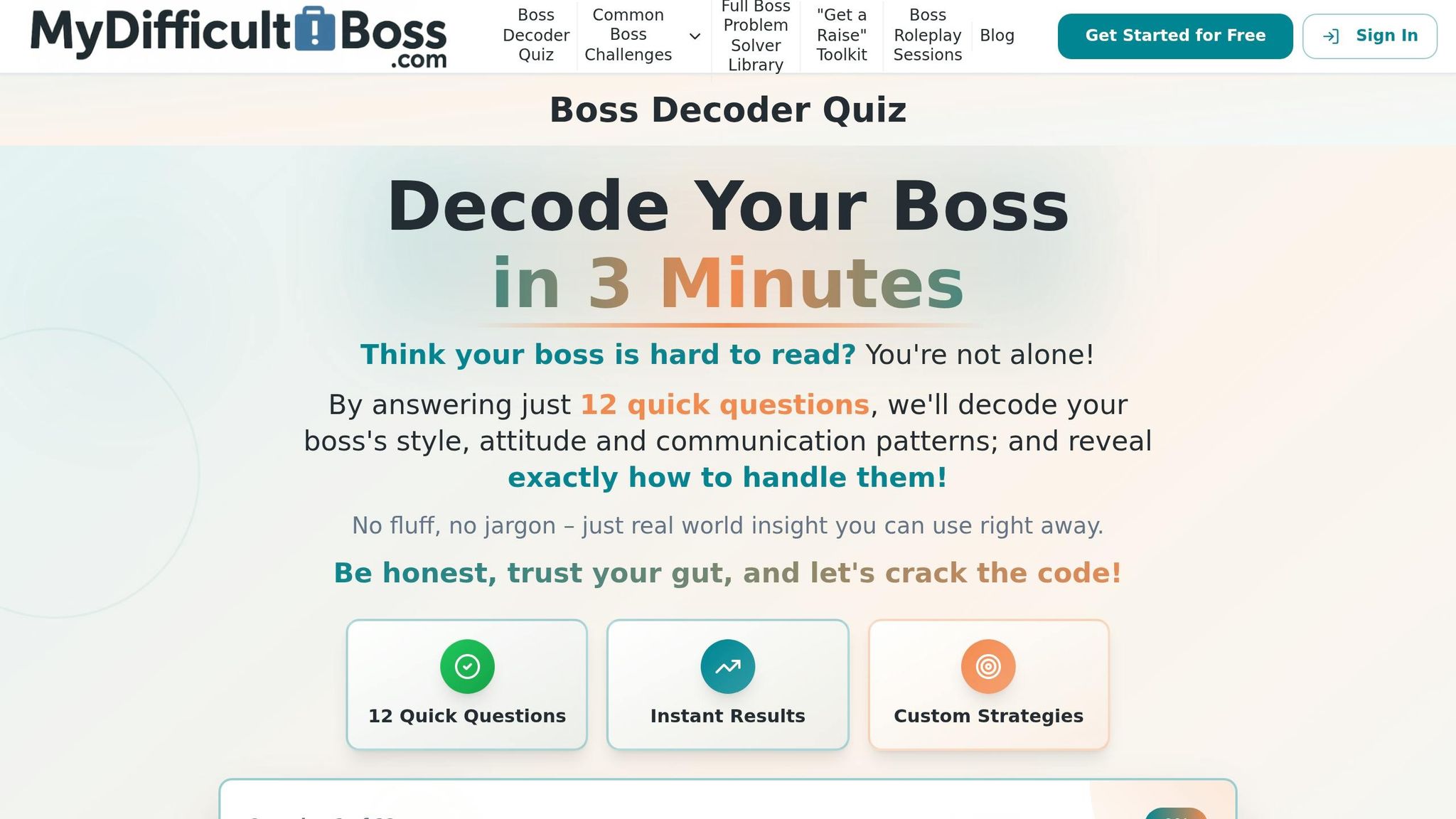
After regaining your energy, tools can help you analyze patterns and proactively manage stress. Understanding your boss’s behavior patterns can shift boundary-setting from reactive to strategic. For example, the Boss Decoder tool on MyDifficultBoss.com helps identify boss types, such as the "Guilt-Tripper" or "Urgency Manipulator", making it easier to anticipate and navigate their tactics.
Another practical approach is creating a "Triggers & Boundaries Map." This involves tracking what drains and restores your energy in a simple two-column document over one week. By noting moments of resentment, cognitive shutdown, or dread, you can pinpoint where boundaries hold strong and where they falter. Reviewing this map during a quick 15-minute weekly check-in allows you to adjust and refine your strategies. This process of identifying and containing stressors helps stabilize your emotional state and prepares you for more significant, long-term changes.
How to Set Boundaries With Work (Without Feeling Guilty) | Therapist’s Tips
Conclusion
Setting boundaries is essential for maintaining your well-being and sustaining your work performance. It starts with recognizing emotional triggers - those feelings of resentment or exhaustion that indicate your limits have been breached. Pay attention to these signals and address them with clear, direct communication. To make your boundaries effective, tie them to specific goals and priorities that matter.
Consistency is key. When you stick to your boundaries, they evolve from being simple requests to becoming respected workplace norms. For example, a 2023 study revealed that 57% of workers who stopped overcommitting themselves experienced an improved work-life balance. By staying firm, you not only reset your own habits but also reshape others' expectations of you. Over time, this creates the foundation for resilience and sustainable success.
"Setting boundaries isn't about checking out. It's a strategic shift toward sustainable, high-impact performance." - Baz Porter, Leadership Coach
Preserving your energy is crucial for achieving long-term success. Resilience helps maintain those boundaries, while self-care after challenging interactions prevents burnout. Websites like MyDifficultBoss.com can help you identify stress triggers and refine your approach.
Shifting your focus from being constantly available to delivering high-quality work takes effort, but it pays off. By prioritizing time to recharge, you’ll show up more focused, creative, and ready to produce meaningful results.
FAQs
How do I set a boundary without sounding rude or unhelpful?
Setting boundaries effectively is all about communication. Use clear and calm language to convey your limits. For example, you might say, "I can focus on this task, but it means pushing other priorities to a later time." This keeps the tone professional and cooperative.
You can also frame your boundaries in a positive way by explaining how they help you perform better. If you need to decline a request, consider offering an alternative solution instead. For instance, you could say, "I can’t take this on right now, but I can revisit it next week or suggest someone else who might assist."
Consistency is key. If someone crosses your boundaries, address it calmly and professionally. This approach reinforces your limits while maintaining a respectful and collaborative work environment.
What do I do when my boss pushes back on my boundary?
If your boss challenges your boundaries, respond in a calm yet assertive manner to reaffirm them. Use clear, straightforward language to explain your needs, and make it a point to stay consistent in your message. It’s also smart to document your conversations to avoid any potential misunderstandings later.
Be mindful of behaviors like micromanagement that may signal overstepping. When addressing such issues, rely on respectful but firm communication to make your stance clear. By staying composed and consistent, you can safeguard your well-being and avoid unnecessary emotional strain.
How can I stop feeling guilty after saying no at work?
Feeling guilty after saying no happens to a lot of us. It often stems from wanting to please others or feeling pressured by societal norms. But here’s the thing: setting boundaries is necessary to protect your energy and avoid burnout. Remind yourself that saying no isn’t selfish - it’s an act of self-care. Be kind to yourself, and try to see it as prioritizing your well-being. The more you practice, the more confident you’ll become in maintaining boundaries while keeping your mental health and work-life balance in check.