Why Personal Branding Matters More Than Boss Approval
Relying on boss approval limits your future — build a personal brand for visibility, career security, and opportunities beyond any manager.

Relying solely on your boss's approval can limit your career growth, while building a personal brand gives you control, visibility, and long-term opportunities.
Here’s the key takeaway:
- Depending on your boss for validation ties your success to one person, leaving you vulnerable to changes like layoffs or leadership shifts.
- A personal brand, on the other hand, highlights your expertise and creates opportunities beyond your current role.
Why focus on personal branding?
- Career security: Your brand stays with you, even if your job doesn’t.
- Visibility: Recruiters are 70% more likely to notice candidates with a strong online presence.
- Opportunities: Personal brands attract speaking gigs, leadership roles, and higher pay.
Your boss may guide team priorities, but your brand defines your reputation and future. Shift your focus to building a professional identity that opens doors everywhere - not just within your current company.
What Is Personal Branding and Why It’s a Career Game-Changer in 2025
sbb-itb-1bb7cb4
Why Personal Branding Matters More
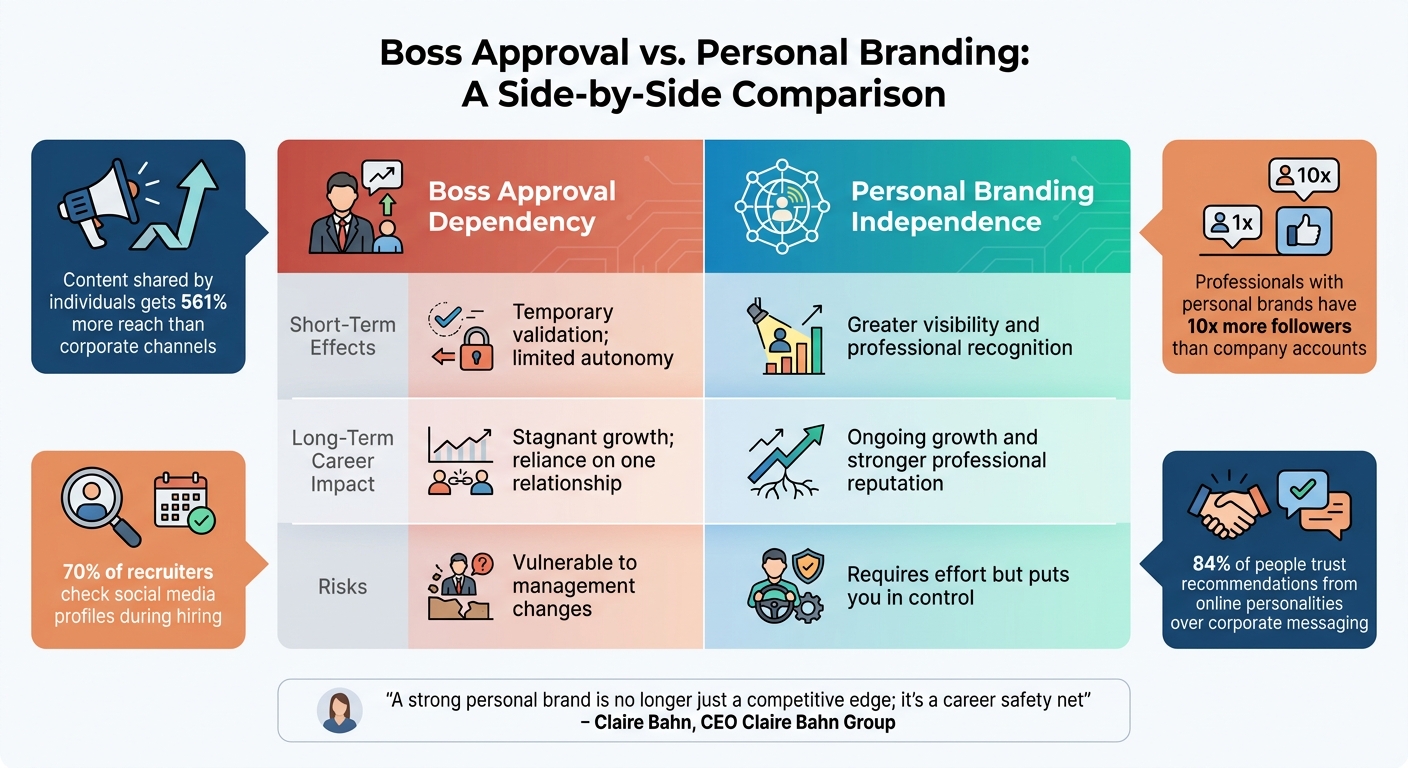
Boss Approval vs Personal Branding: Career Impact Comparison - Infographic © MyDifficultBoss.com
Leaving behind the pitfalls of relying solely on your boss, it’s time to focus on building a professional identity that stands on its own. Your boss may dictate team priorities and provide feedback, but they don’t define your ambition, reputation, or long-term goals. This distinction is more important than many professionals realize. While seeking approval might feel like the safer route, creating a personal brand gives you freedom and control. Shifting from seeking validation to developing your own brand can open the door to real career advantages.
Career Benefits of Building Your Personal Brand
Your personal brand is a professional asset that stays with you, no matter what happens - layoffs, leadership changes, or company restructuring. Consider this: content shared by individuals gets 561% more reach than content shared by corporate channels. Professionals with a personal brand also tend to have 10 times more social media followers than their company’s official accounts.
This visibility isn’t just about numbers - it creates opportunities. 70% of recruiters check social media profiles during the hiring process, and 84% of people trust recommendations from online personalities over corporate messaging. In today’s world, your digital presence can carry as much weight as face-to-face networking - sometimes even more.
Take the example of a global finance leader who partnered with the Claire Bahn Group in 2025. By consistently sharing insights on global economics and positioning himself as an authority, his social media following skyrocketed by 417,000%. This visibility led to features in Fortune and U.S. News & World Report, giving him career security that extended far beyond his job title. Claire Bahn, CEO of the Claire Bahn Group, sums it up perfectly:
"A strong personal brand is no longer just a competitive edge; it's a career safety net".
A well-built personal brand attracts opportunities - whether it’s new clients, speaking engagements, or board positions. In contrast, relying on your boss for validation keeps you waiting for someone else to recognize your value.
Boss Approval vs. Personal Branding: A Comparison
Here’s a side-by-side look at the differences between relying on boss approval and creating a personal brand:
| Aspect | Boss Approval Dependency | Personal Branding Independence |
|---|---|---|
| Short-Term Effects | Temporary validation; limited autonomy. | Greater visibility and professional recognition. |
| Long-Term Career Impact | Stagnant growth; reliance on one relationship. | Ongoing growth and a stronger professional reputation. |
| Risks | Vulnerable to management changes. | Requires effort but puts you in control. |
Boss approval is tied to current performance and immediate business needs. It’s limited to one person’s perspective and can disappear if that person leaves or the company restructures. Personal branding, on the other hand, focuses on building long-term authority and a lasting professional identity. It creates market value that transcends industries and roles, giving you more options and flexibility.
Consider the case of Mike, a finance manager with an impressive MBA. In February 2022, he was denied a promotion despite strong performance. His boss’s reasoning? "Because nobody knows you". Mike’s excellent work wasn’t enough because his visibility didn’t extend beyond his immediate team. A personal brand could have broken down that invisible barrier. Similarly, Nahia Orduña, a technical leader, exceeded expectations at a major tech company, only to be laid off when her role was deemed redundant. Later, at a telecommunications firm, a project she led was abandoned after her boss moved to another team. If she had built a personal brand showcasing her expertise, she would have had options beyond her current role.
As Kelly McGinnis, an Executive Leader, puts it:
"No boss has the capacity to architect your future. They are responsible for the needs of the business. You are responsible for the needs of your becoming".
The takeaway? Hard work and boss approval alone don’t guarantee career security. But a strong personal brand that positions you as a thought leader? That’s something no organizational chart can take away.
What Happens When You Ignore Personal Branding
Choosing to ignore personal branding can have a serious impact on your career. It can affect your earning potential, increase your stress levels, and leave you unprepared for unexpected changes in the job market. Let’s dive into how this plays out.
Limited Opportunities and Lower Market Value
Without a personal brand, you risk becoming invisible in the professional world. Consider this: 70% of employers research candidates online before making hiring decisions, and 85% of hiring managers say a strong personal brand influences their choices. If you’re not showing up in their searches, you’re essentially invisible, no matter how skilled or qualified you are.
This lack of visibility directly impacts your income. Without a standout personal brand, you could miss out on lucrative opportunities like board memberships, consulting work, speaking engagements, or leadership roles - opportunities that often come with significant financial rewards. As personal branding coach Brandon Birkmeyer aptly puts it:
"When you ignore [your brand], you risk becoming invisible".
Instead of leveraging your expertise for higher income streams, you might find yourself stuck earning only what your current job title allows. A strong personal brand, on the other hand, can open doors to diverse income opportunities and premium pay rates.
The Stress of Boss-Dependent Careers
The consequences of neglecting personal branding go beyond financial loss. It can also leave you overly reliant on your boss for career growth and recognition. When your professional success depends entirely on someone else’s approval, it’s easy to feel stuck or overlooked. Executive leader Kelly McGinnis sums it up perfectly:
"My boss was leading the business. I was the one responsible for leading my life".
This dependency becomes especially unsettling during times of uncertainty, such as layoffs, company restructuring, or when your boss leaves. Without a personal brand to fall back on, you’re left without a "career safety net". Career and financial coach Linda Ta Yonemoto highlights how this lack of visibility can isolate you:
"When you don't have regular interaction with your boss and colleagues, you become a ghost within the organization and lose visibility".
Without visibility, you miss out on key opportunities like informal learning, relationship-building, and career advancement.
The problem gets worse when your reputation is tied solely to your current boss or company. With the median job tenure in the U.S. at just 3.9 years as of 2024, most professionals will switch jobs several times throughout their careers. If your professional identity is tied to one role or employer, every job change essentially resets your reputation. On the flip side, a portable personal brand follows you wherever you go, creating opportunities that aren’t dependent on your boss’s endorsement.
How to Build Your Personal Brand
If you’re ready to take charge of your career, building a personal brand is a powerful way to do it. The best part? You don’t need anyone’s approval to get started - not even your boss’s. Here’s a practical guide to help you create a personal brand that stands out, even if you’re navigating a tough work environment.
Step 1: Define Your Value and Professional Goals
Harvard Business School professors Jill Avery and Rachel Greenwald emphasize:
"Much of professional and personal success depends on persuading others to recognize your value."
Start by identifying where your skills, interests, and market needs align. It’s not enough to use vague labels like "Marketing Professional" or "Project Manager." Instead, be specific and memorable. For example, say "B2B SaaS demand generation strategist" or "Digital transformation PM for healthcare systems." To test your brand statement, try the "Cocktail Party Test": if someone can immediately grasp your value after hearing your one-liner, you’re on the right track.
Next, do a quick online search of your name. What comes up? Does it reflect your expertise? If not, it’s time for a visibility audit. Set short-term goals, like improving your LinkedIn profile, and long-term ones, like positioning yourself as a thought leader. Remember, 70% of recruiters check candidates’ social media profiles, so this step matters.
Once your value is clear, create a narrative that communicates your expertise effectively.
Step 2: Create Your Professional Story
Your professional story should highlight your motivations, challenges, and achievements. Jeff Bezos famously said:
"Your brand is what people say about you when you're not in the room."
A good story follows a simple structure: "[Specific action] for [specific audience] through [unique method/advantage]." For instance, instead of saying, "I help companies grow", try something like, "I help healthcare startups scale from 50 to 500 employees through people operations systems." This approach makes your expertise tangible.
Don’t just focus on what you do - explain why you do it. Authenticity is key. In fact, 84% of people trust recommendations from individuals they follow online more than corporate messaging. Consistency across platforms also matters. If your story changes from one place to another, it can dilute your brand’s impact.
Step 3: Choose Your Focus Areas and Platforms
To amplify your story, pick the right platforms and topics. LinkedIn is a great starting point. With 80% of users involved in business decisions, it’s the go-to place for professional visibility. Profiles that post regularly can see up to 5.6 times more follower growth. Update your LinkedIn headline to reflect your personal brand rather than a generic job title.
As AI tools like ChatGPT and Perplexity become more prominent, creating in-depth, well-structured content can help you stand out. Consider writing a detailed 2,000- to 4,000-word article as a showcase of your expertise. Here’s a quick breakdown of platforms and their strengths:
| Platform | Best For | Content Type |
|---|---|---|
| Career growth, B2B leads, thought leadership | Articles, short posts, case studies | |
| Establishing credibility and authority | Indexed articles, press mentions, bios | |
| AI Search | Future discoverability by AI tools | Long-form expert guides |
Research shows that personal content often outperforms corporate content by a wide margin - up to 561% more reach. Even posting on LinkedIn once a week can make a big difference. Entrepreneur Gary Vaynerchuk puts it perfectly:
"Document, don't create. Share what you're learning as you learn it. That's your brand."
Step 4: Stay Consistent and Genuine
The key to building trust is consistency. Over time, your brand becomes a form of career insurance. The difference between self-promotion and personal branding is simple: self-promotion says, "Look at what I did", while personal branding says, "Here’s what I know that can help you." Focus on sharing actionable insights that solve problems for your audience.
You don’t need to be an extrovert or constantly active on social media to succeed. Many introverts thrive by creating thoughtful articles or blogs, which provide a lasting way to showcase expertise. Professionals with strong personal brands often attract up to 10 times more followers than their company’s official accounts.
Use MyDifficultBoss.com to Support Your Personal Brand
Navigating the challenges of building a personal brand under a tough boss can feel overwhelming, but you don’t have to face it alone. MyDifficultBoss.com offers practical tools to help you manage workplace dynamics effectively, giving you the time and energy to focus on growing your professional brand.
The Boss Decoder Tool for Customized Strategies
The Boss Decoder Quiz is a free tool designed to pinpoint your boss’s specific archetype - whether they’re narcissistic, indecisive, absent, or a bully - and provide tailored strategies for handling them. Some bosses use tactics like "isolation" to limit your visibility, cutting off opportunities to build relationships that are key to advancing your brand.
This tool equips you with strategies to set clear boundaries around your time, workload, and communication. By doing so, you can preserve the mental energy needed for high-value activities like networking or creating content to strengthen your personal brand. For example, if your boss tends to highlight your mistakes in front of colleagues, the Boss Decoder offers scripts for "ego-aware" communication to protect your reputation. Career coach Linda Ta Yonemoto emphasizes the importance of keeping detailed records:
"Document everything. I cannot stress this enough. Document incidents and keep accurate records of your wins, accomplishments and metrics".
These records form the backbone of your personal brand, allowing you to shape your professional story on your own terms rather than relying on your boss’s validation.
In addition to these tailored strategies, the platform’s Scenario Library offers actionable solutions for common workplace challenges.
The Boss Problem Solver Library for Practical Solutions
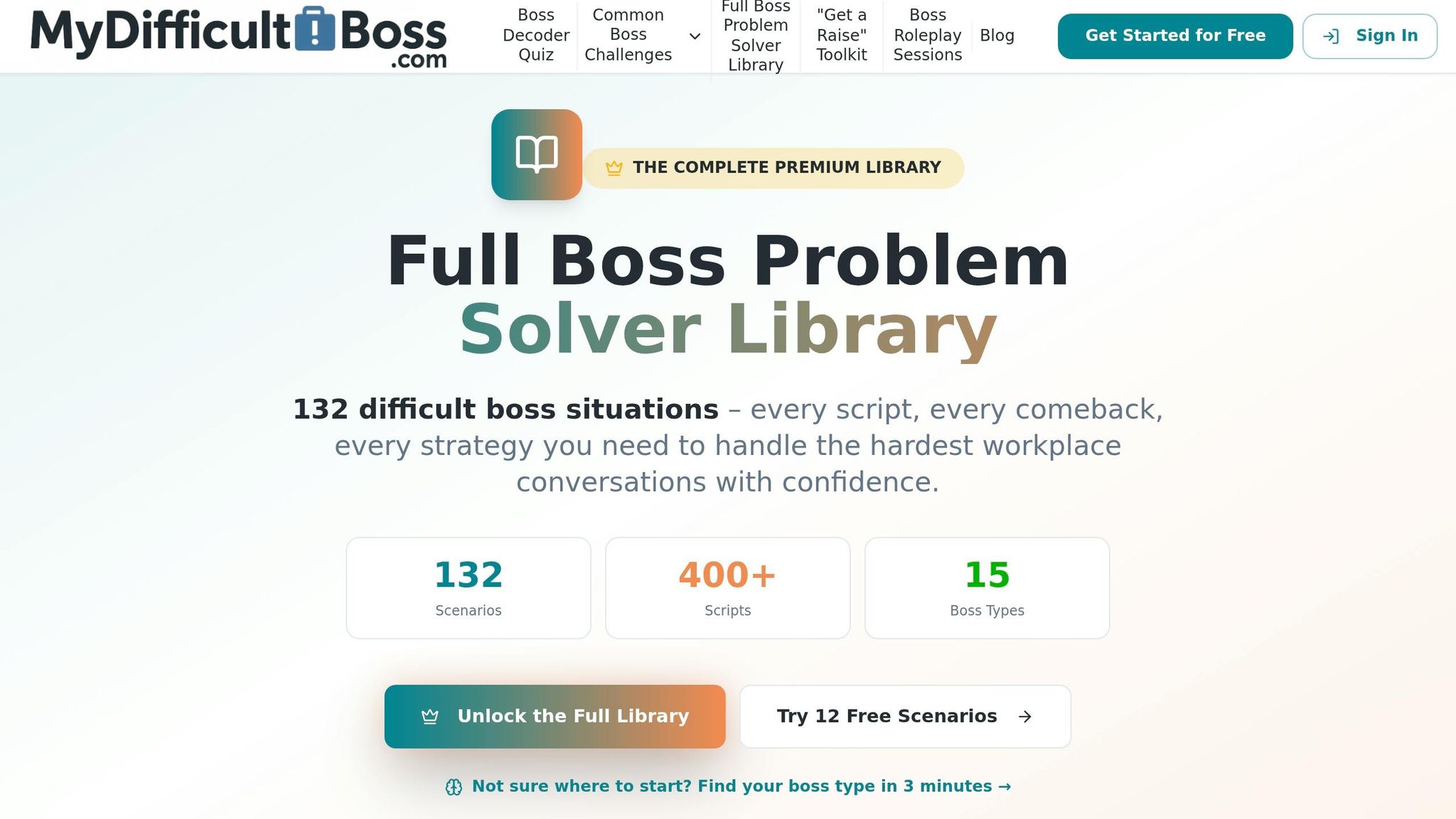
The Scenario Library is packed with 135 solutions for handling difficult workplace situations, from setting boundaries to managing overwhelming workloads. Each scenario includes starter scripts and step-by-step guidance. For instance, if your boss gives vague feedback, the library provides tools to turn that feedback into a concrete development plan based on measurable performance rather than subjective opinions.
The library also encourages you to maintain a wins log and track key metrics to showcase your accomplishments effectively. Additional resources, like the "Toxic Manager Survival Checklist", help safeguard both your mental health and professional reputation as you plan your next career step. These tools ensure that your personal brand remains strong and resilient, empowering you to take control of your narrative and focus on long-term career growth that extends beyond any single role or manager.
Conclusion: Focus on Personal Branding for Career Growth
Your career is yours - it doesn’t belong to your boss or your company. Success is built on your own accomplishments, not just the approval of a manager. While it might seem safer to rely on your boss’s validation, this approach is risky in today’s unpredictable job market. Bosses leave, projects get canceled, and roles disappear, often without warning. But a strong personal brand? That stays with you, opening doors no matter where you go or who you work for.
Personal branding isn’t about ego - it’s about creating visibility, trust, and adaptability in your career. By investing in your brand, you’re building a safety net that shields you from layoffs, company restructuring, or shifts in your industry. It positions you as a go-to expert in your field, not just another name in a stack of résumés waiting for attention.
Unlike the fleeting nature of boss approval, personal branding offers long-term benefits. Data supports this: a strong online presence is now the main way people assess your professional value. Claire Bahn, CEO of Claire Bahn Group, sums it up perfectly:
"A strong personal brand is no longer just a competitive edge; it's a career safety net".
Key Takeaways
Here’s what to focus on: shifting from seeking your boss’s approval to owning your personal brand takes intention and regular effort. Revisit your professional identity and online presence often to ensure they reflect your growing expertise. Make sure your LinkedIn headline highlights your unique value instead of just listing your job title. Share content that showcases your knowledge and offers practical solutions to your audience’s challenges.
Consistency beats perfection. Update your branding every year or two to stay current, and engage in meaningful industry conversations rather than simply posting content. Keep in mind that 84% of people trust recommendations from individuals they follow online, so your authentic voice carries more influence than any corporate message ever could. And if workplace challenges with your boss arise, tools like MyDifficultBoss.com can help you manage those dynamics while preserving the energy you need to build your brand. Your career story is yours to create - make it one that keeps opening doors long after your current role ends.
FAQs
How do I build a personal brand without risking my job?
To build your personal brand responsibly, start by showcasing your skills and strengths in ways that align with your role and your company's values. Focus on highlighting your contributions, maintaining professionalism, and supporting team objectives. Be mindful to avoid actions that could be seen as controversial or overly self-promotional, and always ensure your efforts align with company policies. By prioritizing teamwork and emphasizing internal growth, you can boost your career while maintaining harmony with your employer.
What should I post online if I’m not a “thought leader”?
To develop a strong personal brand, focus on sharing content that showcases your expertise, dependability, and genuine personality. This could mean posting insightful articles about your industry, offering your take on emerging trends, or highlighting your problem-solving skills through real project examples.
Consistency is key. Engage regularly by participating in discussions or sharing helpful resources. These actions can establish your credibility without the need to position yourself as a so-called “thought leader.”
At its core, personal branding is about earning trust, demonstrating authority, and staying visible within your professional network.
How can the My Difficult Boss website help if my boss limits my visibility?
MyDifficultBoss.com offers practical tools to help you navigate tricky situations with your boss while boosting your professional visibility. With the Boss Decoder, you can pinpoint your boss's personality type and customize your approach accordingly. The platform also provides access to over 135 scenarios, complete with step-by-step solutions and ready-to-use response scripts, making it easier to handle tough workplace dynamics.
Even if you feel your contributions are overlooked, these resources are designed to help you highlight your strengths and demonstrate your value.