How to Balance Boundaries and Rapport at Work
Learn how to set clear time, workload and communication limits while building trust with your boss to avoid burnout and boost performance.

Balancing boundaries and rapport with your boss can be tricky but is essential for a productive and respectful work relationship. Here's the key takeaway: boundaries protect your time and energy, while rapport builds trust and collaboration. Striking the right balance avoids burnout and helps you maintain professionalism without damaging relationships.
Key Insights:
- Why It Matters: Too many boundaries can make you seem unapproachable; too much rapport can lead to overwork and stress.
- Benefits: Clear boundaries improve communication, reduce stress, and position you as a reliable team member.
- Types of Boundaries: Time, workload, communication, emotional, physical, and role clarity.
- How to Set Boundaries: Use clear, consistent, and respectful communication. Offer alternatives instead of outright refusals.
- Building Rapport: Active listening, consistent behavior, and understanding your boss’s priorities help strengthen trust.
Start small by setting simple limits, like protecting focus time or defining after-hours availability. Use tools like the Boss Decoder Tool to tailor strategies to your boss’s style. Over time, evaluate and adjust your approach to ensure your boundaries remain effective and your rapport stays strong.
Setting Boundaries with a Difficult Boss by Managing Up (5 Tips to Start Now!)
sbb-itb-1bb7cb4
Assess Your Current Boundaries with Your Boss
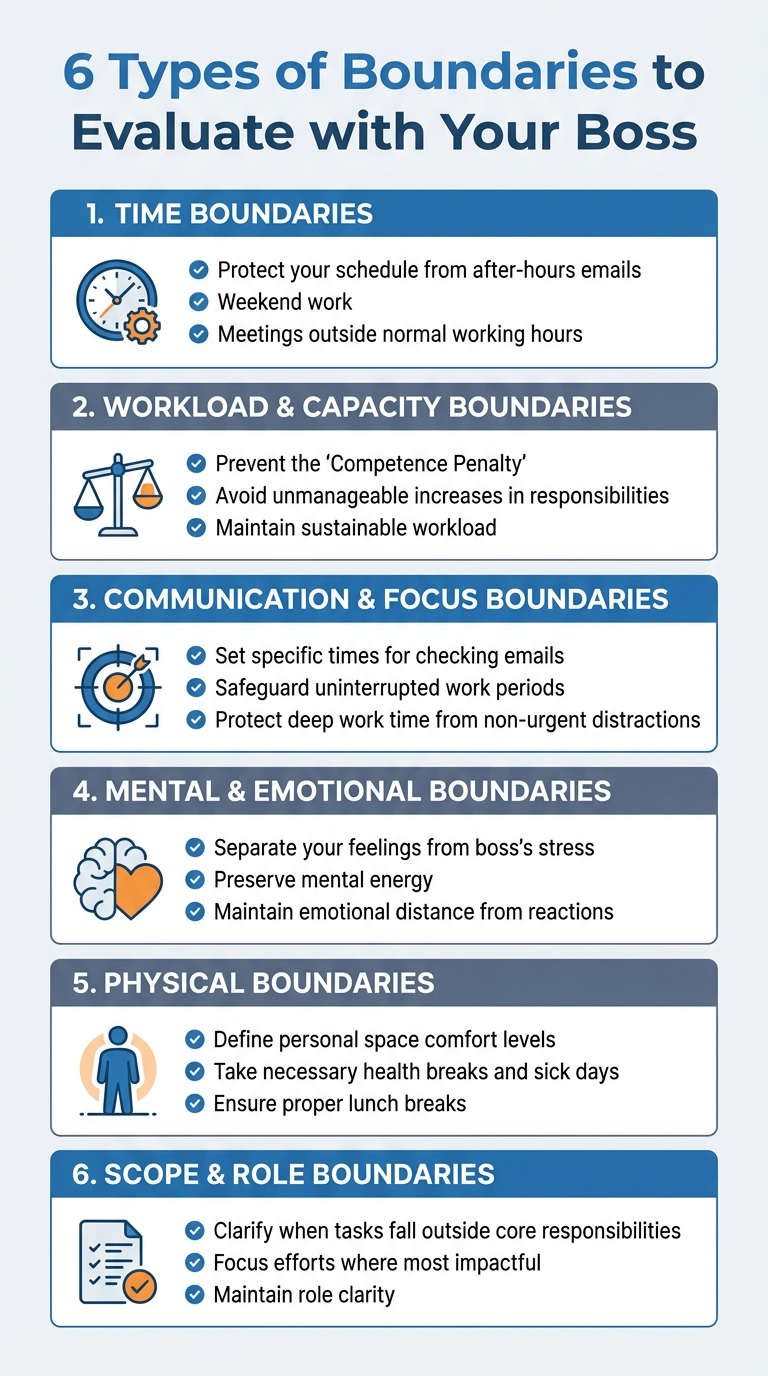
6 Types of Professional Boundaries to Set with Your Boss - Infographic © MyDifficultBoss.com
Before you can work on improving boundaries with your boss, it’s important to understand where things stand now. This step helps you pinpoint what’s working and what might need some fine-tuning.
If you don't set boundaries with your boss, they'll set them for you - and those boundaries will favor their needs, not yours.
Taking charge of this process ensures that the limits in place support your well-being and productivity, rather than just serving your boss's priorities. Let’s look at the key areas to evaluate.
Types of Boundaries to Evaluate
A professional relationship with your boss involves several layers of boundaries:
- Time boundaries: These protect your schedule from after-hours emails, weekend work, or meetings outside your normal working hours.
- Workload and capacity boundaries: These help prevent the "Competence Penalty", where being efficient leads to an unmanageable increase in your responsibilities.
- Communication and focus boundaries: These involve setting specific times for checking emails and safeguarding your uninterrupted work periods from non-urgent distractions.
- Mental and emotional boundaries: These help you separate your feelings from your boss's stress or reactions, preserving your mental energy.
- Physical boundaries: These define your comfort levels around personal space, taking necessary health breaks (like sick days), and ensuring you get a proper lunch break.
- Scope and role boundaries: These clarify when tasks fall outside your core responsibilities, ensuring your efforts are focused where they’re most impactful.
Take some time to reflect on these areas and identify where your boundaries may need to be clearer.
Self-Reflection Questions
Ask yourself these questions to evaluate how strong or weak your boundaries currently are:
- Do I feel respected in my role, or do I feel like my time is being taken advantage of?
- Am I comfortable saying "no" or "not right now" to requests that feel unreasonable?
- How do I react to "urgent" messages that arrive after work hours?
- Am I sacrificing quality to meet deadlines that feel unrealistic?
- Do I have a clear transition between my "work mindset" and "home mindset"?
If you find yourself always available or saying yes to every request, it’s a sign your boundaries might be too loose. On the flip side, saying abrupt "no’s" without offering alternatives could mean your boundaries are too rigid. Striking a balance helps you maintain your capacity while also building trust with your boss.
How to Communicate Boundaries Clearly
Once you've identified areas where your boundaries need improvement, the next step is to communicate them in a way that protects your capacity while maintaining a positive relationship with your boss. The earlier idea - that boundaries foster sustainable and respectful collaboration - serves as the foundation for this approach.
The 4 C's Framework can help guide you: Clarity (use precise language), Consistency (stick to your limits every time), Compassion (express your message respectfully), and Confidence (state your needs firmly without negotiation). Together, these principles create boundaries that feel professional and constructive, not defensive.
Steps to Set Boundaries Respectfully
Be clear, not apologetic. Avoid using apologetic phrases like "I'm sorry" or "I'm trying to." Instead, focus on stating facts about your workload and priorities. For example, instead of saying, "I'm sorry, I'm just too busy", try:
"To handle this effectively, I'd need to adjust the timeline on Project X or get support on Task Y. Which option works best for you?"
Connect boundaries to shared goals. When you explain how setting limits helps meet team objectives or ensures high-quality work, your boss is more likely to view it as a practical approach rather than a personal preference. For example:
"To deliver this at the required level, here's the timeline I can commit to."
This method balances setting limits with maintaining a professional connection, as discussed throughout this guide.
Offer alternatives. Rather than simply saying "no", suggest a different timeline, reduced scope, or ask which priority should shift. This shows you're focused on solutions and the team's success while protecting your capacity.
Start small to build confidence. Begin by setting boundaries in less critical areas, like reserving 30 minutes for lunch or designating "deep work" hours when you won't check emails. These smaller steps help you practice and establish expectations before tackling bigger challenges, like after-hours work requests.
Be proactive, not reactive. Schedule a "Foundation Conversation" with your boss before issues arise. Frame it as a discussion about how you can work most effectively, rather than waiting until you're feeling overwhelmed. Proactive communication demonstrates professionalism and helps prevent tension.
Example Scripts for Common Scenarios
Having phrases ready can make it easier to respond confidently when the moment arises. Here are a few examples:
| Scenario | What to Say | Why It Works |
|---|---|---|
| Urgent late-day task | "I can prioritize this first thing tomorrow morning. If it must be done tonight, which of tomorrow's priorities should be delayed?" | Encourages a discussion about priorities instead of defaulting to overtime. |
| Meeting outside work hours | "I have a conflict with that time slot. I'm available [Alternative Times]. I maintain boundaries around off-hours to ensure I'm fully productive during work time." | Clearly communicates your boundary while offering alternatives and linking it to productivity. |
| Additional work at capacity | "I want to ensure I can give this the attention it deserves. Right now, I'm focused on [Priorities]. To take this on effectively, I'd need to adjust the timeline on [Project]." | Shows you're committed to quality while being transparent about your workload. |
| Protecting focus time | "I've found I do my best work in uninterrupted blocks. I'll be checking and responding to emails at [Specific Times]." | Defines your availability and reduces uncertainty about your focus time. |
If your boss uses "team player" language to pressure you into taking on too much, consider responding with something like this:
"Being a team player means being honest about what I can deliver sustainably and at high quality. I'd rather commit to what I can execute well than overcommit and risk letting the team down."
These strategies not only clarify your limits but also help you maintain a strong professional relationship with your boss.
Building Rapport Without Compromising Boundaries
Establishing boundaries is essential for creating a work relationship that is both respectful and sustainable. The trick lies in fostering trust and connection through consistent, genuine actions that honor your limits while addressing your boss's needs.
Rapport-Building Techniques
One of the simplest yet most effective ways to build trust is through active listening. By fully focusing on what your boss is saying, you not only gain insight into their concerns and goals but also show that you value their input. Pay attention to subtle cues that might reveal their priorities - these details can help you respond thoughtfully without over-committing.
Consistency is another key factor. By clearly communicating your strengths, limits, and commitments - and sticking to them - you build a foundation of trust over time. According to Harvard Business School professors Jim Sebenius and Michael Wheeler, establishing trust early allows you to "constructively handle problems and opportunities that arise later". This reinforces the importance of setting clear boundaries while maintaining open communication.
Interest-based communication is another powerful tool. It focuses on uncovering the deeper needs behind surface-level requests. For instance, if your boss often asks for last-minute updates, the underlying concern might be a desire for stability or recognition from their own leadership. By addressing these core needs, you can strengthen rapport without compromising your workload or time.
A great example of this approach comes from Mayor Kim Driscoll, who shared financial data with her team to demonstrate how modifying health plans could lead to higher wage increases. Her transparency turned a potentially adversarial negotiation into a partnership built on mutual understanding. This example shows how honesty about constraints can strengthen trust and rapport, even in difficult conversations.
By applying these techniques, you can establish a solid professional relationship that respects boundaries while fostering connection.
Balancing Small Talk and Professionalism
Once trust is established, everyday interactions can further enhance your rapport - provided they remain intentional and professional. Casual conversations, when done right, can be a valuable tool for connection.
A good rule of thumb is the 80/20 approach: keep 80% of the conversation focused on professional topics (like work projects, industry news, or company updates) and 20% on personal interests. Pay attention to non-verbal cues - if your boss seems preoccupied, politely wrap things up with a line like, "I know you’ve got a lot on your plate, so I’ll let you get back to it." Research suggests that people form impressions of trustworthiness in as little as 33 milliseconds, and those impressions can last for months.
When engaging in small talk, stick to safe, neutral topics that can spark mutual interest. For example, you might discuss podcasts, books, professional development goals, or recent industry trends. Open-ended questions like "What did you think about the presentation?" can encourage a balanced exchange. Use natural moments - like breaks before or after meetings or during company events - to have these conversations without disrupting productivity.
The goal is to remain authentic while keeping things professional. As communication expert Annemarie advises:
Keep it heavy on professional, light on personal.
Use Tools Like the Boss Decoder Quiz for Tailored Strategies

If you're looking to take your boss management skills to the next level, tools like the Boss Decoder can provide the extra edge you need. While foundational techniques are essential, specialized tools like this one can help you navigate the intricacies of complex boss dynamics. The Boss Decoder focuses on identifying your boss's management style and tailoring strategies to fit.
How the Boss Decoder Tool Works
The Boss Decoder, available on MyDifficultBoss.com, is designed to offer personalized strategies for improving your working relationship with your boss. It operates in two distinct phases to help you build a more sustainable professional dynamic.
- Phase 1: This stage focuses on reframing boundaries as strategic choices. For example, instead of saying, "I need better work-life balance", you might frame it as, "I'm most productive during deep work hours." This approach aligns your personal needs with your boss's business goals, making it easier to establish boundaries without conflict.
- Phase 2: Once the groundwork is laid, the tool dives into specific boundary challenges. Whether it's about managing your time, balancing workloads, or improving communication, this phase helps you address these issues with actionable strategies.
For a deeper dive into these methods, the website offers additional resources to expand on the insights provided by the Boss Decoder.
Additional Resources on MyDifficultBoss.com

MyDifficultBoss.com doesn't stop at the Boss Decoder. The platform also features a comprehensive library filled with practical solutions for various boss-related challenges. These resources include:
- Starter scripts to help you initiate difficult conversations.
- Step-by-step strategies for when initial efforts don’t go as planned.
- Long-term advice for maintaining boundaries while fostering a positive working relationship.
The free tier gives you access to solutions for 11 common boss-related challenges, making it a great starting point. For more complex scenarios - like dealing with a boss who consistently crosses boundaries or struggles with clear communication - the full library provides more detailed strategies to help you find balance between setting limits and maintaining rapport.
Handling Pushback and Maintaining Consistency
Responding to Boundary Violations
When someone crosses your boundaries, the goal is to address it calmly and professionally. The focus should be on managing the situation, not getting caught up in unnecessary conflict. Avoid lengthy debates and instead steer the conversation toward solutions and the broader context.
For example, if your boss says something like, "I thought you were more committed than that", shift the focus to the quality of your work. You could respond with something like:
I bring this up because I want to ensure the quality you expect.
In situations where you're hit with urgent, late-night requests, ask for specifics about the timeline and suggest reprioritizing tasks for the following morning.
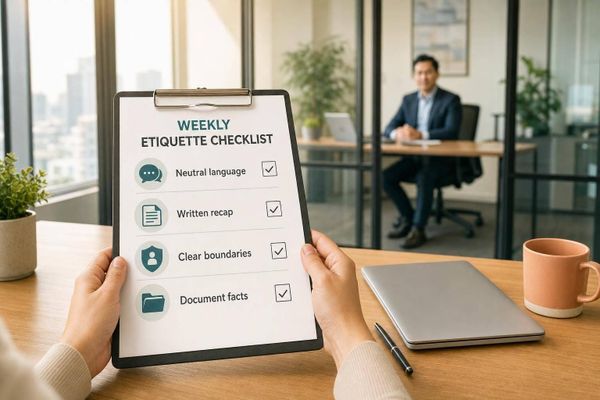
Additionally, it’s smart to follow up verbal agreements or meetings with a concise, neutral email summarizing the next steps. This simple habit can prevent misunderstandings or "rewritten" versions of events later. As Blunt Comms aptly puts it:
Documentation is not paranoia. It's insurance.
By consistently documenting and following up, you reinforce your professionalism and protect yourself, especially in high-pressure or conflict-heavy environments.
Maintaining Consistency
Once you've set boundaries, sticking to them is essential. Inconsistent boundaries quickly lose their effectiveness. Career strategist Nonye Opara explains it well:
Boundaries that change based on your mood or convenience lose their power. Establish clear standards and maintain them professionally.
Consistency might feel uncomfortable at first, but it's what earns respect over time. Stick to the same approach whenever your boundaries are tested. For example, if you're compared to a colleague who works longer hours, highlight your results-driven approach instead. Or, if someone questions whether you're a "team player", redefine the term by focusing on sustainable performance and reliability.
The key is to stay firm and uphold your standards in every situation. This steady approach strengthens your professional image and reinforces the boundaries you’ve worked to establish.
Monitor and Adjust Your Approach Over Time
Tracking Progress with a Simple Table
Setting boundaries isn’t a one-and-done deal - it requires ongoing evaluation. To see how well your boundaries are working, track specific metrics over time. During the first month, keep an eye out for signs like fewer after-hours interruptions and more time for focused work. By months one through three, you should notice improvements in your work quality and a growing respect for your time. After three months or more, you may start to build a reputation for having clear professional standards and maintaining steady performance.
A simple tracking table can help you measure progress. Compare key areas like workload management, stress levels, the quality of your relationships with colleagues or your boss, and the amount of time you can dedicate to focused tasks. Look for shifts in behavior - like moving from saying "yes" to everything to prioritizing tasks that fit within your capacity. Success might look like fewer last-minute "emergencies", less anxiety about declining requests, and higher-quality work thanks to improved focus. Use this data to fine-tune your strategies as needed.
Adjusting Strategies as Needed
As workplace dynamics evolve, your approach to boundaries might need some tweaking. Be on the lookout for what’s called the "Competence Penalty", where being efficient ends up expanding your responsibilities unfairly - without extra resources. If this starts happening, it’s a signal to reinforce your boundaries.
Certain warning signs might also indicate it’s time for a change. These include consistent pushback when you enforce reasonable boundaries, changes to your workload that feel punitive, or direct comments that your boundaries aren’t acceptable. If you encounter these issues, it might be time to involve HR or rethink your strategy. Career strategist Nonye Opara offers this advice:
The boundaries you set today determine the professional life you live tomorrow. Choose to value yourself professionally, and others will follow your lead.
Make it a habit to evaluate your boundaries monthly. The goal isn’t to get everything perfect - it’s to create a way of working that supports sustainable high performance over the long haul.
Conclusion
Striking the right balance between boundaries and rapport is key to building a strong, professional relationship with your boss. Boundaries aren’t about shutting people out - they’re tools for fostering respectful collaboration and avoiding burnout. They also help counter the "Competence Penalty", where being highly efficient can unintentionally lead to a heavier workload.
When you clearly communicate your capacity, strengths, and limitations, you establish trust. This consistency shows self-management and strategic thinking - traits that are often linked to career growth. A solid foundation like this allows you to use targeted tools and strategies to amplify your impact.
Remember, setting boundaries and building rapport aren’t opposing actions - they’re complementary practices that adapt as workplace dynamics change. Websites like MyDifficultBoss.com and their decoder quiz can help you tailor your approach to fit your boss’s style, while also preparing you to adjust as needed.
Setting boundaries also makes you a reliable professional. As career strategist Nonye Opara wisely says:
The boundaries you set today determine the professional life you live tomorrow.
The aim isn’t perfection - it’s creating a sustainable way of working that delivers excellent results while maintaining mutual respect over time.
FAQs
How do I set boundaries without seeming unhelpful?
Setting boundaries starts with clearly and respectfully communicating your limits. Use assertive yet calm language to express how these boundaries support both your productivity and well-being. For example, you might say, "I can dedicate my full attention to this project, but I’ll need to delay others for now."
To avoid confusion, document any agreements made. This ensures everyone is on the same page and minimizes potential misunderstandings. When discussing boundaries, frame them as tools that improve teamwork and efficiency. This approach helps others view them as supportive rather than restrictive.
What do I say when my boss pushes back on my boundaries?
When your boss challenges your boundaries, it’s important to respond with confidence and composure. Use straightforward and firm language, such as, "I can focus on this task, but it will mean delaying others." This approach ensures clarity while maintaining respect.
Keep a record of these conversations to prevent any confusion later and to ensure you're consistent in how you communicate your limits. If the pushback persists, stay professional and calmly explain that your boundaries are in place to help you perform effectively while protecting your well-being.
When should I involve HR about repeated boundary violations?
If someone's behavior keeps crossing the line even after you've tried addressing it directly, it's time to loop in HR. Start by making sure you've clearly stated your boundaries and kept a record of the incidents. If the problem persists, bringing it to HR's attention is the next logical step. They can step in to mediate and help create a workplace that's both respectful and professional.