Best Scripts for Addressing Favoritism with Your Boss
Professional scripts to address favoritism: clarify expectations, highlight results, document patterns, and escalate appropriately.

Favoritism at work is frustrating, but addressing it effectively requires tact. This guide offers practical scripts to help you navigate tricky situations without creating unnecessary conflict. From clarifying expectations to showcasing your contributions, each approach focuses on professionalism and growth. Key points include:
- Clarify Expectations: Ask your boss how success is measured and what factors influence advancement.
- Highlight Contributions: Share specific examples of your achievements to ensure your work is noticed.
- Discuss Patterns: Use neutral, fact-based language to address recurring concerns about fairness.
- Promote Transparency: Suggest systems for clear, merit-based decision-making.
- Escalate If Needed: If issues persist, document concerns and involve HR while focusing on team impact.
Favoritism is often not illegal, but it can harm morale and productivity. These strategies help you address the issue constructively and protect your career.
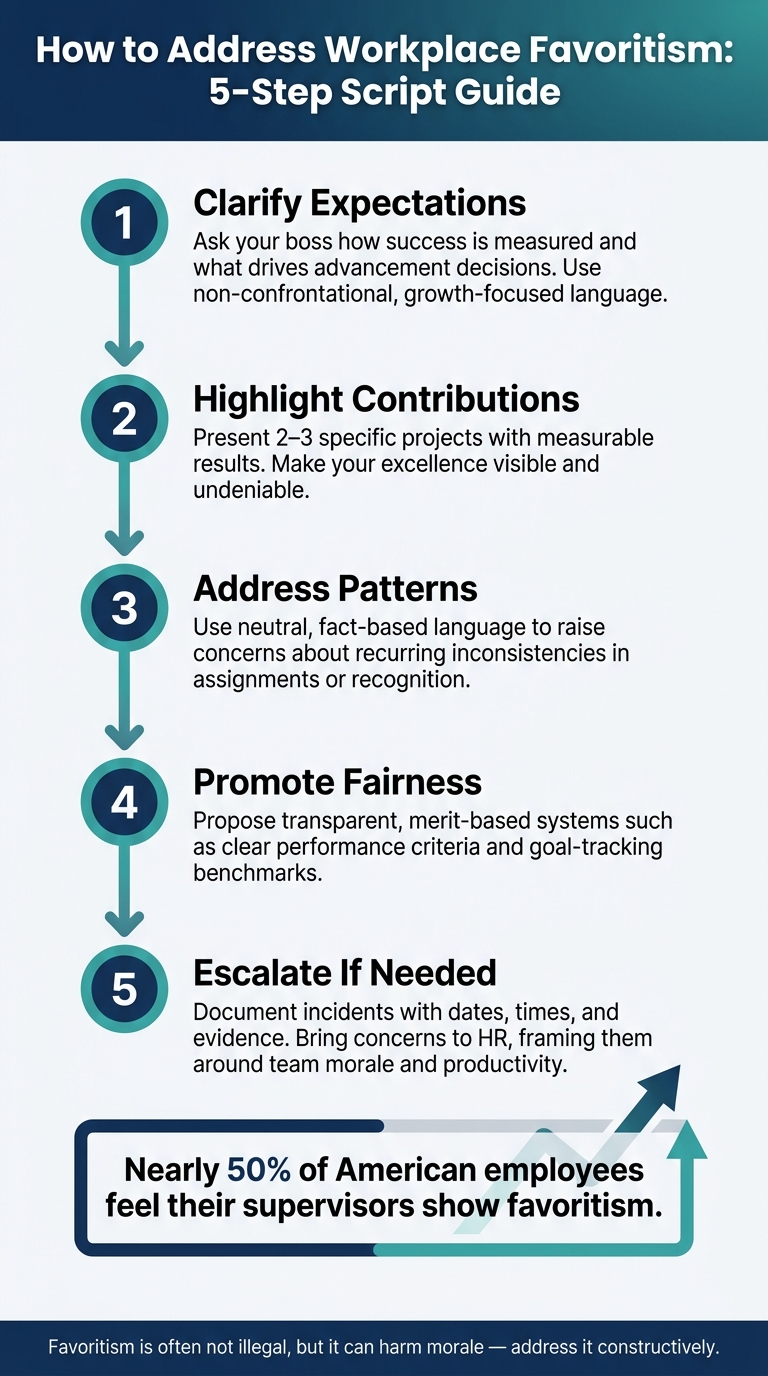
How to Address Workplace Favoritism: 5-Step Script Guide - Infographic © MyDifficultBoss.com
How To Handle Favoritism 🤯 At Work Without Getting In Trouble
sbb-itb-1bb7cb4
1. Clarifying Expectations
Script: "Help Me Align With What Matters Most"
If you suspect favoritism in the workplace, a great starting point is to ask your boss to clearly define what success looks like for you. This shifts the focus to your professional development rather than comparing yourself to others.
Approach the conversation as a step toward growth, not as a complaint. Instead of saying, "I feel like I'm being overlooked", try something more constructive, like:
"I've been reviewing my objectives for the year and have a few ideas that I'd like to discuss with you. Would Thursday be a good day for me to schedule something?" - University of Texas at Austin Human Resources
This phrasing helps steer the discussion toward actionable goals and measurable criteria. Once you're in the meeting, ask directly about how success is measured on your team and what factors influence advancement. James "Jay" Guilford, Owner of CoWorks Leadership Strategists, suggests a clear but non-confrontational approach:
"Can you explain the merit system behind growth? I've delivered on [mention 2–3 projects], yet my progress remains stalled."
This way, you emphasize your dedication to improvement while encouraging transparency about the criteria for advancement. It also allows you to showcase your accomplishments and potentially reveal inconsistencies in how progress is evaluated.
A great resource to also use to scope out your conversation is MyDifficultBoss.com which has lots of word for word scripts (and strategies) you can use in dealing with a boss who plays favorites at work.
For added clarity, keep a record of past instances where expectations or decisions felt unclear or inconsistent. Documenting these moments ensures you can back up your points with concrete examples during the conversation.
2. Highlighting Contributions
Once you've clarified expectations, the next step is to make sure your boss notices the value you bring to the table. This involves presenting your work in a way that's grounded in measurable results and clear achievements.
Script: "Let Me Show You What I've Been Working On"
After setting expectations, take the initiative to showcase your work. Highlighting your contributions isn’t about boasting - it’s about presenting evidence of your efforts and results. Brenda R. Smyth, Supervisor of Content Creation at SkillPath, emphasizes this point:
"Pointing fingers at your boss is not going to get you anywhere. What you need is a clear picture of how your boss views your work and the expectations. If you're not sure, suggest a quick meeting and bring examples of the outstanding work you've done."
To prepare, choose 2–3 projects that demonstrate your impact - whether it’s meeting tight deadlines, solving complex problems, or achieving specific outcomes. Use these examples to steer the conversation toward future opportunities. For instance, discuss high-profile assignments or additional responsibilities you’re eager to take on. This approach keeps the discussion positive and forward-thinking, rather than defensive.
As James "Jay" Guilford of CoWorks Leadership Strategists puts it:
"The best way to counteract favoritism is to make your excellence undeniable."
Focus on how your work aligns with the team’s objectives. Avoid comparing yourself to colleagues. Instead, let your results and dedication speak for themselves.
3. Addressing Patterns
Script: "I've Noticed Some Patterns I'd Like to Discuss"
After highlighting your personal contributions, it’s time to address patterns that might suggest systemic favoritism. The goal here is to steer the conversation away from personal frustrations and toward a broader discussion about fairness within the team.
James "Jay" Guilford of CoWorks Leadership Strategists explains:
"These questions aren't, and should not be issued as, accusations. They're invitations for transparency. They'll encourage your boss to examine whether favoritism is skewing workplace fairness."
Instead of pointing fingers, focus on asking open-ended questions that foster transparency. For example, avoid naming specific colleagues and instead ask something like:
"Can you clarify how projects are assigned across the team? I've noticed recurring discrepancies that concern me."
This approach shifts the focus from personal grievances to observable patterns. Document examples of unequal treatment, such as uneven project assignments, gaps in recognition, or limited access to high-visibility opportunities. By presenting clear evidence, you can frame the discussion around fairness rather than personal dissatisfaction.
Jeanette Coleman, Director of Human Resources at Axcet HR Solutions, emphasizes the importance of perception:
"What matters is not only what's actually happening, but what employees believe is happening."
To encourage reflection without creating tension, you might ask your manager: "Are all team members given equal opportunities?" This neutral question encourages them to consider potential blind spots and sets the stage for exploring fairness strategies in the sections that follow.
4. Promoting Fairness
Script: "Let's Build a System That Works for Everyone"
When patterns of inconsistency emerge, addressing them with clear and transparent processes can help restore fairness. Instead of focusing on past issues, shifting the conversation toward team-oriented solutions keeps things productive and forward-looking.
Studies reveal similar concerns in the workplace: nearly half of American employees feel their supervisors show favoritism. Tackling this problem requires a collaborative approach.
Here’s a script you can use to start the conversation:
"I propose we refine our performance review criteria to be more transparent and merit-based. I think having a clear, merit-based roadmap would be highly motivating for the whole team."
This approach encourages teamwork and trust. Rather than pointing fingers, you’re presenting yourself as someone committed to the team's growth and success. Eva Chan, Senior Career Coach and CPRW, and Sean Smith, CEO and former Head of HR, both stress that using objective, clearly defined criteria for promotions, rewards, and major projects helps build trust and ensures decisions feel fair and merit-driven.
To take it a step further, suggest implementing a goal-tracking system with well-defined benchmarks. This provides a practical, non-confrontational solution everyone can get behind.
5. Escalation Strategies
Script: "I'd Like to Bring This to HR's Attention"
If addressing favoritism directly doesn’t lead to meaningful change, it might be time to escalate the matter to HR. When doing so, framing your concerns carefully is essential. Instead of focusing on how the issue impacts you personally, emphasize its broader impact on team morale and productivity:
"I've noticed some patterns that seem to be affecting team morale and productivity, and I wanted to discuss them to see how we can create a more balanced environment."
Before meeting with HR, preparation is key. Jeanette Coleman, SPHR & SHRM-SCP, Director of HR at Axcet HR Solutions, highlights the importance of being well-documented:
"Accusations of favoritism can escalate into formal complaints, so you'll want to have documentation to ensure clarity and transparency."
To build a strong case, keep a detailed record of incidents, noting dates, times, and the individuals involved. Save any relevant emails or messages, and, if possible, gather observations from colleagues who have noticed similar issues. Organize all this information to present a clear, factual account during your conversation with HR.
While favoritism itself isn’t illegal, it crosses into unlawful territory if it involves discrimination or retaliation based on race, gender, age, or other protected characteristics. In such cases, having thorough documentation becomes even more critical, and you may need to consider external options, like reaching out to the EEOC.
Conclusion
This guide focuses on shifting workplace conversations from blame to clarity. Each strategy - whether it's clarifying expectations, emphasizing contributions, addressing recurring issues, ensuring fairness, or involving HR - centers on fostering transparency. This approach not only safeguards your professional reputation but also encourages your manager to make decisions based on merit rather than bias. Plus, it creates a documented trail of your efforts, which can be crucial if the situation escalates to HR.
No single script works for every scenario, so tweak the language to suit your workplace dynamics, your relationship with your boss, and the specific issues you've noticed. The aim isn’t to “win” an argument but to foster a dialogue that leads to fairer treatment and clearer expectations. For more specific advice, MyDifficultBoss.com provides a library of 135+ difficult boss scenarios, complete with detailed solutions, starter scripts, and a Boss Decoder Tool to help you understand your manager’s style and choose the best approach.
The ultimate goal is to let your work speak for itself. As Guilford wisely says, "The best way to counteract favoritism is to make your excellence undeniable." These scripts are just the starting point. Your consistent professionalism, thorough documentation, and unwavering dedication are what drive meaningful and lasting change.
FAQs
How do I bring up favoritism without sounding accusatory?
To tackle favoritism in the workplace without coming across as confrontational, set up a private meeting with your boss and approach the discussion with a calm and professional demeanor. Center the conversation on your own growth by asking for feedback on ways you can enhance your contributions to the team. This approach shifts the focus to self-improvement, fosters a constructive conversation, and steers clear of direct accusations, paving the way for a more positive and productive dialogue.
What should I document before talking to my boss or HR?
Before bringing up favoritism with your boss or HR, it's important to gather clear evidence. Start by documenting specific incidents, noting details like dates, times, and descriptions of the behaviors that demonstrate favoritism. Be sure to include how these actions have affected your work performance or morale. Additionally, save any relevant communications - such as emails or messages - that back up your concerns. Having detailed and organized documentation will make your case easier to explain and more credible during discussions.
When does favoritism become illegal discrimination or retaliation?
Favoritism becomes unlawful when it revolves around protected characteristics such as race, gender, age, disability, religion, or sexual orientation. It also crosses the legal line if it results in unfair treatment that breaches anti-discrimination laws.