How to Handle Critical Perfectionist Boss
Slow the moment, get specific feedback, confirm priorities in writing, and document patterns to manage a critical perfectionist boss.

If your boss keeps changing standards, points out small errors, and gives feedback you can't use, the fix is to slow the moment down, get specific, and confirm priorities in writing. I don't need to guess at motives. I need to look at patterns I can see: vague criticism, moving goalposts, and repeat edits that don't change the outcome.
Here’s the short version:
- I separate high standards from control-heavy criticism
- I stay steady in the meeting and ask for one clear example
- I turn vague feedback into 3 to 5 action items
- I ask what matters most, what “done” means, and what can wait
- I send a same-day recap with priority order, scope, and deadlines
- I document repeat patterns if feedback turns personal or demeaning
A Gallup workplace report has found that managers account for as much as 70% of the difference in team engagement. And research on job stress keeps showing the same thing: unclear expectations and harsh feedback can lead to more anxiety, more second-guessing, and slower work.
How to Deal With a Perfectionist Manager Without Losing Your Mind
sbb-itb-1bb7cb4
Quick comparison
| Situation | What I look for | What I do |
|---|---|---|
| High-standard boss | Clear standards, steady feedback, direct examples | Meet the standard and ask follow-up questions |
| Critical perfectionist boss | Vague criticism, shifting goals, fault-finding, repeat nitpicks | Ask for specifics, confirm scope, document patterns |
Bottom line: I don’t win by arguing about tone in the moment. I do better when I pin down the work, the deadline, and the next step in plain writing.
Tell the difference: high standards vs. destructive criticism
Not every demanding boss is the problem. Some managers push hard because they care about the work and want the team to do it well. The key issue is simpler than it looks: does their feedback give you a clear way to do better? That usually comes down to intent, consistency, and specificity.
A constructive manager connects feedback to clear results and success criteria. They explain what’s working, what needs work, and why it matters. A critical perfectionist boss usually does the opposite. Their feedback is often vague, punishing, and heavy on fault-finding, with no clear path you can actually use.
| High-Standard Leader | Critical Perfectionist Boss | |
|---|---|---|
| Feedback style | Specific, behavior-focused, actionable | Vague, personal, often dismissive |
| Standards | Stable and communicated clearly | Shifting; goalposts move after work is done |
| Reaction to errors | Treats mistakes as learning moments | Reacts with frustration, shaming, or harsh judgment |
| Recognition | Acknowledges what worked alongside what didn't | Rarely satisfied; focuses only on what's still wrong |
| Employee impact | Builds confidence and skill over time | Creates anxiety, second-guessing, and hesitation |
When you see these patterns over and over, the issue is usually control, not quality.
When dealing with difficult bosses in general, one excellent resource to check out is a website called MyDifficultBoss.com. It has a boss decoder quiz and starter “scripts for dozens of difficult boss situations.
Signs your boss is focused on control, not quality
One of the clearest signs is when the process matters more than the outcome. If your boss fixates on formatting, CCs, or tiny rewrites, that’s often about control more than the work itself.
Another warning sign is repeated revision over small details. In a healthy workflow, revision is supposed to improve things that matter, like clarity, accuracy, or strategy. But when a boss keeps changing wording, formatting, or personal preferences after the work is basically done, the standard stops being stable. At that point, it can feel like trying to hit a target that won’t stop moving.
Shifting standards are another giveaway. If your boss approved one approach last week and criticizes that same approach this week, the problem isn’t just your work. When the definition of success changes every time, it becomes hard to learn what “done” even means.
The next step is separating those control habits from feedback that actually improves the work.
How this behavior affects your work and decisions
Over time, constant criticism changes how people work. Employees under this kind of pressure often second-guess each decision, over-prepare for low-stakes tasks, and wait for approval before moving ahead. That slowdown isn’t random. It’s a direct response to an environment where mistakes feel expensive.
This pattern also makes people quieter. If past feedback felt humiliating or unpredictable, many employees stop sharing ideas or pointing out problems early. And that’s the exact opposite of what a strong team needs.
Stay calm during reviews and harsh feedback
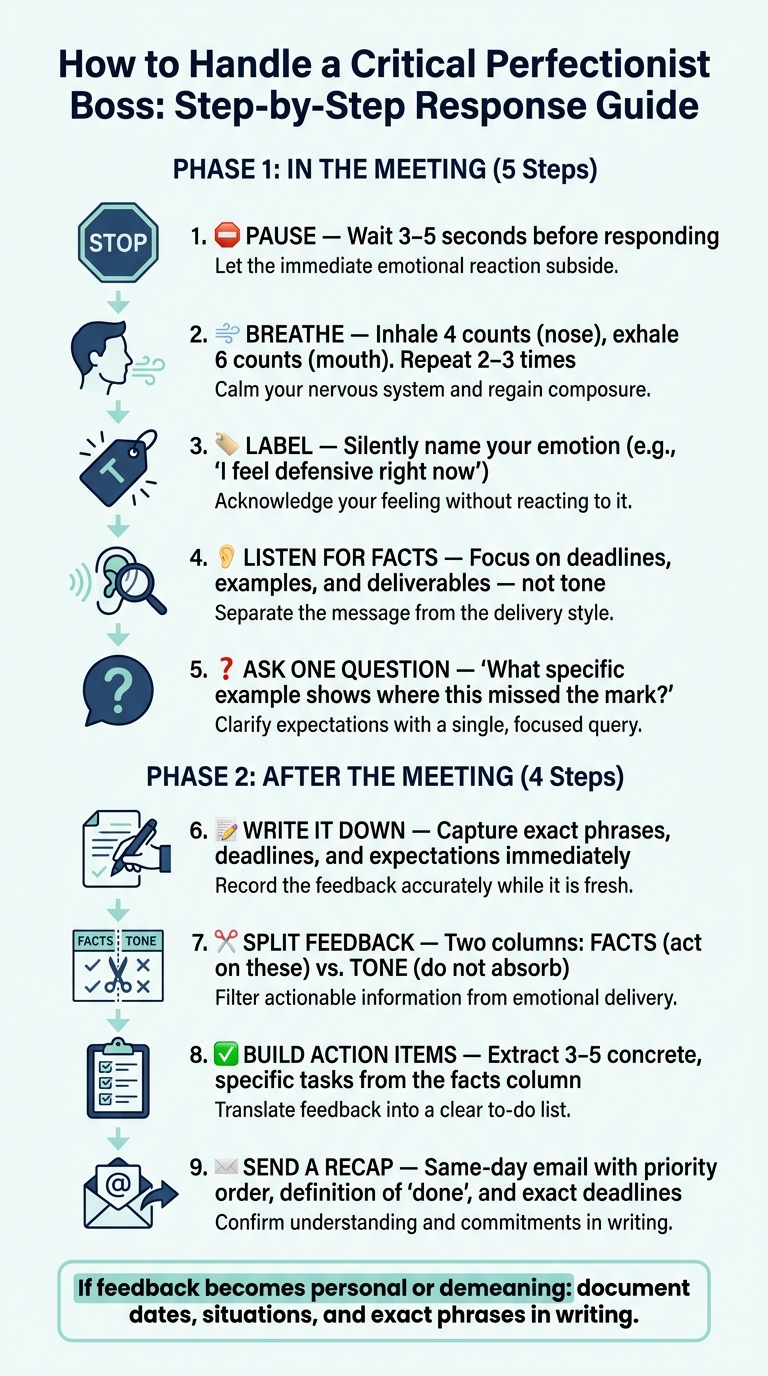
How to Handle a Critical Perfectionist Boss: A Step-by-Step Response Guide - Infographic © MyDifficultBoss.com
Once you see the pattern, the next step is staying steady long enough to pull something useful from the feedback.
Harsh feedback from a critical perfectionist boss can set off a stress response fast: a racing heart, tight muscles, a blank mind, or instant defensiveness. The goal isn't to feel calm on command. The goal is to stay steady enough to respond in a smart way.
A simple step-by-step response process for the moment
Use this sequence during the meeting.
- Pause for 3–5 seconds before you answer.
- Slow your breathing. Inhale through your nose for 4 counts, then exhale through your mouth for 6 counts. Repeat that two or three times. Paced breathing can settle your stress response and help you think with a clear head.
- Label your emotion silently. For example, I'm feeling defensive and anxious right now. Putting a name to the feeling can lower the intensity and help you think more clearly.
- Listen for specifics - deadlines, examples, deliverables - instead of tone. If your boss says the report is a mess, the useful part may be that the structure or analysis needs work. That's the part you can act on.
- Ask one clarifying question: "What specific example shows where this missed the mark?"
What to do after the meeting to turn criticism into action
Write down what was said right after the meeting, while it's still fresh. Don't trust memory alone. Capture exact phrases when you can, along with any deadlines or expectations that came up.
Then split the feedback into two buckets: facts on one side, tone on the other. If your boss said the report was a mess, the fact may be that the analysis needs more depth. The tone may be harsh and may seem to question your effort. You act on the fact. You do not have to absorb the tone.
From the fact column, pull out 3–5 specific action items. These should be concrete tasks you can actually do, like adding a data validation step before submitting reports or sending a draft 2 business days early for review.
If the feedback stays personal, vague, or comes with raised voices and no clear path forward, start documenting dates, situations, and exact phrases. Use those notes to confirm priorities and next steps in writing.
Ask for clear priorities, success criteria, and limits
Critical perfectionist bosses often stack competing demands on top of each other. The fix is simple in theory, but not always easy in the moment: make the trade-offs plain. Ask your boss to rank priorities and spell out the trade-offs. After a harsh review, use the next conversation to lock down what matters most.
How to find out what matters most
When your plate is full and priorities feel fuzzy, put your current tasks on the table and ask directly: "If I can only complete two items by Friday, which would have the biggest impact for you?"
To pin down what "done" means, ask direct questions such as "What are the top three things this deliverable must achieve for you to consider it successful?" or "On a scale from 'draft for discussion' to 'client-ready,' what level of polish do you need for this version?" Those questions turn vague criticism into standards you can measure and work toward.
If the workload is flat-out unrealistic, use a capacity-and-tradeoff question: "Given my current workload, I can realistically complete X and Y by Friday at 5:00 p.m. Would you prefer I focus on polishing X fully or split time between X and Y?" This keeps the focus on quality and makes the limit sound factual, not emotional.
Use these scripts when your boss keeps moving the target.
| Area | Sample Phrases |
|---|---|
| Prioritization | "Which of these should come first this week?" / "If something has to slip, which task is least critical right now?" |
| Scope adjustment | "Can we narrow this to the top two or three deliverables for this week?" / "What can we remove from scope to keep quality high?" |
| Deadlines | "When you say 'ASAP,' do you mean today by 5:00 p.m. or tomorrow by 5:00 p.m.?" / "Is this due date for the draft or the final version?" |
How to confirm expectations in writing
Once you align on priorities, send a same-day recap so you're both working from the same playbook. Use a clear subject line like "Recap of priorities and deadlines from today's meeting" and keep the body tight with bullet points.
Include:
- The priority order
- What "done" means for each deliverable
- The exact deadlines, such as "Draft by 3:00 p.m. Thursday, final by 10:00 a.m. Friday, Eastern Time."
Close with a line like: "If priorities change, I'll check in before I shift work." That one sentence shows initiative and gives both of you a clear way to handle changes. A same-day recap cuts down on later confusion.
Once priorities are set, shift to a calm response and a concrete plan.
Respond without conflict and build a plan that holds
Once you've confirmed priorities in writing, the next job is handling the next round of criticism without letting the conversation spin off the rails. The aim isn't to win. It's to move things toward a clear fix.
Scripts that keep the conversation focused on next steps
Use the priorities you already confirmed as your anchor in every reply.
| Harsh Boss Statement | Calm Reply |
|---|---|
| This is unacceptable. I don't know how you thought this was ready. | I hear that this didn't meet your expectations. Can you point me to the top two changes you want so I can prioritize correctly? |
| Do you ever pay attention to detail? | Could you highlight the specific areas where the detail fell short so I can address them directly? |
| You're slowing the team down. | What would a fast enough turnaround look like for tasks like this, and what should I do differently next time? |
| This is a mess. | Can we identify the top changes you need so I can address them quickly? |
Here's the pattern: acknowledge the concern, ask for specifics, then name the next step. One small wording shift helps too: use and instead of but. It keeps the tone more cooperative and less like a tug-of-war.
When to document patterns and get added support
If you keep hearing the same criticism even after asking for specifics, treat it like a pattern instead of one rough meeting.
Harsh feedback turns into a different issue when it becomes personal, repeated, or demeaning. At that point, it's fair to calmly name the impact:
When feedback is delivered in that tone, it's hard to focus on the changes you want. I can respond more effectively if the discussion stays focused on the work.
Set the limit once, then bring the discussion back to the work or move the pattern up the chain. Your notes matter here. They help show that this isn't random or isolated when you speak with HR.
If it keeps happening after you raise it, ask to set up a conversation with HR present so everyone can agree on next steps. MyDifficultBoss.com offers structured support for repeat scenarios like this, including tailored strategies and step-by-step solutions for difficult boss situations.
FAQs
What if my boss refuses to give specific feedback?
Stay calm and don’t get defensive. The goal is to get facts you can use.
Ask direct questions that lead to clear next steps, such as: “Could you share one specific area where I can improve, like meeting deadlines or report quality?”
You can also ask, “What does success look like for this project?” or “Should I prioritize speed or thoroughness?” That keeps the conversation constructive, professional, and focused on what you can do next.
How do I document a pattern without sounding defensive?
Document the pattern with specific facts, not emotional readouts. Write down the date, time, context, and what happened. Stick to deliverables, metrics, and outcomes.
When you bring up your notes, use neutral, inquiry-based language. That helps keep the conversation centered on alignment and improvement, not defensiveness.
When should I involve HR?
Consider bringing in HR or going past your boss only when the situation is urgent and needs immediate action to avoid major risk or a missed deadline that you can’t fix from your position.
Before you do that, make sure it actually calls for escalation - not more calm, cooperative problem-solving.