Checklist for Navigating Office Etiquette with Bosses
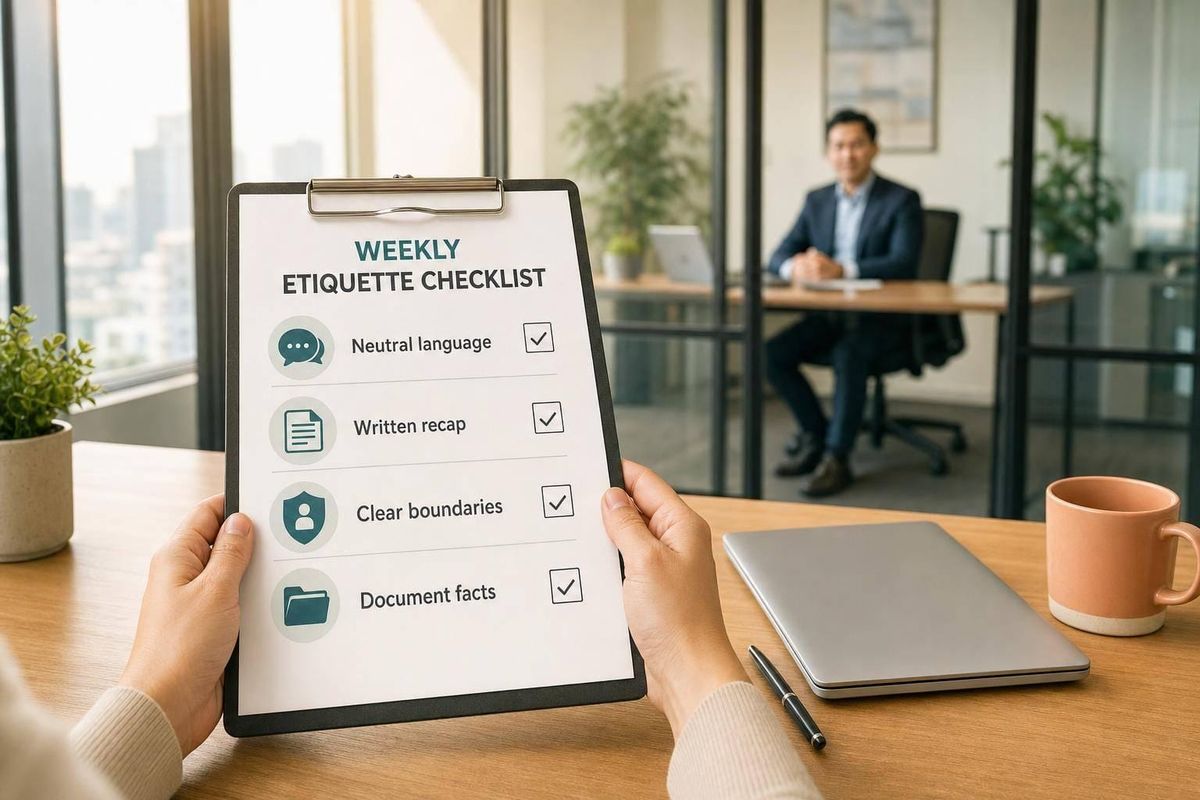
Weekly checklist to stay professional with difficult bosses: use neutral language, written recaps, clear boundaries, and factual documentation.
If your boss is hard to work with, the safest move is simple: stay calm, confirm things in writing, and keep your focus on the work. That matters because 87% of workers in one survey said they’ve had at least one toxic boss or manager.
I’d boil this down to a short weekly checklist:
- Use neutral language in meetings, email, and chat
- Confirm priorities, deadlines, and ownership in writing
- Set clear work-hour and response-time norms
- Pause before replying during tense moments
- Keep a private fact-based log if problems keep happening
- Escalate only when there’s a pattern and clear work impact
A few numbers stand out fast:
- 87% have dealt with a toxic boss
- 55%+ say miscommunication is more likely in group talks than in one-on-ones
- Only about half of workers say they clearly know what’s expected of them
- 71% say they feel pressure to answer email after hours
This article is about one thing: how I can stay professional when a boss is vague, critical, or pushes past normal limits. The core idea is simple: communicate clearly, document key points, protect my time, and stick to facts instead of emotion.
If you’re not sure exactly what kind of boss you have, check out the Boss Decoder Quiz at MyDifficultBoss.com.
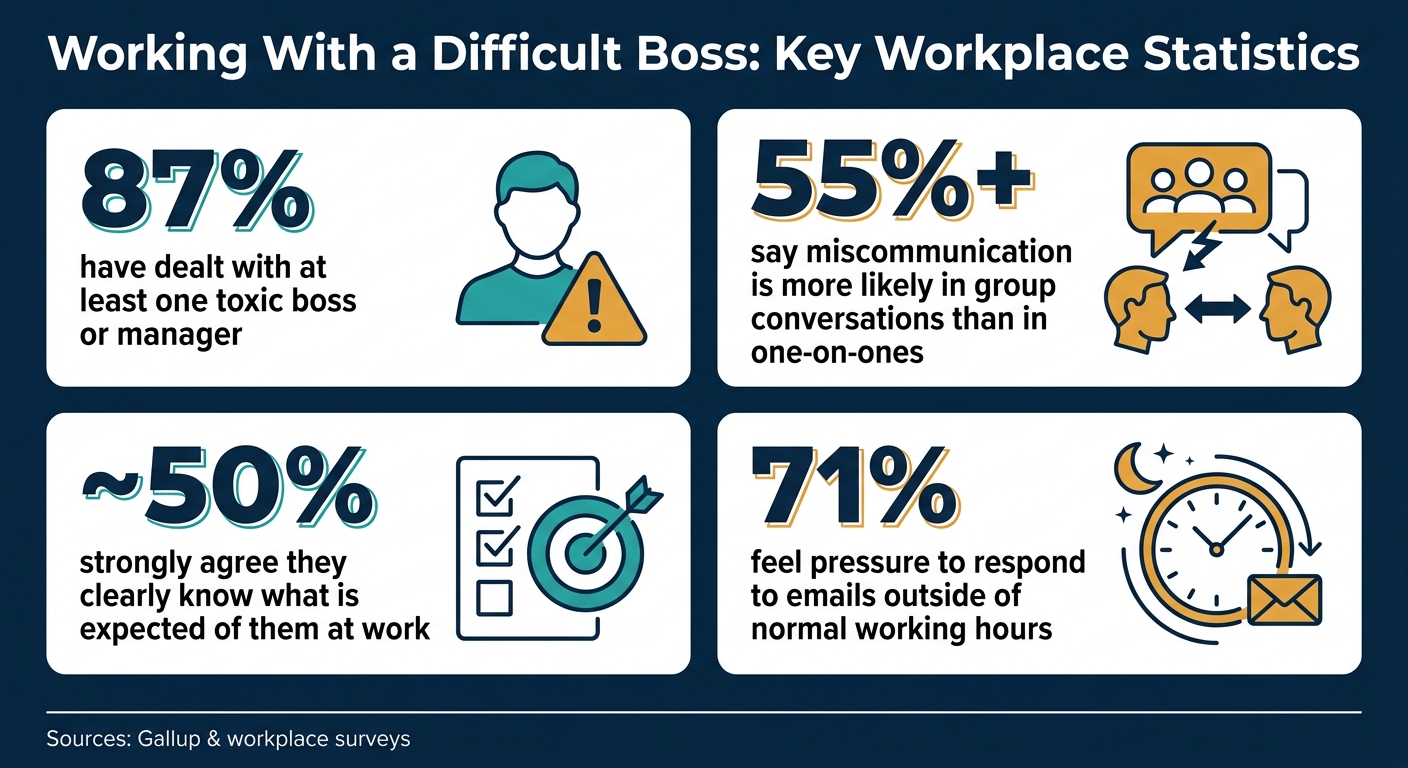
Office Etiquette Stats: Toxic Bosses, Miscommunication & After-Hours Pressure - Infographic © MyDifficultBoss.com
How to Deal with a Difficult Boss | Workplace Communication Tips
sbb-itb-1bb7cb4
Checklist for Professional Communication With Your Boss
With a difficult boss, small communication mistakes can snowball fast. The safest place to start is simple: keep your wording neutral and double-check what your boss meant.
Use Neutral Language and Confirm Understanding
Skip blunt, all-or-nothing language. Phrases like "You always change things at the last minute" or "This is ridiculous" can make your boss shut down and pull the conversation away from the work itself. A better move is to stick to the facts and show the impact: "The deadline is tomorrow, and the scope has expanded. Here are three options to handle this."
In live conversations, paraphrasing can prevent mix-ups before they turn into a mess. After you get directions, try something like: "So what I'm hearing is that the report is due by August 13, 2026, and you'd like a summary of risks in the first section - did I get that right?"
Once your wording is calm, the next step is making sure you use the right channel at the right time.
Follow Email, Chat, and Meeting Norms
Use the norms of each channel to keep your message professional.
| Communication Area | Professional | Unprofessional |
|---|---|---|
| Tone | Calm, steady, measured | Raised voice, sighing, interrupting |
| Email subject line | "Request: Approval for Q4 Budget" | "Frustrated About This Project" |
| Email body | Short paragraphs, bullet points, neutral language; use U.S. date formatting ("August 13, 2026"), state the required action and deadline clearly in the closing line | Long blocks of text, ALL CAPS, excess exclamation points |
| Chat messages | Brief, one topic at a time, sent during work hours unless urgent and previously discussed | Rapid-fire pings, emotional venting, late-night messages |
| Meetings | Arrive a few minutes early, bring notes or an agenda, notifications silenced | Late, unprepared, phone visible and active |
If you draft an email while upset, don't hit send right away. Pause for a minute and scan for emotional adjectives like "unfair", "impossible", or "ridiculous." Then swap them out for plain impact statements.
For chat, keep it short and stick to one topic at a time. Chat works best for quick updates or clarifying a detail. If the issue is sensitive, move it to email or a meeting. And if a decision gets made in chat, send a short recap so everyone is clear on what happens next.
Disagree Without Sounding Defensive
When you need to push back, do it in private and keep the focus on the work.
Bring concerns up in a one-on-one first. Over 55% of employees say miscommunication is more likely in group conversations than one-on-one, and challenging a boss in front of the team can hurt trust and your standing. A short request works well: "Could we talk through the approach to this project later today?"
From there, start by showing that you understand their point of view - "I understand you're under pressure to hit the quarter's targets" - and then move into your concern with steady language: "One concern I have is…" or "Can I offer a different angle on this?" Bring specific facts.
Checklist for Expectations, Boundaries, and Availability
Clear communication helps pin down scope, timing, and who gets to decide what. That matters even more when you're dealing with a hard-to-read or hard-to-work-with boss. Gallup data show that only about half of U.S. workers strongly agree they know what is expected of them at work. When expectations are fuzzy, small issues can turn into bigger friction fast.
Confirm Priorities, Deadlines, and Decision Authority in Writing
After a conversation, send a short recap email. Keep it simple, and end with a line that invites corrections. That gives everyone one place to check what was agreed.
For each task, list:
- Deliverable
- Owner
- Due date
- Priority
- Success metric
Also make the decision path plain. Note who approves the work, who can change the scope or deadlines, and who needs to be told if something shifts.
Before you begin, get clear on a few points: what decision the task is meant to support, who will review it, what format they want, and when your boss wants to see a draft. That kind of upfront clarity can cut down on mix-ups and rework.
Set Clear Norms for Working Hours and Response Times
Mark your working hours on your calendar, such as 8:30 AM–5:30 PM, and label that time Focus time or Busy. In Slack or Teams, even a short status can do a lot of work. Something like Heads down on client reporting until 3 PM, best via email sets expectations fast without sounding stiff.
For after-hours messages, it helps to agree on the rules in writing. Define urgent in shared terms: today’s client deliverables, outside deadlines, or outages. Everything else can wait until the next business day.
You can also set response windows, such as:
- One business day for routine messages
- Two working hours for urgent ones
Roughly 71% of surveyed workers say they feel expected to respond to emails outside normal hours. Naming the norm early can help protect your output and your well-being.
Recognize and Respond to Boundary Problems Professionally
If the same availability issue keeps popping up, treat it as a boundary problem, not a one-time ask. Normal pressure usually has a business reason and a clear end point. Boundary problems keep repeating.
Here’s the difference:
| Healthy Boundary | Problematic Request |
|---|---|
| Boss occasionally asks for weekend help on a major deliverable and offers overtime or comp time | Boss frequently sends nonurgent tasks at 10:00 PM and expects immediate responses |
| Boss occasionally reschedules a meeting to early morning because of a client's time zone | Boss routinely books 7:00 AM or 8:00 PM meetings without checking your availability |
| Temporary crunch period with a defined end date and acknowledged impact | Ongoing overload with no adjustment to scope, deadlines, or resources |
Once you notice a pattern, log it. Write down the date, time, channel, the request, and the impact on your work. Stick to neutral facts. For example:
"Three hours of Sunday overtime were required for a task pending since Wednesday"
That says a lot more than saying your boss is unreasonable.
If you need to bring the issue up, tie it to output and staying steady over time. You can say that you’re able to support occasional late nights for launches, but the current pattern of last-minute weekend requests is making it harder to do your best work during the week. Then ask to talk through planning or staffing options.
Checklist for Handling Difficult Boss Behavior Without Escalating Conflict
Even after you set expectations and boundaries, tense moments still happen. What matters then is how you respond. When a boss pushes past those boundaries, stop trying to negotiate in the moment and shift to a calm response you can document.
Pause, Regulate, and Respond to the Work Issue
In the first minute of a tense interaction, slow down your breathing, reset your thinking, and answer the work issue calmly. Before you speak, take one or two slow breaths. Inhale for about 4 seconds, then exhale for 6. While your boss is talking, write down deadlines, scope changes, and any quality concerns. In your head, name the moment in neutral terms: This is feedback about the deadline, not I'm being attacked.
When you reply, bring the conversation back to the work instead of the tone:
| Situation | What to Say Instead |
|---|---|
| Boss raises voice about a missed deadline | I hear your concern about the timeline. Let me clarify what we can deliver by Friday. |
| Boss gives conflicting instructions | To make sure I address this correctly, can we clarify the top priorities for today? |
| Boss makes a personal remark | I want to meet your expectations. Can we go over what you'd like to see in my next presentation? |
Don’t mirror a hostile tone. Don’t cut them off. And don’t start defending your character. Each time, redirect the discussion to deliverables, timelines, and quality. If the problem keeps going after the meeting, use your written recap to record what changed.
Document Key Interactions and Summarize Agreements
After a tense conversation, send a short follow-up email that same day. Keep it simple. Include four things:
- A subject line with the date and topic
- One sentence on what was agreed
- The next step, with a clear owner and deadline
- A line inviting corrections
That gives you a written record without dragging the conflict back open.
Separate from that, keep a private incident log outside company systems. This log is for spotting patterns if you need to escalate later, not for day-to-day follow-up. For each entry, include the date and time, such as 08/13/2026, 2:30 p.m.–2:45 p.m., the channel, who was there, what was said or decided, and the impact on your work. Stick to neutral, observable language. Write boss changed deadline from 08/20 to 08/18 without email notice instead of boss was unreasonable. Those facts can support you later if you need to take the issue further.
Escalate Only With Facts, Confidentiality, and a Clear Purpose
Escalate only when there’s a clear pattern and you’ve documented the business impact. Most difficult boss situations don’t need HR right away. It makes sense to escalate when direct communication has failed, the behavior keeps happening, and there is a policy issue or a clear effect on the work.
If you do move the issue forward, lead with patterns and consequences, not personality complaints. For example, point to repeated public criticism in team meetings that contributed to turnover and missed deadlines on a specific project. That lands much better than saying your boss is difficult.
Protect your privacy while you figure out next steps. Venting to coworkers can hurt your reputation, weaken your position if a formal process begins, and come across as gossip. If you need support before escalating, go to HR, your EAP, or a trusted mentor outside your reporting line.
Conclusion: Communicate Clearly, Set Boundaries, and Stay Professional
These habits keep the focus where it belongs: on the work. Use neutral language, confirm expectations in writing, and stay calm under pressure.
They still work with a difficult boss. But they only work if you're steady on your end. That means neutral language, documented agreements, and a calm, consistent approach even when things get tense.
Key Checklist Habits to Use Every Week
Use three habits each week: written recaps, neutral language, and private documentation.
Keep a private incident log with objective details. When disagreements come up, use neutral language and address the issue directly and privately first.
For recurring problems, stick to the same response pattern: pause, document, and follow up in writing. Reuse the same script, recap, and documentation habits when the same issue shows up again.
If a situation needs to be escalated, do it with objective facts, confidentiality, and a clear professional purpose.
The goal is to stay grounded, keep records, and act on facts, not frustration.
FAQs
What should I put in a private incident log?
Write down the facts from each incident: the date, time, what was happening, and exactly what your boss said or did. Stick to the behavior itself, like outbursts, unfair treatment, or moments when someone else took credit for your work.
A clear written record helps you spot patterns and triggers over time. It also gives you solid documentation if you ever need to escalate the issue.
When should I escalate a problem with my boss?
Escalation should be a last resort. Use it only when a critical decision is stuck and you need action right away to avoid major risk or a missed deadline. Before you take that step, make sure the issue can't be handled within your role.
If you do need to escalate, write down the key facts first. Include dates, times, specific incidents, and any clear pattern of unfair treatment, outbursts, or inconsistency.
How do I set after-hours response boundaries?
Separate urgent messages from everything else. If something isn’t actually time-sensitive, tell your boss you’ll reply during business hours and say when they can expect the next update.
Use short, factual status notes so people don’t keep checking in late. When needed, recap decisions or expectations the same day to keep everyone on the same page. And if you don’t have an answer yet, say you’ll look into it and follow up by a specific time.