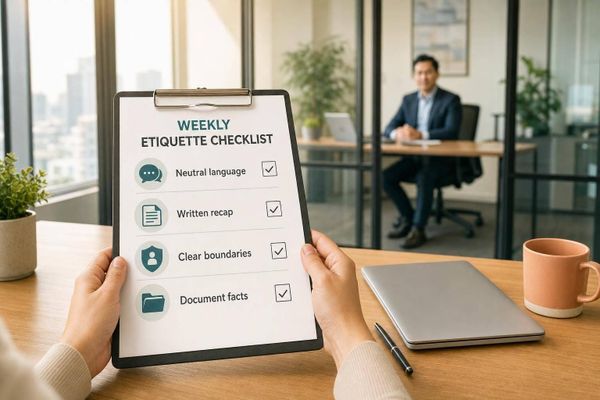
How To Hold Your Boss Accountable Professionally
Step-by-step method to document missed commitments, get measurable commitments, and escalate professionally.

Yes, you can hold your boss accountable without making it personal. I do it by sticking to facts, writing down missed commitments, asking for one clear change, and following up in writing.
If I had to boil the whole process down, it would look like this:
- Define the issue in work terms: deadlines, approvals, decisions, response times
- Track the pattern: dates, what was agreed, what changed, and how the work was affected
- Talk in private: use facts, business impact, and one direct request
- Get a clear commitment: exact due dates, reply windows, and check-in times
- Escalate only when there’s a repeated pattern: and tie it to team, client, or budget impact
Here’s the main idea: this is about doing my job well, not judging my boss as a person. A late approval that causes $1,500 in extra labor or a 2-day delay is a work issue. That’s what I focus on.
A simple way to think about it:
| What I avoid | What I do instead |
|---|---|
| “You never follow through.” | “The review missed the August 13, 2026 deadline, which delayed delivery by 2 days.” |
| Bringing up many problems at once | Focusing on one issue, one impact, and one ask |
| Verbal-only talks | Sending a written recap with owner, action, and due date |
| Escalating out of frustration | Escalating with a dated record and business impact |
The goal is simple: keep the conversation calm, specific, and tied to results. That gives me a better shot at getting the support I need and protecting my own work at the same time.
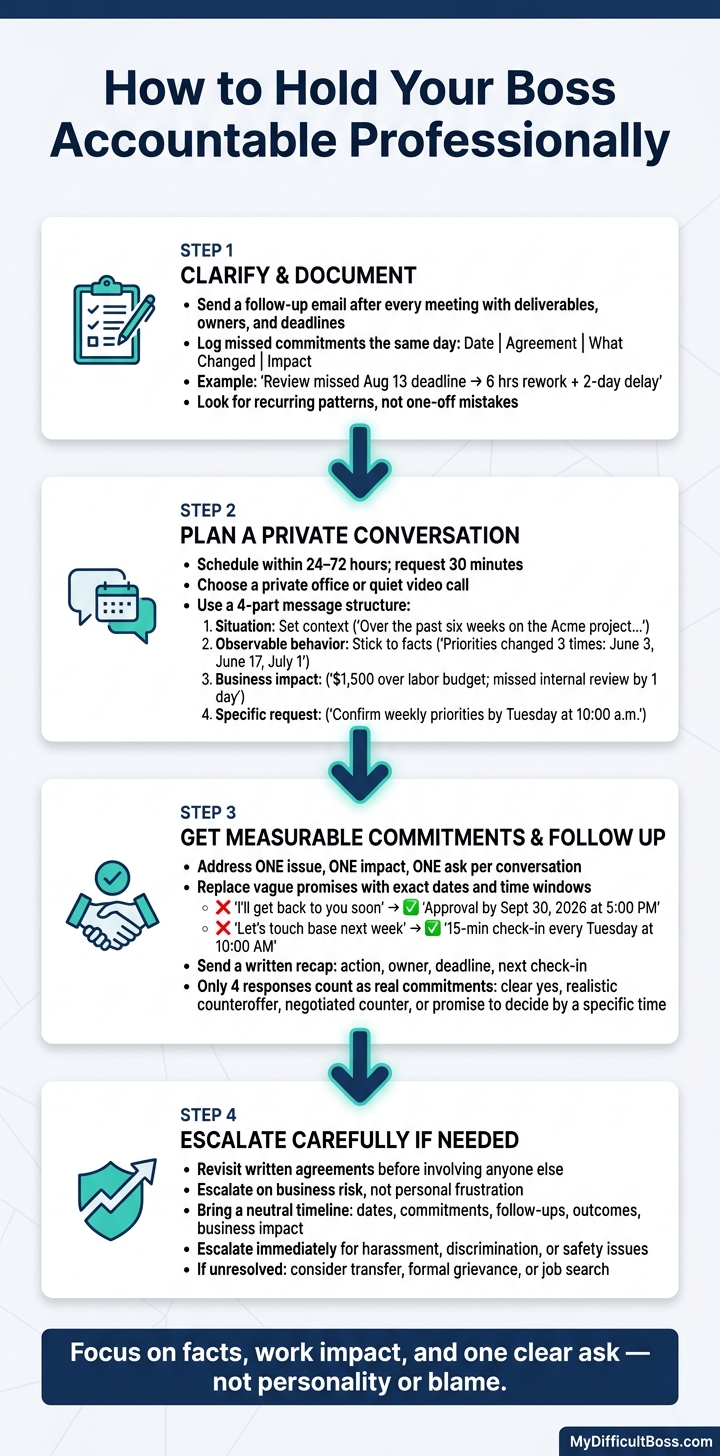
How to Hold Your Boss Accountable: 4-Step Professional Framework - Infographic © MyDifficultBoss.com
How to Hold People Accountable (Without Upsetting Them)
sbb-itb-1bb7cb4
Step 1: Clarify Expectations and Document the Pattern
Before you bring it up, put the facts in writing. That gives you a clear record of what was agreed, what shifted, and what the work impact was. It also helps you talk about the issue in a calm, businesslike way instead of sounding upset.
Confirm deliverables, deadlines, and who owns each decision
After every one-on-one or project kickoff, send a short follow-up email that same day. Keep it tight. A subject line like Summary of August 14, 2026 project kickoff makes the note easy to find later.
Inside the email, use simple bullet points for deliverables, owners, deadlines, and next steps. For example:
- Report draft: Alex owns it; due August 14, 2026.
- Client meeting scheduled for August 21, 2026 at 3:00 PM; you will present the roadmap, I will handle Q&A.
For each item, assign one owner and one date. That small detail matters. It cuts down on confusion and gives you something clear to point back to if plans drift.
Keep a dated log of missed commitments and their work impact
When a commitment is missed, write it down that same day. A simple spreadsheet works fine. Use columns like Date, Original agreement, What changed or was missed, and Impact.
For example: Review not received by August 13, 2026 deadline; proposal went out with outdated pricing; required 6 additional hours of rework and delayed delivery by 2 days.
Stick to the work impact: time lost, missed deadlines, quality problems, or coordination issues. That keeps the record grounded in facts.
Once the same issue shows up more than once, you have something solid for the conversation.
Use MyDifficultBoss.com to spot recurring boss patterns
After your log has a few entries, look for themes. Maybe it’s missed approvals. Maybe priorities keep changing. Maybe responses don't come when they’re needed. When the same kind of problem keeps showing up, it’s no longer a one-off mistake. It’s a pattern.
MyDifficultBoss.com can help you sort that out. Use the Boss Decoder to match the pattern to a boss type and get a script built for that situation. That match can help you plan a private conversation with more precision.
Your record then becomes the starting point for Step 2.
Step 2: Plan a Private, Structured Conversation
Use what you found in your log to keep the talk on track. Don’t jump in while tempers are high. Let things settle, then set up the conversation within 24–72 hours. Ask for 30 minutes this week to talk about deadlines and approvals.
Pick a private office or a quiet conference room, not a hallway or open workspace. If your team is remote or hybrid, a video call with your camera on usually works better than a phone call. You can read facial expressions, catch pauses, and keep the tone more even. Also, skip time slots right before big deadlines or late on a Friday. Bring your dated examples with you so the discussion stays concrete.
Build your message around facts, impact, and one clear request
A simple four-part structure helps you stay calm and makes your point easier to follow:
-
Situation – Set the context in a few words.
"Over the past six weeks on the Acme client project…" -
Observable behavior – Stick to what happened, not your guess about motives.
"…we've had three instances where the priorities changed after we had already started work - on June 3, June 17, and July 1." -
Business impact – Tie the issue to results.
"Each change led to rework and overtime; last week we went $1,500 over the labor budget and missed the internal review deadline by one day." -
Specific request – Ask for one concrete change.
"To avoid this, I'd like us to confirm the weekly priorities by Tuesday at 10:00 a.m. and stick to those unless the client requires an urgent change."
One specific, measurable request is much easier for a boss to say yes to than a vague ask for “better communication.” It gives both of you something clear to act on.
Write short script lines before the meeting
Before the meeting, write three short lines: a neutral opener, one factual example, and one request. That prep can save you when the pressure kicks in. It helps you avoid a shaky start or language that sounds like blame.
Start with a shared goal:
"I really value the work we're doing on the Q4 rollout, and I want to make sure I'm supporting you and the team as effectively as possible."
Then introduce the issue in a neutral way:
"I've noticed some patterns with how we're handling deadlines and approvals, and I'd like to walk through them so we can find a smoother way to work."
Avoid broad statements like "you always" or "you never." Those phrases tend to make people shut down fast. Swap them for clear observations. Instead of "You're disorganized", say, "When priorities change after work has begun, I struggle to keep the project plan accurate." This approach is especially effective if you are dealing with a micromanager who needs to feel in control of the process. That small shift - from judging the person to describing the behavior - can change the whole tone of the conversation.
Emotional confrontation vs. structured accountability talk: a side-by-side comparison
Preparation isn’t just about calming your nerves. It also shapes how the conversation lands and how people see you afterward.
| Aspect | Emotional confrontation | Structured accountability talk |
|---|---|---|
| Approach | Reactive, driven by frustration or anger | Planned, based on documented examples and a clear goal |
| Tone | Accusatory, personal, blame-heavy | Calm, factual, focused on work and outcomes |
| Likely outcome | Defensiveness, conflict, possible avoidance | Higher chance of clear commitments and improved collaboration |
| Effect on reputation | Seen as unprofessional or volatile | Seen as mature, solutions-oriented, and professionally strong |
If the boss agrees to a change, capture it in writing next.
Step 3: Ask for Specific Commitments and Follow Up in Writing
When the conversation ends, turn it into something you can measure. If you leave with vague intent instead of a clear commitment, you haven't moved much. The point of this meeting isn't to vent. It's to walk away with agreements you can track.
Address one issue at a time and connect it to work results
Use your dated log to zero in on the issue doing the most harm right now. Stick to one issue, one impact, and one ask.
For example: The Q3 budget sign-off was delayed 10 business days past the date we agreed on, July 15. Because of that delay, the vendor held pricing only until August 1, and we lost the preferred rate. Then make the ask: Can we agree that budget approvals will be completed within three business days of submission?
If there are other patterns you need to deal with, like slow email replies or canceled meetings, common traits of a ghost boss, save them for another talk. Piling on too many problems at once can make your boss shut down, and it weakens your point.
Then ask: What got in the way on your end? or How do you see it from your side? That keeps the tone cooperative, not accusatory. It can also bring out limits or pressures you didn't know about.
Agree on deadlines, response times, and check-in dates
Once your boss recognizes the issue, get specific fast. Vague intent doesn't create accountability. Dates do. Ask for exact dates and time windows, not rough estimates.
A few examples:
- For approvals: For the next proposal, which I'll send on 09/16/2026, would you be able to complete your review by end of day on 09/21/2026?
- For email replies: When I send you a question that affects same-week deliverables, can we agree that you'll respond within 24 hours, or let me know if you need more time?
- For recurring alignment: Could we set a 30-minute Tuesday check-in at 10:00 a.m. Pacific to confirm priorities?
If your boss hesitates, don't just drop the issue. Negotiate. You might say: Given your schedule, what review window is realistic - three business days, or would five business days work better? The goal is a standard that works in practice, not some ideal version that falls apart the first busy week. Keep tying the request back to results: I'm asking for specific timeframes so we avoid last-minute crunch and missed client deadlines.
If the deadline is missed, go back to the written agreement before you escalate.
Send a short recap that confirms the action, owner, deadline, and next check-in. Use a clear subject line like Summary: Acme Project Commitments. A simple format works well:
- One sentence of context
- A bullet list of what was agreed, with owner, action, and deadline
- The next check-in date
- A line inviting corrections
Use your log to confirm what was agreed. End with: Please let me know if I've missed anything - happy to adjust.
If the agreement slips, that recap becomes your record for the next step.
Vague promises vs. measurable commitments: a side-by-side comparison
Use language you can check later. If you can't check it, it isn't a commitment.
| Vague Promise | Measurable Commitment |
|---|---|
| I'll get back to you on that soon. | I will provide my approval on the final draft by September 30, 2026, at 5:00 PM. |
| Let's touch base next week. | We will have a 15-minute standing check-in every Tuesday at 10:00 AM Pacific to review milestones. |
| I'll try to look at your emails faster. | I will respond to all time-sensitive emails within 4 business hours. |
| This is Priority #1. | This project is Priority #1; Project X is paused until October 15. |
| I own the decision; you own execution. | I am the final decision-maker for the budget, and you own the execution of the vendor selection. |
Only four responses count as real commitments: a clear yes, a realistic counteroffer, a negotiated counter-offer, or a promise to decide by a specific time. Anything else doesn't create accountability.
Step 4: Escalate Carefully, Protect Your Boundaries, and Decide Your Next Move
If the pattern keeps going after your written follow-up, it’s time to move from direct talks to escalation.
Revisit prior agreements before escalating
Before you bring in anyone else, go back to your dated log and written recap. Compare those notes with what actually happened. In your next one-on-one, calmly point to the earlier commitment, the missed deadline, and the effect on the work.
This also gives your boss a fair chance to explain what changed. Maybe priorities shifted. Maybe a new issue got in the way. If so, you can reset expectations. But if the same miss happens again after that reset, you’ll have a clear record for the next step.
Escalate based on business risk, not personal frustration
One missed deadline is often a process issue. A repeated pattern that slows work, throws off coordination, or creates compliance risk is a different story.
Escalation makes sense when you can show clear impact on the business, the team, or your role. That often looks like:
- repeated missed approvals that delay project timelines
- delayed decisions that dump an unfair workload on you
- unanswered messages that affect client results
When you escalate to HR, your boss’s manager, or a skip-level leader, bring a short and neutral timeline. Include dates, commitments, follow-up attempts, the actual outcome, and the business impact. If the issue involves harassment, bullying, discrimination, safety, or other ethical or legal concerns, escalate right away through the right internal channel.
Protect your boundaries and decide your next move
While this is still unresolved, keep your paper trail tight. Confirm key requests by email. Ask for clear deadlines. Note when a decision is still pending. That protects you if unclear direction or delayed responses start causing problems that could land on your desk.
Keep requests, deadlines, and pending decisions in writing while the issue is unresolved.
If escalation goes nowhere, look at your next option with a clear head. That could mean a transfer, a formal grievance, or a job search. If the role no longer works, one of those paths may be the healthier move. MyDifficultBoss.com also offers tools for spotting boss patterns and getting ready for hard conversations.
FAQs
What if my boss gets defensive?
If your boss gets upset, don't mirror that energy or turn it into an argument. Stay calm, listen closely, and ask clear follow-up questions like, “Can you explain why you see it that way?”
Ask for specific examples, then sum up what you're hearing to make sure you understand it right. From there, guide the talk toward next steps. If you start to feel overloaded, it's fine to ask for a short break and set a follow-up so you can respond in a professional way.
When should I escalate the issue?
Consider escalating only when your boss’s indecision stalls a critical decision and you need action right away to avoid major risks or missed deadlines. Before you do that, make sure the situation actually calls for escalation and isn’t something you can solve on your own.
If escalation starts to look necessary, document specific incidents. Include dates, times, and clear details about what happened.
How do I document missed commitments?
Create a written, fact-based record. After the conversation, send a same-day recap that confirms the decision, deadlines, and the action item assigned to you.
If the commitment slips, note what changed, state the cause in neutral terms, share the new plan and timeline, and finish what you said you would do. Keep notes brief, dated, and specific so you’re not relying on memory later.