Calm vs. Reactive: Emotional Approaches in Negotiations
Use calm, fact-based negotiation: pause, present results and market data to win better pay and protect workplace relationships.

If I want better pay, staying calm usually works better than reacting on impulse. In salary talks, tone can shape the result almost as much as the numbers. The article’s main point is simple: a calm style keeps the discussion on results, market pay, and next steps, while a reactive style can shift attention to conflict and hurt both the offer and my standing with my boss.
Here’s the short version:
- Calm behavior means pausing, listening, using facts, and speaking in a steady way.
- Reactive behavior means interrupting, arguing, taking comments personally, or speaking from frustration.
- Why it matters: about 28% of U.S. workers who asked for higher pay got exactly what they asked for, and about 66% of people who negotiated got a better offer, with average gains near 18.83%.
- What helps most: bring proof of results, know market ranges, slow down, ask clear follow-up questions, and use prepared lines when tension rises.
- What to avoid: lowball panic, personal complaints, side-by-side coworker comparisons, and snap answers under pressure.
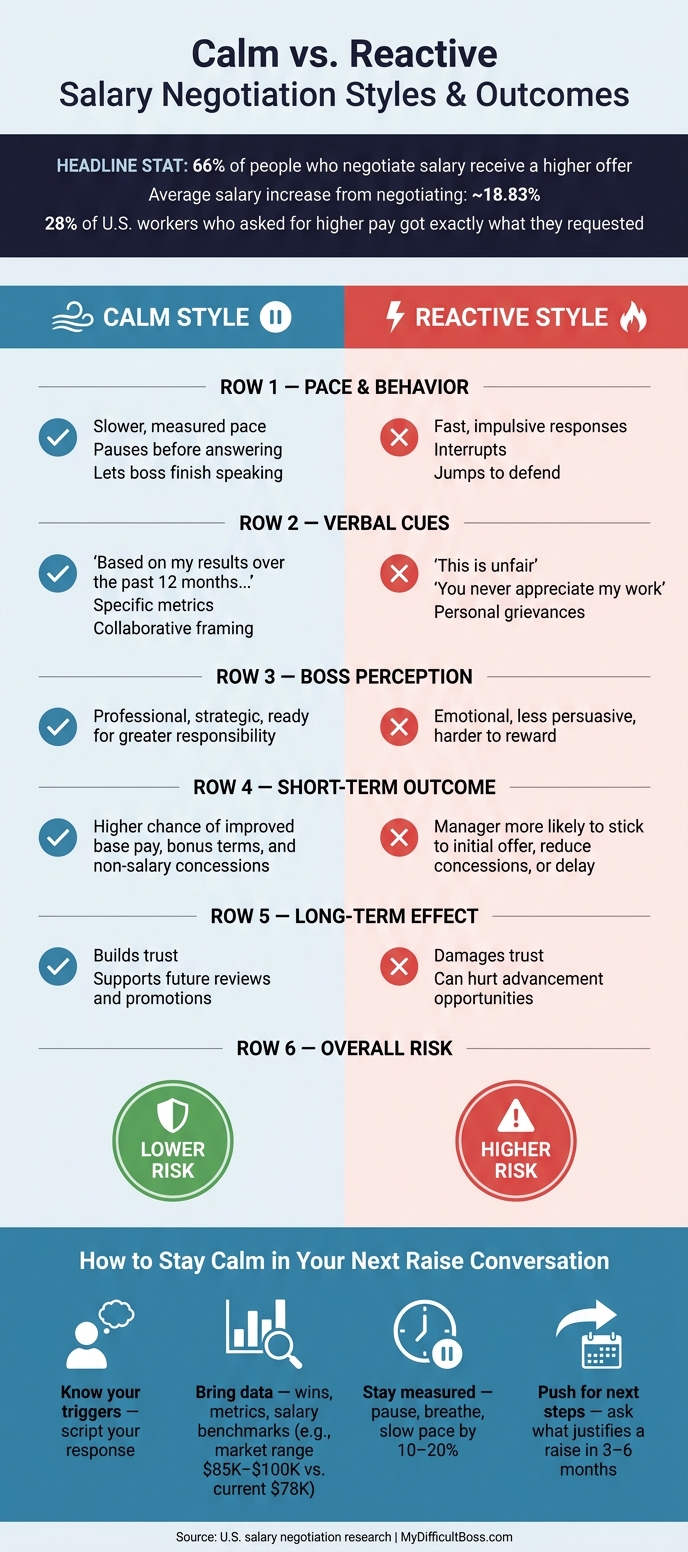
Calm vs. Reactive Negotiation: Outcomes, Behaviors & Stats - Infographic © MyDifficultBoss.com
How to Get What You Want Every Time: 3 Steps to Negotiate Anything With Anyone
sbb-itb-1bb7cb4
Quick Comparison
| Point | Calm style | Reactive style |
|---|---|---|
| Pace | Slower, measured | Fast, impulsive |
| Focus | Results, pay range, next steps | Frustration, blame, past slights |
| Boss reaction | More open to discuss terms | More likely to pull back or delay |
| Short-term effect | Better shot at improved pay or bonus terms | Lower chance of movement |
| Long-term effect | Helps future reviews and promotion talks | Can hurt later discussions |
If I boil the article down to one lesson, it’s this: emotion control is not about being passive. It’s about keeping leverage, protecting the relationship, and giving myself the best shot at a better outcome.
Calm vs. reactive: what each negotiation style looks like
These styles show up in your pace, word choice, and body language. And with a difficult boss, that can change how your request lands.
What calm behavior looks like in a raise conversation
A calm negotiator speaks slowly and pauses before answering. They let the manager finish, listen closely, and connect each point to results. Instead of saying I deserve more, they say something like: Since January, I led three projects that generated measurable revenue, and I'd like to discuss a raise that reflects that impact.
That keeps the discussion on compensation terms, not personal frustration. If a boss gets vague or dismissive - budget is tight right now - a calm person redirects the conversation: I understand. Could we review my contributions and the compensation range that fits that impact?
You can see the difference even more clearly when emotion starts to take over.
Nonverbal behavior backs this up. Calm negotiators keep steady eye contact, relax their hands, and avoid fidgeting, sighing, or looking away. They sit upright without looking stiff.
What reactive behavior looks like in a raise conversation
Reactive behavior often starts with speed. The employee answers before the manager finishes, jumps in to defend themselves, or reads a neutral comment as a personal attack. Common reactive lines include: That's not fair - I've been here longer than Sam or You never appreciate my work. The conversation moves from value to grievance almost right away.
Once that happens, the focus shifts from your performance to your reaction. And when the tone gets emotional, the manager starts wondering whether you're hard to manage - and whether you're ready for a raise.
"Don't get emotional during a negotiation… Instead, stay professional and calm."
As Yale's Justice, Equity, Diversity, and Sustainability office advises, stay professional and calm.
Here’s the quickest comparison:
| Aspect | Calm Style | Reactive Style |
|---|---|---|
| Typical behaviors | Controlled pacing, pauses before answering, stays on topic | Fast responses, interrupting, arguing every point |
| Verbal cues | Based on my results over the past 12 months..., specific metrics, collaborative framing | This is unfair, You never appreciate my work |
| Listening behavior | Lets boss finish, asks clarifying questions, paraphrases | Interrupts, focuses on rebuttal, ignores feedback |
| Boss perception | Professional, strategic, ready for greater responsibility | Emotional, less persuasive, harder to reward |
| Overall risk | Lower | Higher |
Those differences shape your leverage, which matters in the next stage of the negotiation.
How each approach affects negotiation results
Calm and reactive styles don't just feel different. They change how much room your boss gives you.
In U.S. salary negotiations, about 66% of people who negotiate their salary get a higher offer, with average increases of around 18.83%.
Why staying calm gives you more leverage
Staying calm turns the meeting into a fact-finding session, not a tug-of-war.
You can ask focused questions about compensation criteria, budget cycles, and timing. For example, you might ask what criteria the compensation committee is using this year, or what would trigger a review in 90 days. That gives you a roadmap. It also keeps the conversation from getting boxed into a simple yes-or-no answer.
Calm also gives you space to look at the full offer before you react. If a manager offers $82,000 to $86,000 and raises the target bonus from 8% to 10%, ask how the bonus is calculated before you decide what the offer means.
Why reacting emotionally can reduce your chances of a better offer
When the conversation gets emotional, managers often pull back. They may freeze the current proposal, push the decision down the road, or steer the discussion toward performance concerns instead of compensation.
Visible anger tends to backfire in particular. It is often seen as inappropriate and can lead to smaller concessions than a calm one.
The longer-term cost can matter just as much. Reactive behavior in salary talks can follow you into performance reviews and promotion decisions. Managers may become more guarded, share less context, and feel less willing to advocate for someone they see as difficult to manage.
| Aspect | Calm Approach | Reactive Approach |
|---|---|---|
| Short-term outcome | More likely to improve base pay, bonus terms, and non-salary concessions through structured questions and data | Managers are more likely to stick to the initial offer, reduce concessions, or delay decisions |
| Future relationship | Builds trust and willingness to share budget and promotion information | Damages trust and makes future negotiations tenser |
| Advancement signal | Signals strategic thinking and leadership readiness | Can raise concerns about judgment, reducing advancement opportunities |
That leverage only matters if you can hold it when the boss pushes back.
How to stay calm when your boss is difficult
Knowing that calm gives you leverage is one thing. Staying calm when your boss brushes off your work or comes in way below what you expected is another. The good news: composure isn’t a fixed trait. It’s a skill you can build before you even step into the room.
If you want a little backup before the conversation, MyDifficultBoss.com has starter scripts and practical tips to help you deal with all types of difficult bosses..
Prepare your facts before the meeting
Before the meeting, gather your recent wins and tie them to numbers. Maybe you led a project that wrapped up 3 weeks early and saved about $25,000 in overtime costs. Add your KPIs, any added scope - like taking over a former coworker’s accounts or leading a new team - and U.S. salary benchmarks for your role and city.
If similar roles in your market usually pay $85,000 to $100,000 and you’re making $78,000, that difference is your anchor - not your feelings.
Put it all into a one-page summary. Then book a meeting focused on compensation. When you walk in with that kind of backup, it’s much easier to handle pushback without getting thrown off balance.
Use in-the-moment techniques to stay composed
If your boss pushes back, slow the moment down. The point is simple: pause before you answer.
MIT Sloan negotiation research backs this up. Pausing silently can move you from a reactive state to a more reflective one, which tends to improve outcomes for both sides. In plain English, that can look like:
- taking one full breath before you speak
- slowing your pace by about 10% to 20%
- writing down key points while your boss talks
Taking notes can steady your hands and slow the pace of the conversation.
If the room starts to feel tense, don’t jump into a counterpunch. Ask a clarifying question instead. You might ask which milestones or results would support moving your salary closer to $X, or what success would need to look like over the next few months. That shift matters. It moves the discussion away from personal worth and toward clear, observable standards.
Replace emotional reactions with prepared scripts
When things start heating up, don’t wing it. Use short, prepared scripts. They help you avoid saying something in the moment that you wish you could take back.
The basic pattern is simple: acknowledge, redirect to results, and keep the conversation pointed ahead.
Here are a few scripts that fit common situations:
- When your accomplishments are minimized: acknowledge the role expectation, then restate the measurable results.
- When a lowball offer lands: thank them for the proposal, say that based on your responsibilities and market data you expected something closer to $X–$Y, and ask: "What would move the offer toward $X–$Y?"
- When you need time: say you’d like 24 to 48 hours to review the offer against market data and your responsibilities, then come back with a measured response
That last one is especially helpful when a hard-to-deal-with boss pushes for an answer on the spot. It’s not avoidance. It’s a calm, professional way to avoid an impulsive call you may regret.
Conclusion: Why calm is usually the stronger negotiation approach
Calm protects both the offer and the relationship. That matters more than most people think.
If you get reactive, you may hurt your chances of getting a raise now and make later talks harder too. The research backs this up: regulated emotions lead to better agreement and higher satisfaction, while anger, anxiety, and frustration are tied to deadlock and lower satisfaction. And when a lower-power negotiator shows anger, it often sparks anger in return and leads to fewer concessions - the exact opposite of what you want.
There’s another piece here that’s easy to miss: calm helps protect your reputation. People remember how you handle pressure. That can shape future reviews, promotions, and how seriously your manager takes you the next time money comes up.
Key takeaways for your next raise discussion
Use these four habits to keep that edge in your next raise conversation:
- Know your triggers and script your response.
- Bring data: wins, metrics, salary benchmarks.
- Stay measured: pause, breathe, use neutral language.
- Push for next steps: ask what would justify a raise in 3–6 months.
If your boss is hard to read, the Boss Decoder on MyDifficultBoss.com can help you match your response to their style.
FAQs
How can I stay calm if my boss gets defensive?
Focus on calming your physical response and moving the conversation toward clear, practical solutions. Take slow, deep breaths, keep your tone neutral, and use open body language.
Listen closely, acknowledge their frustration without taking the bait, and use "I" statements to share your point of view without blame. If things start to feel like too much, it's okay to ask for time to think before you keep going.
What should I say if the first offer is too low?
Stay calm and professional. Don’t react on emotion.
A simple way to handle it is to acknowledge the offer, then move the conversation to your value and the research you’ve done:
“I appreciate the offer. However, based on my research and the value I’ve delivered through my recent projects, I was expecting a range closer to X.”
If you want a little backup before the conversation, MyDifficultBoss.com has starter scripts and practical tips to help you ask for the pay you deserve.
When should I ask for time before responding?
Ask for time when you feel overwhelmed, need to process information, or want to avoid an impulsive emotional reaction. It shows you’re taking the discussion seriously and gives you space to respond in a calm, useful way.
You might say, "I’d like to think this over - can we discuss it tomorrow?" or "Let me check my capacity and get back to you with a realistic timeline."