Validation-Seeking Bosses: Psychological Triggers
Why bosses crave approval, how it harms teams, and research-backed steps to set boundaries, document decisions, and reduce emotional labor.

A boss who needs constant approval can drain a team fast. In plain terms, this pattern often comes from three main drivers: ego needs, self-doubt, or control. And when that happens, employees often end up doing extra emotional work just to keep things calm.
Here’s the short version:
- Some bosses chase praise because criticism hits their self-image hard.
- Some want reassurance because they feel shaky in the role or fear being exposed.
- Some use approval and image to hold power over people.
- The result is often the same: more stress, more self-censorship, and less trust on the team.
- The best response is usually simple: use clear facts, set limits, and keep a written record.
A few points stood out to me from the research in this piece:
- A study of 242 managers linked imposter feelings with higher anxiety, perfectionism, and work strain.
- Research cited in the article also ties narcissistic leadership to more employee stress, emotional exhaustion, and intent to quit.
- When a boss depends on praise, teams often shift from telling the truth to protecting the boss’s image.
If you’re trying to make sense of this kind of manager, I’d boil it down like this: the same behavior can come from different causes, but the team impact is often similar. People start overthinking emails, hiding concerns, and watching the boss’s mood more than the work itself.
Here’s a quick side-by-side view:
| Driver | What I’d expect to see | What it does to the team |
|---|---|---|
| Narcissistic traits | Praise-seeking, credit-grabbing, anger at pushback | Silence, caution, less honest feedback |
| Fragile confidence | Reassurance-seeking, second-guessing, overchecking | Slower work, lower autonomy |
| Anxious attachment | Micromanaging, constant checking, fear of exclusion | Stress, blurred limits, people-pleasing |
| Imposter feelings | Overpreparing, fear of mistakes, worry about higher-ups | Tension, delay, overwork |
| Dark Triad traits | Blame-shifting, image play, control tactics | Mistrust, fear, risk of unfair treatment |
My takeaway is simple: don’t overread the motive, respond to the pattern. Use neutral language, tie discussions to deadlines and results, and document key decisions. That won’t fix the boss, but it can help protect your work and lower the emotional drag.
Psychological Triggers Behind Validation-Seeking Bosses
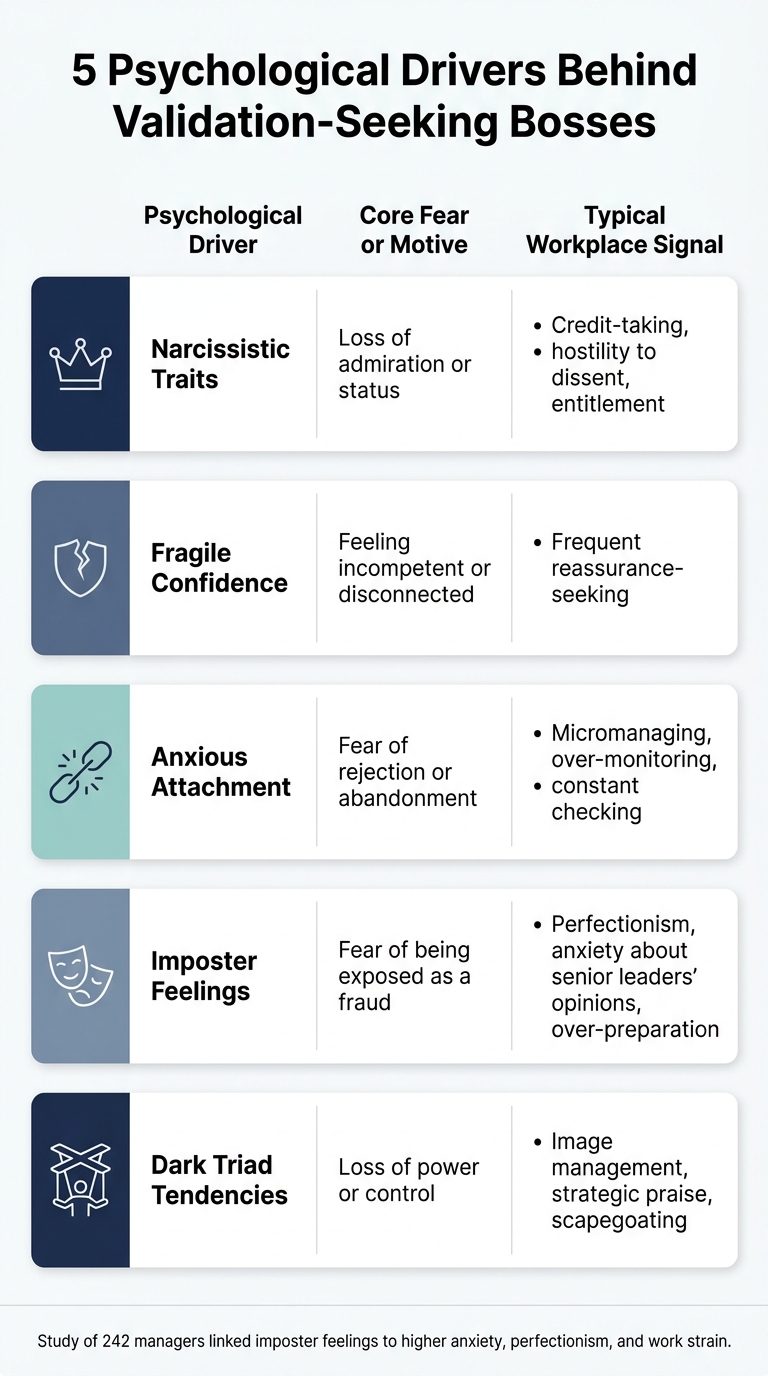
5 Psychological Drivers Behind Validation-Seeking Bosses - Infographic © MyDifficultBoss.com
Validation-seeking can come from different places. One boss wants admiration. Another is driven by self-doubt. Someone else is reacting to rejection fear or trying to protect status. On the surface, the behavior can look almost the same. Underneath, the trigger is very different.
One excellent website to check out is MyDifficultBoss.com which offers a Boss Decoder Tool, 135+ difficult boss scenarios, step-by-step solutions, dozens of starter scripts, and other long-term guidance.[
Narcissistic Traits and the Need for Admiration
Some leaders with narcissistic traits pair grandiosity with a strong sensitivity to criticism. They want praise, and they tend to react poorly when they don’t get it. At work, that often looks like constant praise-seeking, taking credit, and blaming other people when things go wrong.
Even balanced feedback can set off a harsh response. A boss may turn irritable, act guarded, or punish people in subtle ways. After a while, teams start adjusting their behavior. They soften criticism, praise the boss in public, and steer clear of open disagreement.
Psychologists describe this as a need for a steady flow of praise and attention. If that flow gets interrupted by a lukewarm review or pushback from an employee, the reaction can be far bigger than the moment calls for.
When the driver is less about praise and more about self-doubt, the pattern shifts.
Fragile Confidence, Insecure Attachment, and Imposter Feelings
A different kind of validation-seeking shows up when the issue is shaky confidence, not entitlement. Some bosses keep chasing reassurance because they doubt their ability or question whether they belong in the role. In that case, praise becomes a substitute for confidence.
Anxious attachment can make this even stronger. Leaders with this pattern may micromanage, watch people too closely, and look for constant reassurance from both senior leaders and their own teams. They may read neutral signals as rejection, which feeds even more checking, second-guessing, and control.
Imposter feelings can make the cycle worse. A validation study of 242 managers found that imposter feelings formed a distinct, unhealthy pattern tied to higher anxiety, perfectionism, emotional instability, and greater work-related strain. These managers feel like frauds even when their track record says otherwise. So they keep leaning on approval from senior leaders to quiet the fear of being exposed.
Dark Triad Tendencies and Status-Driven Control
There’s also a third pattern: status protection. Here, the goal isn’t reassurance. It’s control.
Leaders with Dark Triad traits are often driven less by insecurity and more by the need to protect power and position. Research suggests that leaders often score higher on Dark Triad traits compared with non-leaders. When status feels at risk, these traits can show up as heavy image management, calculated use of praise, and a willingness to scapegoat or intimidate to stay on top. A Machiavellian boss, for example, may use recognition like a leash - giving visibility to loyal people and withholding credit from anyone who pushes back.
The key point is simple: the same outward behavior can come from very different motives. That’s why the workplace signals matter.
| Psychological Driver | Core Fear or Motive | Typical Workplace Signal |
|---|---|---|
| Narcissistic traits | Loss of admiration or status | Credit-taking, hostility to dissent, entitlement |
| Fragile confidence | Feeling incompetent or disconnected | Frequent reassurance-seeking |
| Anxious attachment | Fear of rejection or abandonment | Micromanaging, over-monitoring, constant checking |
| Imposter feelings | Fear of being exposed as a fraud | Perfectionism, anxiety about senior leaders' opinions, over-preparation |
| Dark Triad tendencies | Loss of power or control | Image management, strategic praise, scapegoating |
sbb-itb-1bb7cb4
How Validation-Seeking Shows Up in Daily Boss Behavior
These drivers don’t stay hidden for long. They tend to show up in day-to-day behavior: praise-seeking, image management, defensiveness, and a steady need for reassurance.
Praise Hunger, Rating Obsession, and Public Image Management
A validation-seeking boss often looks for reassurance after pretty ordinary work. You might see them fishing for compliments after routine meetings, pushing for praise instead of accepting a neutral response, or pulling team recognition back toward themselves when someone else gets credit.
They can also fixate on scores, awards, and executive visibility as proof of status. That often means making choices based on what will look good to senior leaders, not what helps the team most. It can spill into tightly managed optics too: taking credit for team work in executive meetings, leaving out key contributors, or pushing employees to frame problems in a positive light instead of naming them plainly.
Defensiveness, Micromanaging, and Overreaction to Criticism
When feedback threatens this kind of boss’s self-image, the response is often out of proportion. Even a mild concern can set off instant rationalizing, visible irritation, or blame-shifting onto the team.
Micromanaging here usually isn’t just about quality. It’s often about protecting how the boss looks. They may want to review minor emails, overrule team decisions before executive meetings, or dictate exactly how work should be done so the final result reflects well on them. This tends to get worse in high-visibility moments, like senior-leader presentations or quarterly reviews.
Seeking Approval from Above and Reassurance from Below
The pattern moves in both directions.
Upward, the boss keeps managing impressions with senior leadership. That can look like putting energy behind projects that impress certain executives, asking how they came across after presentations, or casually bringing up ties to senior leaders.
Downward, employees can get pulled into an emotional support role they never signed up for. The boss may want repeated affirmation of their decisions and may treat people as disloyal if they don’t cheer enthusiastically. Research on insecure attachment and narcissistic vulnerability describes this as ongoing reassurance - using employees' admiration to buffer feelings of inadequacy.
| Direction | What the Boss Does | What Employees Experience |
|---|---|---|
| Upward (toward executives) | Impression management, credit-claiming, mentioning connections to senior leaders, visibility chasing | Last-minute pivots, uneven resource allocation, team contributions go unrecognized |
| Downward (toward employees) | Approval-testing, loyalty expectations, emotional boundary-blurring | People-pleasing pressure, self-censorship, emotional labor beyond job scope |
Over time, these patterns start shaping stress levels, work standards, and whether people feel safe speaking up.
Effects on Employees, Teams, and Performance
Employee Stress, People-Pleasing, and Burnout Risk
Those daily approval demands come with a real cost. Working for a boss who constantly needs validation can wear people down, even when the workload itself is light. The pressure isn't just about getting the work done. It's about managing the boss's mood and staying on the right side of it.
That pressure shows up fast in day-to-day behavior. Employees become hypervigilant, watching for signs of approval or backlash. They overprepare for routine meetings, rewrite simple emails, delay decisions, and slip into people-pleasing just to avoid a negative reaction. Research on narcissistic leadership shows that employees report higher stress, emotional exhaustion, and intentions to quit, even when their actual workload isn't extreme. Over time, a sense of safety gets tied to keeping the boss reassured.
Once that pattern takes hold, the fallout doesn't stay limited to one person.
Distorted Standards, Reduced Psychological Safety, and Ethics Concerns
At the team level, this pattern bends standards and chips away at psychological safety. Narcissistic leaders reduce psychological safety, which makes people less likely to share information or admit mistakes. If a boss's self-worth depends on admiration, honest feedback starts to dry up.
The standard shifts from value to image. Teams start polishing minor updates, cherry-picking data, and hiding near-misses to make the boss's area look clean. In that kind of setting, appearance management gets rewarded more than actual results. That can drain morale for the people doing the deepest work. And when that happens, collaboration and performance drop.
Research-Informed Ways to Respond and Key Takeaways
Use Structure, Neutral Feedback, and Clear Bounds
Once you can see the pattern, the next move is simple: lower the emotional charge and protect your record of what happened. That usually means brief, fact-based communication tied to deliverables, deadlines, and metrics.
In day-to-day work, that can look like confirming expectations in writing after meetings and sending clear status updates instead of vague check-ins. It also helps to give acknowledgment that is narrow and specific, not broad or flattering. For example: The client approved the revised timeline, and the launch risk is now low. Then mark the result once and move the conversation forward: "I've captured your priorities in the notes below; please let me know by noon if anything is missing."
If a boss reacts badly to criticism or to anything that feels unclear, neutral wording can keep things from spiraling. Focus on impact, not motive. For example:
"Frequent priority changes make deadlines harder to meet; can we agree on a weekly priorities list?"
That keeps the exchange professional. It also creates a written record if the issue later needs to be escalated.
Match Your Response to the Likely Psychological Driver
The same outward behavior can come from different motives. So the best response depends on the pattern you’re dealing with, not just the surface behavior.
| Psychological Driver | Common Boss Behaviors | Likely Employee Impact | Evidence-Informed Response |
|---|---|---|---|
| Narcissistic traits | Craves admiration, takes criticism personally, protects public image | Employees self-censor and avoid honest feedback | Use specific praise only when earned, keep feedback fact-based, avoid public confrontation |
| Insecure attachment | Frequent check-ins, reassurance-seeking, fear of being excluded | Constant interruptions, emotional labor, blurred boundaries | Set predictable updates, answer the same way each time, don't absorb their anxiety |
| Imposter-driven reassurance-seeking | Micromanaging, overchecking work, sensitivity to mistakes | Lower autonomy, second-guessing, slower output | Use concrete evidence and document decisions |
| Dark Triad tendencies | Manipulation, blame-shifting, strategic charm, control tactics | Anxiety, mistrust, risk of unfair treatment | Document everything, keep communication strictly work-related |
With Dark Triad patterns, paper trails matter. Document key decisions, scope changes, and approvals. If blame starts shifting later, stay grounded in the approved version of events.
When Specialized Tools Can Help
Sometimes you need help in the moment, not just theory. A guided tool can make the next step clearer.
MyDifficultBoss.com offers the Boss Decoder, 135+ difficult boss scenarios, step-by-step solutions, starter scripts, and long-term boundary guidance.
FAQs
How can I tell insecurity from narcissism?
It often comes down to what drives them and how they respond.
An insecure boss is usually acting from anxiety, fear of failure, or pressure from higher up. That can show up as micromanaging, second-guessing your work, or needing to stay in control of every small detail.
A narcissistic boss, on the other hand, is more driven by control, praise, and validation. They may take credit for your work or put you down to protect their position.
When should I document my boss's behavior?
Document your boss's behavior when you need to spot patterns, track inconsistencies, or get ready in case the issue needs to move up the chain.
Write down the specific facts of each incident: the date, time, what was happening, and what your boss said or did. That includes outbursts, unfair treatment, or taking credit for your work. The goal is simple: create a clear record instead of relying on memory alone.
Over time, those notes can show patterns. You may notice certain triggers, like tension around budget reviews or team meetings. A written record can also help you show where your contributions were overlooked or claimed by someone else.
What if setting boundaries makes things worse?
If setting boundaries seems to add tension, change the approach. Move from confrontation to collaboration. Skip ultimatums, and frame your needs as solution-focused requests that also support your boss’s goals.
If things still feel volatile, document agreements clearly and lean on data to keep conversations professional and objective. MyDifficultBoss.com offers starter scripts and response strategies to help you protect your boundaries without creating extra conflict.