How to Deal With an Absent Boss (When Your Manager Is Never Around)
Practical strategies for handling an absent boss: schedule check-ins, document work, build a support network, and escalate or seek new roles if needed.

When your boss is never around, it can leave you without direction, support, or clear priorities. The risk is either overstepping or falling behind while trying to figure things out on your own. Here are practical ways to take control, communicate effectively, and succeed even with an absent manager.
Working with an absent boss can be frustrating, but you can still manage your workload effectively. Here’s the short version:
- What is an absent boss? Someone who’s either unavailable or disengaged, leaving you without guidance, feedback, or approvals.
- How it impacts you: 42% of employees report lower morale, and 59% face productivity challenges. Career growth can also stall due to lack of mentorship or recognition.
-
Key strategies to manage:
- Schedule regular check-ins and insist on keeping them.
- Document your work and communications to create a paper trail.
- Build a support network within your organization for guidance.
- Use tools like the Boss Decoder Tool for tailored advice.
If the situation doesn’t improve, consider escalating the issue or exploring new job opportunities. For detailed strategies and conversation scripts for dealing with an absent boss, visit MyDifficultBoss.com.
How To Handle a Absent Boss
How to Identify an Absent Boss
An absent boss is someone who consistently shows a lack of availability or engagement, making it hard for you to get the support you need to do your job well. Spotting these patterns of disengagement is the first step toward addressing them effectively. If you’re unsure, the Boss Decoder Tool can help you identify these behaviors.
Missing or Minimal Communication
One of the most obvious signs of an absent boss is poor communication - or virtually no communication at all. Emails might go unanswered for days or even weeks. Chat messages could be left on read, and requests for feedback might be met with vague, unhelpful comments like, "Just keep doing what you're doing." Sometimes, they’ll even deflect responsibility with remarks like, "You know the job better than I do." These behaviors often indicate a lack of mental or emotional investment in their role as a leader.
"Because the boss has no idea what you are working on, he cannot deliver any specific feedback or affirmation." – Brian de Haaff, CEO, Aha
Beyond communication, a lack of clear direction is another hallmark of an absent boss.
No Clear Direction or Goals
An absent boss often leaves their team without a clear sense of direction. They fail to set priorities or define strategies, leaving you to guess what’s important. Constructive criticism? Rare. Positive reinforcement? Even rarer. This lack of guidance can leave you unsure if you’re meeting expectations. When higher-ups ask about progress, these bosses frequently have little to report, as they lack the necessary insights into their team’s work. Worse yet, they may delegate tasks without providing enough authority or context, leading to confusion and misalignment with the organization’s broader objectives.
But it doesn’t stop there. Their absence becomes even more apparent when meetings are consistently canceled or avoided.
Rarely Available for Meetings
Another major indicator is chronic unavailability for meetings. An absent boss might frequently cancel one-on-ones or team check-ins, leaving you with few opportunities for meaningful interaction. They may vanish for long periods, offering vague reasons like "working from home" or "in meetings", with little follow-up afterward. When they do show up, it’s often at the last minute, demanding immediate updates and catching you off guard. Some even exclude you from critical leadership or strategy discussions where your input is essential. According to Gartner, managers today have 51% more responsibilities than they can realistically manage, which might explain some of this behavior - but it doesn’t make it any less damaging to your productivity.
How an Absent Boss Affects Your Work
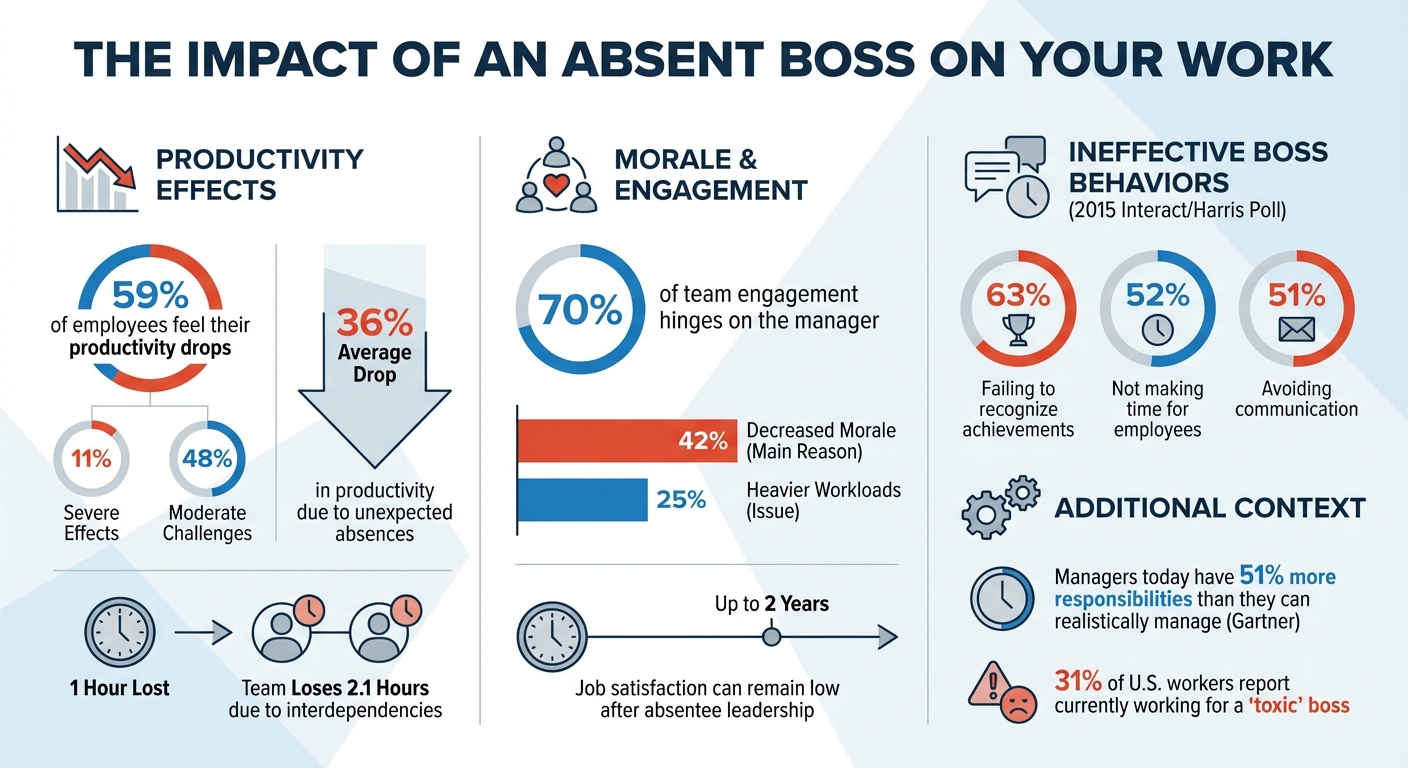
How Absent Bosses Impact Employee Productivity and Morale: Key Statistics - Infographic © MyDifficultBoss.com
An absent boss can throw a wrench into both your daily responsibilities and long-term career trajectory. Recognizing these challenges highlights the importance of taking proactive steps to navigate this tricky situation.
Effects on Your Productivity
When your manager is unavailable, it often feels like you're left to navigate without a map. Brian de Haaff, CEO of Aha!, explains the issue perfectly:
"Because the boss never has time to focus on strategy, you are left without an agreed-upon roadmap for your work... The result: Plenty of aimless wandering and a gnawing sense of anxiety."
This lack of direction can significantly impact productivity. A survey by Robert Half revealed that 59% of employees feel their productivity drops when their boss is absent, with 11% noting severe effects and 48% reporting moderate challenges.
It gets worse when decisions are needed. Waiting days - or even weeks - for responses from an absent boss can delay your progress or force you to act without approval. Studies show that unexpected absences can lead to a 36% drop in productivity on average. The ripple effect is striking: for every hour of lost work by one individual, the team loses 2.1 hours due to interdependencies. These disruptions don’t just slow work - they also take a toll on team morale.
Impact on Team Morale
An absent manager doesn’t just affect tasks - it shakes the entire team dynamic. Since 70% of team engagement hinges on the manager, their absence often leads to a noticeable dip in morale. In fact, 42% of employees in one survey cited decreased morale as the main reason for productivity declines under an absent boss, while 25% pointed to heavier workloads.
Without leadership, unresolved workplace issues can fester, and resentment builds as certain team members end up carrying more weight. Jason Cortel, Director of Global Workforce Management, captures this perfectly:
"opens the door for bullies to run the playground."
The emotional impact is significant. Studies suggest that job satisfaction can remain low for up to two years after working under absentee leadership. Teams are left grappling with unclear roles, elevated stress, and a sense of disconnection. Beyond morale, this absence can also derail your professional growth.
Risk of Career Stagnation
One of the most damaging effects of an absent boss is the potential for stalled career progress. These managers rarely advocate for their employees during promotions or opportunities for advancement. A 2015 Interact/Harris Poll of 1,000 U.S. workers found that the top three ineffective boss behaviors were all tied to absence: failing to recognize achievements (63%), not making time for employees (52%), and avoiding communication (51%).
Without consistent feedback or mentorship, it becomes harder to grow your skills or get the recognition you deserve. You’re left questioning whether you’re meeting expectations, with no clear guidance on how to move forward - or someone to champion your career within the company.
For practical advice, conversation tips, and strategies tailored to this situation, have a look here.
Practical Strategies for Managing an Absent Boss
When your boss is rarely available, it’s important to take charge of the situation instead of waiting for them to step in. By being proactive, you can secure the approvals, feedback, and guidance you need to stay on track.
Schedule Regular Check-Ins
Make recurring one-on-one meetings a priority and treat them as non-negotiable. If your boss cancels, reschedule immediately to keep communication consistent. Sending a clear agenda before each meeting can help focus the discussion on critical items like approvals, feedback, and strategic decisions. Jennifer Winter suggests highlighting key action items at the top of your communication to ensure they aren’t missed.
Keep Records of Your Work
Keeping a detailed record of your work is essential when your boss is frequently unavailable. Regular updates via email not only create a paper trail but also demonstrate that you’ve flagged issues and completed tasks on time. As Jennifer Winter notes:
"The one time you need that back-up email that shows you did everything right, you'll never worry about over-communicating again."
After any interaction, even brief ones, follow up with a summary email to confirm deliverables, deadlines, and priorities. Additionally, maintain a log of your accomplishments, including metrics, testimonials, and links to major projects. This documentation can be a powerful tool during performance reviews or when advocating for a promotion.
If direct communication with your boss proves difficult, consider turning to other resources within your organization for guidance.
Build a Support Network
When reaching your boss directly isn’t effective, look for alternative sources of support. Identify people who have your boss’s attention, such as an executive assistant, senior colleagues, or another leader in the company. Dana Brownlee emphasizes the importance of building relationships with key individuals:
"Administrative professionals hold significant influence, so it never hurts to befriend them. They also might be able to give you valuable advice about how to best manage the boss."
You can also ask your boss to appoint a peer or another leader as a temporary point of contact for urgent matters. If career guidance from your manager is lacking, seek out mentors in other departments or professional networking groups. Additionally, senior teammates can offer valuable feedback and help you identify growth opportunities that might otherwise go unnoticed. These relationships not only fill the gap left by an absent boss but can also increase your visibility within the organization.
Using MyDifficultBoss.com Resources for Tailored Solutions
Dealing with an absent boss can feel isolating, but it doesn’t have to be. My Difficult Boss offers a robust set of tools specifically designed to help employees navigate this exact challenge. From conversation scripts to step-by-step strategies, the platform delivers personalized guidance tailored to your unique situation. These resources work hand-in-hand with the proactive strategies already discussed. For more details, including scripts and strategies for handling an unavailable boss, visit their dedicated page here.
Use the Boss Decoder Tool
The Boss Decoder Tool is a quick, interactive quiz that takes just three minutes to complete. This tool helps to identify your boss type - including "The Ghost", the manager who’s rarely around. Once you finish, you’ll receive a personalized playbook packed with strategies to help you speak up, set boundaries, and communicate more effectively. It also provides clear dos and don’ts to guide your interactions. With 31% of U.S. workers reporting they currently work for a "toxic" boss, having a customized plan can make a world of difference.
Get Conversation Scripts and Step-by-Step Solutions
One of the standout features of the My Difficult Boss site is its collection of ready-to-use conversation scripts. These scripts are designed to help you professionally address issues like missed deadlines or lack of support, breaking down complex problems into clear, behavior-focused discussions. The platform also prepares you for various responses, offering strategies to handle dismissive or unhelpful reactions with confidence. For more targeted advice, check out the Ghost Boss resources here.
Browse the Full Resource Library
If your challenges go beyond basic communication, the My Difficult Boss website’s extensive resource library has you covered. With over 135 scenarios addressing different boss behaviors, the platform is a treasure trove of solutions. It even includes specialized tools like the "Get a Raise" toolkit and interactive 24/7 role-play sessions to help you prepare for difficult conversations. Whether you’re tackling a one-time issue or planning your long-term career approach, these resources offer ongoing support as your situation evolves.
Take advantage of these tools to address your current challenges, and keep evaluating your options to effectively manage your absent boss.
Evaluating Your Long-Term Options
Even with your best efforts, an absentee boss might not change. So, how can you safeguard your career in the long run? Research indicates that job satisfaction tends to decline over two years when working under an absentee leader. Setting a clear timeline to assess the situation can help you make informed decisions about your career.
Track Changes Over Time
Start by keeping a detailed log of your interactions with your boss. Record the date, time, communication method (email, phone, messaging), and the purpose of each outreach. This creates a clear timeline that shows whether your boss is becoming more engaged or continuing to stay unresponsive. Pay attention to response times for important matters and note any shifts in behavior. Also, track how often one-on-one meetings are scheduled versus how many are canceled, skipped, or feel rushed and impersonal. If things don't improve, this documentation can serve as evidence should you need to escalate.
Career consultant Jennifer Winter highlights the importance of this approach:
"Filling your boss in on everything that's going on may seem like overkill, but think of it as insurance. The one time you need that back-up email that shows you did everything right, you'll never worry about over-communicating again".
If improvements are lacking, these records will be essential for taking further action.
Escalate When Needed
If your tracking shows no progress after a reasonable timeframe, it might be time to escalate the issue. Use your records to support your case when addressing concerns with HR or upper management. Focus on specific challenges, such as delays in approvals, misaligned goals, or the lack of feedback. Strategist Genevieve Conley Gambill explains:
"If you really do need your manager to act, [overcommunicating] can force a discussion about the issue... you'll have the documentation to show that you identified and flagged the issue to them proactively. This can be valuable if you later need to escalate the issue to their manager or even to HR".
Before escalating, consult with a trusted mentor or senior leader for advice. If escalation doesn’t lead to meaningful change, it may be time to reassess your position within the company.
Consider Looking for New Opportunities
Sometimes, the best choice is to explore new opportunities. Dina Smith of Fast Company puts it plainly:
"Absentee bosses represent the extreme and worst of laissez-faire leadership. Your boss is arguably the one person in your company with the most influence over your future promotion".
If your manager’s lack of support is hindering your growth and career trajectory, consider internal transfers or external roles. Networking with senior leaders can help you identify internal opportunities. If you decide to pursue new roles outside the company, your performance log - detailing your achievements, metrics, and endorsements from stakeholders - can serve as compelling evidence of your impact, even in challenging circumstances.
As Gambill advises:
"It's not worth it to stick in a situation where you can't get the basic support you need to succeed".
For more in-depth advice, including conversation tips and situation-specific strategies, visit this resource.
Conclusion
Managing an absent boss can be tough, but it’s not impossible if you take charge of your work and communication. Research highlights that frequent interaction is the strongest predictor of satisfaction with leadership. So, if your boss isn’t reaching out, it’s on you to create those opportunities. Schedule check-ins, document your work, and lean on a supportive network to stay on track.
This challenge is also a chance to grow your leadership skills. As Mary Schaefer, MHRM, puts it:
"Compensate for the lack of support from your supervisor... Be your own manager. In this way, you are also honing your leadership skills, because you're leading yourself".
By stepping up, you’re not just keeping things running - you’re showing that you’re ready for more responsibility. Employers notice self-direction and initiative, so use this as an opportunity to shine.
Make sure to document your accomplishments, decisions, and communications. This not only protects you but also provides a solid record for performance reviews or escalation if needed.
If you’re looking for even more strategies, conversation scripts, or expert tips, visit MyDifficultBoss.com. The site offers over 135 scenarios and specific guidance for handling a “ghost boss.” Check out their dedicated page for dealing with an absent managers. It’s packed with tools to help you manage these tricky situations with confidence.
FAQs
How do I get quick approvals when my boss won’t respond?
To speed up approvals, focus on managing up by ensuring your requests align with your boss's key priorities. Use a mix of communication methods - like email, phone calls, and messaging apps - to keep your requests visible. Suggest clear deadlines or propose short meetings to encourage quicker responses. For more detailed strategies and conversation examples, check out resources on working with unavailable managers or tools like the Boss Decoder Tool to enhance communication and get timely approvals.
What should I document to protect myself with an absent boss?
To safeguard yourself when navigating the challenges of working with an absent boss, make it a priority to document important interactions. This includes tracking your attempts to communicate - like emails, messages, or meeting requests - as well as any instructions or decisions they share with you. Additionally, maintain detailed records of your work and any efforts you make to seek guidance or clarification. Having this documentation ensures there's a clear record to refer back to if questions about your performance or communication come up later.
When should I escalate an absent boss to HR or leadership?
If your boss’s absence or lack of communication is seriously affecting your ability to work or your well-being, it’s time to escalate the issue. This could involve situations like ongoing unresponsiveness, a lack of direction, or obstacles that prevent you from completing tasks.
Before taking this step, try addressing the problem directly with your boss or using strategies from resources like the My Difficult Boss website. However, if these efforts don’t resolve the issue and it’s causing stress or dissatisfaction in your job, escalating the matter to HR or higher leadership becomes essential. Remember, your work performance and mental health should always come first.