How To Push Back On Micromanagement Without Conflict
Set clear boundaries with a micromanaging boss using documentation, structured updates, and a low‑conflict conversation plan.

Micromanagement can drain your confidence, disrupt your workflow, and even lead to burnout. While addressing it feels tricky, you can set boundaries without escalating tensions. Here's how:
- Spot the signs: Frequent check-ins, excessive approvals, or redoing your work unnecessarily.
- Self-check first: Ensure missed deadlines or errors on your part aren’t triggering the behavior.
- Document patterns: Keep a detailed log of incidents showing how they impact your work.
- Reframe the conversation: Focus on collaboration, not confrontation. Suggest solutions like structured updates or decision-making frameworks.
- Understand your manager’s pressures: Address their concerns by offering reassurance and clarity.
- Propose small changes: Test new approaches, like weekly updates instead of daily interruptions.
- Build trust over time: Consistent performance and proactive communication can shift the dynamic.
It’s also also helpful to use tools at websites like MyDifficultBoss.com which provides scripts and strategies for dealing with bosses who micromanage.
If these steps fail, consider escalating the issue or involving HR. The key is balancing respect with clear communication to improve the situation.
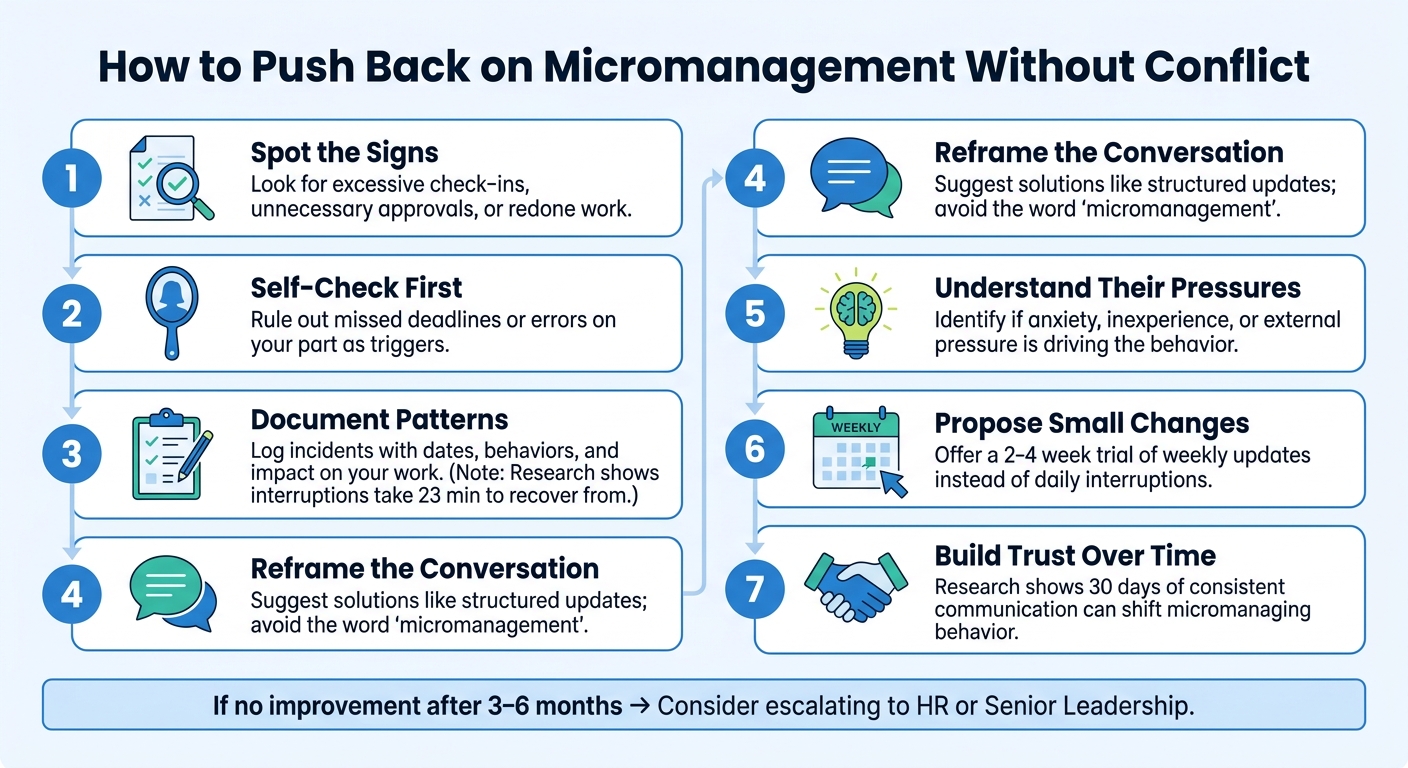
How to Push Back on Micromanagement: A Step-by-Step Guide - - Infographic © MyDifficultBoss.com
How to Spot Micromanagement and Understand Its Effects
Common Signs of Micromanagement
Micromanagement often follows predictable patterns. One of the clearest signs is excessive status checking - think multiple updates requested in a single day or early-morning messages about work you submitted the night before. Another red flag is needing approval for decisions that fall squarely within your role, which can stall progress and divert attention from meaningful tasks. Then there’s the classic fly-in, fly-out behavior: a manager stays hands-off during most of a project but swoops in at the last minute with vague, unhelpful critiques that were never mentioned earlier. A final telltale sign? When completed work is redone, not because it’s incorrect, but to suit the manager’s personal preferences.
"Micromanaging creates a transactional relationship in which the manager fixates on minor mistakes and focuses on a person's weaknesses and work style."
Spotting these patterns can help you reflect on how they might be affecting your own work habits.
Checking Whether You're Part of the Problem
Before jumping to conclusions, it’s worth asking if your own actions might have triggered closer oversight. Have you missed deadlines? Submitted work that required major corrections? Gone long periods without updating your manager? These lapses can sometimes heighten a manager’s anxiety, leading to more scrutiny - even if their reaction feels over the top.
Julie Zhuo, author of The Making of a Manager, highlights this connection:
"The manager who micromanages is often more anxious than controlling. The anxiety drives the behavior, and the behavior is often responsive to information rather than to autonomy requests."
If your self-assessment reveals no major issues, the micromanagement is likely rooted in your manager’s habits or insecurities rather than your performance. Understanding this distinction is key because it shapes how you approach the situation. Once you've evaluated your role, start documenting the behaviors you’ve noticed.
How to Document Micromanagement Patterns
After ruling out performance issues on your end, the next step is to keep a record of micromanagement incidents. For each instance, include the date, describe the behavior, and explain its impact on your work. For example:
"On May 5, manager requested three status updates on the same report between 1:00 PM and 3:00 PM, disrupting focus and delaying completion by two hours."
This kind of detailed log is far more effective than venting vague frustrations.
Interruptions can have a measurable impact. Research shows that it takes an average of 23 minutes to refocus after a single interruption. Over time, these disruptions can create significant productivity losses, which your documentation will help highlight. Track these patterns consistently over two to three weeks to determine whether the issue is temporary or ongoing.
Here’s a quick comparison to help you distinguish between normal oversight and micromanagement:
| Healthy Oversight | Micromanagement |
|---|---|
| Focuses on outcomes and clarifies what "done" looks like | Dictates every step, down to minor details |
| Relies on scheduled 1:1s or weekly updates | Demands constant, unscheduled updates throughout the day |
| Encourages independent decision-making | Requires approval for minor decisions and insists on being CC'd on all emails |
| Provides coaching to improve future work | Rewrites completed work based on personal preference |
| Removes obstacles to help the team work efficiently | Creates bottlenecks that slow progress |
Having a clear record of these patterns will prepare you for a constructive conversation about setting boundaries.
sbb-itb-1bb7cb4
How to Prepare a Low-Conflict Pushback Plan
Getting Your Mindset Right Before the Conversation
Before you approach your boss, take a moment to adjust your mindset. Research from 2023 highlights that micromanagement often stems from a manager's anxiety about outcomes they’re responsible for but can’t directly control. This understanding can help you reframe the situation and focus on offering reassurance instead of confrontation. As Kim Scott, author of Radical Candor, explains:
"The conversation that moves a manager from controlling to delegating is rarely the conversation where the employee asks for more autonomy. It is the conversation where the employee asks how the manager wants to be informed."
Rather than aiming to "win" the discussion, your goal is to build trust so your manager feels comfortable delegating. With this in mind, shift your frustrations into constructive and specific requests.
Turning Complaints Into Clear Requests
Instead of venting your frustrations, focus on presenting actionable solutions. Avoid using the term "micromanagement", as it often puts managers on the defensive. For example, rather than saying, "You check in on me too much", suggest, "How about I send you a daily end-of-day summary to keep you updated on progress?" This approach addresses the same issue but in a way that feels collaborative.
Frame your requests as ways to save your manager time or improve visibility - this makes them easier to accept. For instance, you can ask, "Which decisions should I handle independently, and which ones need your input?" Questions like this not only clarify expectations but also help build a more balanced working relationship. Next, consider what your manager might be dealing with to further refine your approach.
Understanding What Your Boss Is Dealing With
Managers often face pressures you might not fully see. Tight deadlines, accountability to leadership, or even their own insecurities can drive their need for close oversight. Before your conversation, think about what might be influencing their behavior. Are they a newer manager struggling to delegate? Are they under pressure from a high-stakes project? Understanding these factors allows you to frame your requests in a way that addresses their concerns. For instance, saying, "I’d like to take more off your plate" is much more effective than "You need to back off".
Here’s a quick guide to different types of micromanagers and how to approach them:
| Micromanager Type | What's Driving It | Best Approach |
|---|---|---|
| Anxious Micromanager | Fear of failure or looking bad to leadership | Offer proactive updates to build trust |
| New Manager | Struggles with delegation; misses hands-on work | Be patient and help them feel confident delegating |
| Control-Focused | Prefers involvement for its own sake | Set firm boundaries; escalation may be needed |
How to Have a Structured Conversation to Reset Boundaries
A Step-by-Step Conversation Framework
Approach the conversation thoughtfully, using neutral terms like an "Alignment Sync" or "Scope Conversation" to avoid putting anyone on the defensive. This structured method creates a foundation for a productive discussion while reinforcing earlier strategies for setting boundaries respectfully.
Here’s a simple framework to follow:
- Name the situation: Start with something like, "I want to make sure we're aligned on decision-making and communication expectations." This shows you’re aiming for collaboration, not confrontation.
- Describe the impact on your work: Use "I" statements to explain how certain processes affect your workflow. For instance, "I find it harder to move quickly when I'm waiting for sign-off on smaller decisions." This keeps the focus on tasks, not personalities.
-
Propose a clear structure: Suggest a decision-making framework to clarify roles and responsibilities. For example, you could break decisions into categories like this:
Decision Level Who Decides Your Role Fully Delegated You Inform manager after the fact Consult Before Deciding You (with input) Propose a solution; manager shapes it Manager Decides Manager Provide research and a recommendation Manager Owns Manager No involvement from you - Ask for agreement: Wrap up with a direct question like, "Does this feel workable to you?" or "Which of these categories would you want to revisit first?"
Offering Alternatives and Negotiating Boundaries
Once you’ve laid out the framework, you can explore alternatives to balance updates and interruptions. For example, if daily check-ins are too disruptive, suggest switching to weekly updates. A consistent format can help streamline these updates. Include:
- What’s currently in progress
- Recently completed tasks
- Areas where you need input (with deadlines)
- Plans for the upcoming week
If your manager prefers being copied on every email, propose sending a daily summary instead. This approach provides the same level of visibility but reduces noise. The idea is to meet their need for information while protecting your ability to stay focused.
Julie Zhuo, author of The Making of a Manager, points out that micromanaging often stems from anxiety rather than a need for control. That anxiety can be eased with better information systems rather than simply asking for more autonomy. The goal here isn’t just independence - it’s creating a system that works better for both of you.
How to Keep the Conversation Constructive
One way to derail this conversation is by letting it feel like a reverse performance review. Instead, focus on curiosity. Ask your manager directly: "Is there something specific I can do differently to help you feel more confident in my work?". This question can reveal any underlying trust issues without making them feel cornered. It also reinforces the idea of a balanced working relationship.
If your manager seems hesitant, suggest a short trial period - two to four weeks - to test out the new arrangement. Framing it as an experiment lowers the stakes and makes it easier for them to agree. Plus, it gives you both a natural point to revisit the setup, adjust as needed, and build trust over time.
How to Maintain Autonomy and Adjust Boundaries Over Time
Building Trust Through Consistent Performance
Maintaining autonomy isn’t just about setting boundaries initially - it’s about reinforcing them through reliable performance. One agreement won’t cut it; you need to consistently deliver results to sustain independence.
A great way to do this is by proactively sharing updates. For example, sending a brief weekly summary can work wonders. Include what you’re working on, what you’ve completed, any areas where you need input, and what’s coming up next. This small habit can ease your manager’s concerns and reduce unnecessary check-ins. As Kim Scott points out, sharing clear updates helps build trust.
Interestingly, research shows that it takes about 30 days of consistent communication to shift a manager’s tendency to micromanage. That’s just one month of proactive updates to reframe their approach. By sticking to this routine, you’re not only keeping them informed but also showing that you’re capable of handling tasks on your own.
Showing You Can Manage Your Own Work
Consistent updates are just one part of the equation. Small, intentional actions can show that you’re on top of your responsibilities without needing constant oversight. For instance, after meetings or new assignments, confirm priorities verbally and follow up with a short written summary. This eliminates misunderstandings and provides a clear record of your progress.
If your manager often checks in right after assigning a task, get ahead of it by setting expectations. For example, you might say, “I’ll send you an initial plan by Thursday afternoon.” This simple step can minimize the need for immediate follow-ups. And when you notice a potential issue, flag it early and include a proposed solution. This not only demonstrates your awareness but also builds confidence in your ability to handle challenges.
Revisiting Boundaries After a Trial Period
Once you’ve built trust and shown you can manage your work effectively, it’s time to revisit those boundaries. After the trial period, come prepared with concrete results - like meeting deadlines, reducing daily check-ins, and addressing issues promptly. Don’t just say the new approach “felt better”; back it up with specifics.
Using the earlier framework, you can leverage these outcomes to negotiate even greater autonomy. For instance, you might say, “I’ve been managing X independently for the past month. Can we try having me take full ownership, with you stepping in only at key decision points?”. This type of focused, low-risk request can help you gradually establish a more independent working relationship.
For additional strategies and tools to help you maintain autonomy and handle micromanagement, check out the resources available on MyDifficultBoss.com.
How To Deal With a Micromanaging Boss: What’s Really Going On and What To Do
What to Do When Micromanagement Doesn't Stop
When setting boundaries and providing proactive updates fail to address micromanagement, it may be time to take things up a notch.
When to Bring In HR or Senior Leadership
If you've consistently tried to address the issue with no improvement, involving HR or senior leadership might be necessary. This isn't about admitting defeat - it's about protecting your ability to thrive in your role.
The tipping point for escalation is when micromanagement starts to harm your performance or creates a negative work environment. Studies show that employees under constant micromanagement often see a decline in their overall performance. Missed deadlines or a noticeable drop in team morale are clear signs that the situation needs intervention.
Escalation isn't about skipping steps; it's the next logical move to maintain a productive work environment and safeguard your mental well-being.
Before escalating, it’s important to distinguish between an anxious micromanager and a toxic boss. The table below can help you evaluate which type of behavior you're experiencing:
| Trait | The Anxious Micromanager | The Toxic Boss |
|---|---|---|
| Motivation | Driven by fear of failure or loss of control | Thrives on holding power over others |
| Feedback style | Fixates on small details like formatting or wording | Uses feedback to belittle or embarrass |
| Credit | Takes over tasks to ensure quality or speed | Steals credit in front of higher-ups |
| Can it be fixed? | Yes, with trust-building and clear communication | No, often requires finding an exit strategy |
For an anxious micromanager, HR can help reset expectations and improve the dynamic. If the behavior is toxic, it may be time to think about longer-term solutions, including leaving the role.
How to Prepare for an Escalation Conversation
Walking into an escalation meeting unprepared can lead to misunderstandings or worsen the situation. The key is to approach the conversation professionally, focusing on solutions rather than frustrations.
Start by documenting specific examples where micromanagement directly impacted your work. Use your notes to highlight how certain behaviors have hindered productivity or team effectiveness.
Avoid labeling the manager as a "micromanager" during the conversation. As Elizabeth Perry, Coach Community Manager at BetterUp, advises:
"Overgeneralizing their behavior might lead them to feel as though you're being confrontational and rude for no reason."
Instead, focus on describing behaviors and their effects. Frame the discussion around team productivity and overall effectiveness, steering clear of personal grievances. The Nevada Association of Employers emphasizes this approach:
"Addressing performance issues immediately, creating a path to succeed through training and feedback, and open communication will go a long way to maintaining a peaceful and productive environment."
Come prepared with actionable solutions. For instance, suggest replacing daily check-ins with weekly updates or recommend using a project management tool that allows managers to stay informed without constant check-ins.
Using Outside Resources for Support
If you're feeling unsure about how to approach the situation, resources like MyDifficultBoss.com can be incredibly helpful. They offer over 135 scenarios, complete with starter scripts, step-by-step strategies, and tailored advice to help you handle tough conversations with confidence.
Conclusion: Key Steps for Addressing Micromanagement
Dealing with micromanagement doesn't have to involve a dramatic showdown. The best path forward blends self-awareness, preparation, and steady action - not complaints or ultimatums.
Before approaching your boss, take a hard look at your own performance. Then, focus on how you communicate rather than just what you say. Kim Scott, author of Radical Candor and a former executive at Google and Apple, explains it well:
"The conversation that moves a manager from controlling to delegating is rarely the conversation where the employee asks for more autonomy. It is the conversation where the employee asks how the manager wants to be informed."
This advice highlights the importance of shifting from reactive complaints to proactive, strategic communication. Regular updates, like concise status emails, can minimize unnecessary check-ins, foster trust, and gradually lead to greater independence. Research on self-determination theory even shows that losing autonomy is one of the strongest factors driving burnout and disengagement at work. By following these steps, you can build a stronger foundation for managing micromanagement effectively.
However, if after 3–6 months of consistent effort there’s no meaningful change - and the behavior is impacting the entire team regardless of individual performance - it might signal a deeper issue. At that point, escalation or planning for longer-term solutions may be necessary.
FAQs
What should I say if my boss demands constant updates?
If your boss often asks for updates, handle it professionally by suggesting regular check-ins. You could say something like, "To ensure you're always in the loop, how about we schedule a weekly update meeting? I can share progress and address any questions during that time." This method respects their need for information while reducing constant interruptions, fostering trust and improving communication flow.
How do I set decision-making boundaries without sounding confrontational?
To establish decision-making boundaries without coming across as confrontational, it's important to strike a balance between clarity and respect. Use calm, assertive language to communicate your limits. For example, you could say, "I can prioritize this project, but I'll need to delay others for now." Writing down agreements and summarizing conversations can help prevent confusion later on. Stay consistent in upholding your boundaries, and if they're crossed, address the issue calmly while maintaining a professional and respectful tone.
When is it time to involve HR or senior leadership?
If micromanagement persists despite your attempts to set boundaries, communicate openly, and address the issue directly, it’s time to involve HR or senior leadership. This is particularly crucial if the behavior is affecting your productivity or mental well-being. Escalating the matter ensures that it is handled at the appropriate level when personal efforts fall short.