Toxic Leadership Effects: How Teams Adapt and Thrive
How teams respond to toxic leaders — from silence and infighting to peer habits, documentation, and when to escalate or exit.

Toxic leadership can drain output, trust, and health fast. I’d sum it up this way: teams usually go one of three ways under a toxic boss - they go quiet, they turn on each other, or they put simple guardrails in place to protect the work and the people doing it.
Here’s the short version:
- Toxic leaders repeat harmful patterns like blame-shifting, public criticism, explosive outbursts, withheld information or unclear instructions, and punishing people who speak up.
- The damage shows up in results and well-being. The article points to a 48% drop in team productivity, a 78% drop in employee commitment, and $223 billion in turnover tied to toxic workplace cultures over five years.
- Default coping moves often backfire. Silence, overwork, selective updates, and peer conflict may keep things calm for a while, but they also hide risk and wear people down.
- Teams that hold together usually use simple peer habits. Things like no-blame check-ins, written follow-ups, shared scripts, clear ownership, peer debriefs, and factual logs can cut confusion and blame.
- There’s a limit to coping. If stress starts hurting sleep, health, or home life - and the company keeps rewarding the behavior - the next step is to document, escalate, transfer, or leave.
What stood out to me is that this isn’t just about a bad boss. It’s about what a team does next. Some groups slide into fear. Others build small, steady ways to protect trust and keep work moving.
If I had to boil the article down to one point, it would be this: teams can reduce harm, but they can’t fix a leader who refuses to change. That means the smartest response is often a mix of peer support, clear process, fact-based records, and a hard look at when it’s time to move on.
When Leadership Is The Problem: Surviving (and Influence) a Top-Down Toxic Culture | 3 Minute Brief
sbb-itb-1bb7cb4
What Toxic Leadership Is and the Damage It Causes
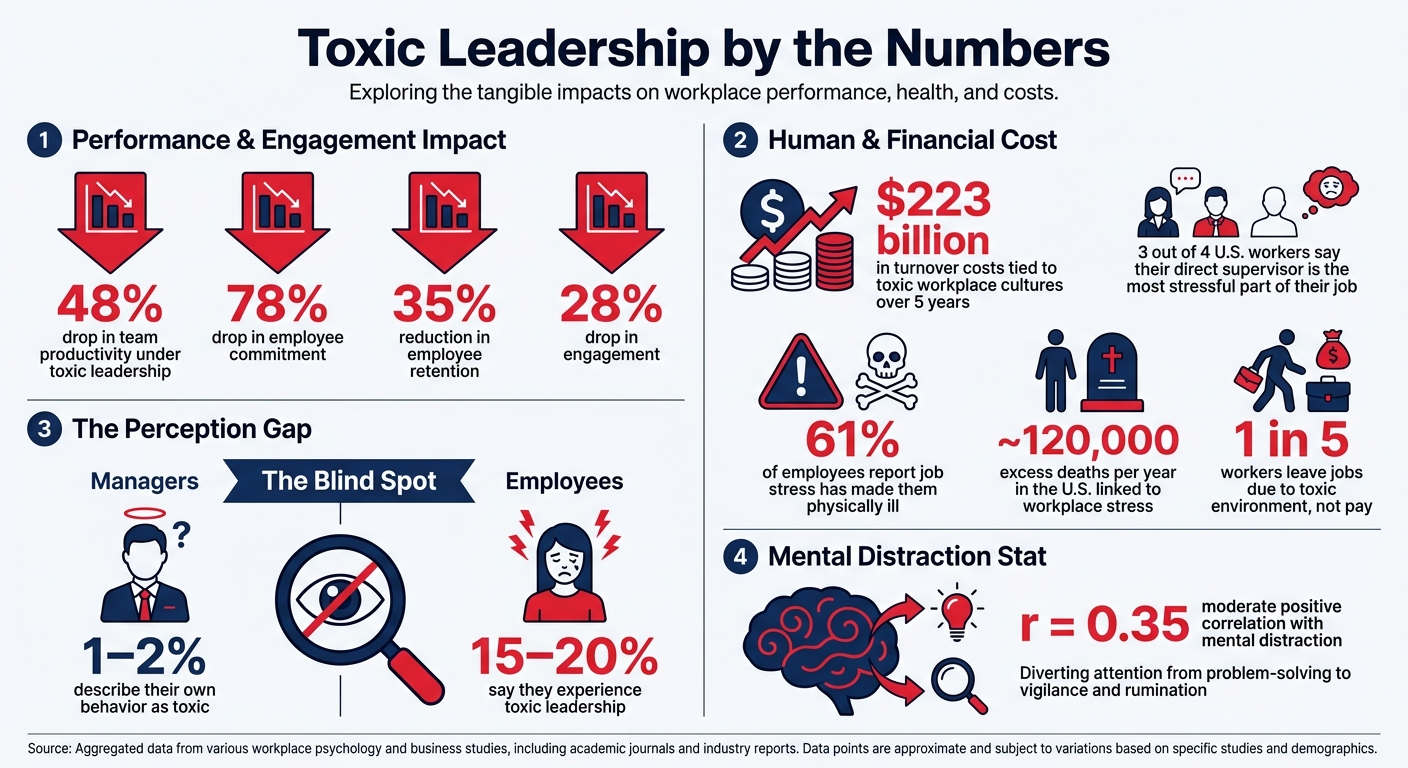
Toxic Leadership by the Numbers: Impact on Teams & Workplaces - Infographic © MyDifficultBoss.com
Toxic leadership is more than a bad attitude or hard-nosed management. It’s a repeated pattern of destructive behavior - manipulation, intimidation, blame-shifting, and self-focus - that wears people down and drags performance with it. The fallout shows up fast in trust, coordination, and day-to-day output.
A demanding boss can still hold people to a high bar and change course when someone gives clear feedback. A toxic boss does something else. They keep repeating the same patterns: undermining people, humiliating them, shifting blame, or creating instability.
The data makes the harm plain. Toxic leadership is tied to a 48% drop in team productivity and a 78% drop in employee commitment. On top of that, three out of four U.S. workers say their direct supervisor is the most stressful part of their job. In most cases, that damage doesn’t begin with one dramatic blowup. It starts with a handful of repeated behaviors that teams spot early.
The Behaviors Teams Notice First
The first signs are often subtle. Small shifts happen again and again until the team starts treating them as normal.
One of the earliest signals is shifting expectations - goalposts move, but no one explains why. Then comes public criticism: calling someone out in a meeting, blaming them in front of coworkers, or using group settings to shame people instead of fixing the problem. Favoritism also stands out early. When loyalty to the boss matters more than results, peer trust breaks down fast.
Two quieter behaviors often do the most damage over time. The first is withheld information. Toxic leaders often lean on verbal direction so there’s no clear record, which helps them dodge accountability and keep control through confusion.
The second is punished dissent. A team member asks a fair question, flags a concern, or offers a different view - and suddenly they’re isolated, left out of key meetings, or hit with quiet retaliation. Once people learn that speaking up has a price, silence spreads. And once that silence settles in, it’s hard to undo.
Part of the problem is simple: most leaders don’t see these patterns in themselves. Research shows that only 1% to 2% of managers describe their own behavior as toxic, while 15% to 20% of employees say they experience it. Those early warning signs often push teams into coping habits that make the harm worse.
If you’re not sure exactly what kind of boss you and the team have, check out a website called MyDifficultBoss.com which has an excellent Boss Decoder Tool as well as starter scripts for dozens of boss related scenarios.
Why Some Teams Break Apart While Others Pull Closer
When toxic behavior becomes normal, teams usually move in one of two directions.
Some teams adapt to fear. People stop sharing ideas. They protect their own standing. They pull back from working together. Tension grows, silos take shape, and more energy goes into self-protection than into the work itself.
Other teams respond in a very different way. Instead of turning inward or against one another, they pull closer. They build stronger peer ties and lean on shared norms to keep the group working. The teams that stay intact usually do it by building peer support and clear ground rules before fear takes over. The next section shows which coping patterns deepen the damage - and which ones help teams keep functioning.
Team Coping Patterns That Make Things Worse
When a leader is toxic, teams don’t just suffer. They react.
Most of these reactions start as survival habits, not fixes. They help people get through the day. But over time, they can deepen the damage instead of containing it. Some responses protect the team. Others quietly protect the boss’s dysfunction.
How Fearful Silence Creates Hidden Risks
Silence is a common response to a volatile boss, but the cost is high. When people feel it’s unsafe to speak up, they stop sharing plain, honest updates. If they expect retaliation, they start filtering what they say, hiding problems, and holding back feedback. Research shows that toxic leadership can drive employee silence in ways that go far beyond ordinary caution.
In these settings, employees often become human shock absorbers. They carefully screen updates on the way up, trying not to trigger the boss before bad news reaches the top.
That may keep the peace for a moment, but it creates risk. Once updates are filtered, the team loses the feedback it needs to do good work. Senior leadership may see surface-level calm while serious problems sit underneath.
Fear also drains attention that should go to solving problems. Studies show toxic leadership has a moderate positive correlation with mental distraction (r = 0.35), which means employees spend more attention on vigilance and rumination instead of problem-solving. Error rates go up. Decision quality slips.
How Peer Conflict and Overwork Lead to Burnout
Silence protects the leader. Conflict protects individuals.
When a leader puts constant pressure on the team, that pressure rarely stays contained between the boss and one employee. It spreads sideways. Teammates start competing for the leader’s favor, holding back information from each other, and shifting blame to avoid becoming the next target.
Another pattern shows up among the team’s strongest contributors: overfunctioning. High performers pick up the slack created by dysfunction. They work longer hours to keep projects moving and protect the team’s output. For a while, that can make the team look stable. In practice, it pushes people toward chronic exhaustion.
As strain builds, trust drops and collaboration weakens. Workplace stress already contributes to approximately 120,000 excess deaths per year in the United States, and 61% of employees report that job stress has made them physically ill.
The table below shows how these coping patterns tend to play out over time:
| Maladaptive Coping Pattern | Long-Term Cost to Team |
|---|---|
| Silence & Compliance | Erodes psychological safety; blocks critical feedback and innovation |
| Protective Shielding | Accelerates burnout in high performers; masks systemic dysfunction from HR |
| Selective Information Sharing | Weakens decision-making; creates execution risks and hidden problems |
| Blame-Shifting & Infighting | Destroys peer trust and fosters favoritism and blame shifting |
| Cynicism and Withdrawal | Leads to hopelessness, stagnation, and loss of intrinsic motivation |
| Overwork | Drives chronic burnout, stress-related illness, and high-performer turnover |
What makes these patterns so damaging is that they feed on themselves. Silence hides problems. Overwork leads to exhaustion. Exhaustion leads to more errors, and those errors invite more blame. Cynicism spreads from one person to the next.
These habits can keep a team moving for a while, but they also harden dysfunction.
The next section shows the small shared practices that interrupt these patterns before they become the team’s default.
Team Strategies That Protect Cohesion and Keep People Functioning
Teams can interrupt these patterns with a few simple peer habits. Each one pushes back against what toxic leadership tends to create: silence, confusion, and blame. The point isn't to fix the whole workplace overnight. It's to help people keep working, stay clear-headed, and protect each other.
Build Small Pockets of Psychological Safety
Start small. The goal isn't a perfectly safe workplace. It's a dependable space where teammates can speak openly with each other, even if they can't do that with the boss.
A regular no-blame check-in can help. This can be a short team meeting focused on shared challenges and what's getting in the way of progress. It gives people a steady opening to speak up without turning the conversation into a complaint session.
Simple agreements also make a big difference, such as:
- how to flag a concern without exposing a colleague
- when a problem needs to be surfaced
- how the team responds when someone is clearly struggling
Sometimes a brief conversation that ends with a clear plan for handling problems is enough to change the tone. People stop guessing. They start coordinating.
Once teammates can speak honestly with each other, the next move is to make that communication steady and easy to track.
Use Shared Norms, Boundaries, and Work Processes
One of the best things a team can do under volatile leadership is cut ambiguity with structure. When a boss gives mixed signals or chaotic direction, clear internal norms help fill that gap.
Toxic leaders often lean on verbal directions because there's no paper trail. A simple fix is to send short written summaries after meetings so everyone has the same record of what was decided and who owns what.
Shared scripts help too. When an unreasonable demand shows up, a calm, pre-agreed response that asks which priority should come first moves the exchange from emotional to procedural. That sets a boundary without picking a fight.
Teams can also define clear ownership. Who decides what? Who handles which requests? Without that clarity, confusion can become a daily source of conflict.
Structure helps, but teams also need ways to spot patterns before people burn out or start blaming themselves.
Build Peer Support and Make Sense of Patterns Together
Peer support helps counter isolation and cuts self-doubt. Buddy systems and short one-on-ones between teammates keep people connected and make it easier to notice early signs of burnout.
Short debriefs after difficult interactions can help too. Use neutral language to describe what happened, what the impact was, and what to do next. That keeps the team grounded. It also helps people separate leadership abuse from personal failure.
A shared factual log can do the same thing. Writing down dates, specific behaviors, and concrete impact gives the team something solid to refer to instead of spiraling into rumination.
MyDifficultBoss.com offers tools like the Boss Decoder, starter scripts, and scenario guides for practical next steps.
The table below maps each adaptive strategy to the team dynamic it's designed to protect:
| Strategy | Team Dynamic Protected | Practical Action |
|---|---|---|
| No-Blame Check-ins | Psychological Safety | Regular short meetings focused on shared obstacles, not frustrations |
| Written Confirmations | Accountability & Trust | Neutral post-meeting summaries to prevent shifting blame or rewriting decisions |
| Shared Scripts | Boundaries & Autonomy | Pre-agreed responses to unreasonable demands that stay calm and procedural |
| Clear Ownership | Focus & Cohesion | Defined roles and decision rights that hold steady despite leadership inconsistency |
| Peer Debriefs | Reality Testing & Well-being | Short structured conversations that separate the boss's patterns from personal failure |
| Factual Logging | Safety & Escalation Readiness | Factual logs of dates, behaviors, and impact kept quietly for later use |
Used together, these habits help teams stay steady while they decide whether to document, escalate, or leave.
When Teams Survive, When They Improve, and When to Escalate or Leave
Once peer support is in place, teams run into a tougher call: stabilize, escalate, or leave. Peer habits can steady a team for a while, but they can't fix a leader who keeps rewarding abuse. And not every team under toxic leadership lands in the same spot. Some stay afloat and do just enough to make it through the week. Others build tighter peer ties and clearer ways of working. That gap usually comes down to deliberate habits, not luck.
What Teams That Improve Do Differently
Survival mode is about soaking up dysfunction. Improvement is about building structure anyway, such as managing a micromanager by setting proactive boundaries. Toxic leadership is tied to a 35% reduction in employee retention and a 28% drop in engagement.
Teams that get better tend to protect a shared purpose that lasts longer than the leader's behavior. They create their own norms for meetings, feedback, and response times. They also guard the process, not just the deadline. That matters because healthy ways of working can stick around even when leadership is erratic.
They also make time for regular stay conversations. These are short, honest check-ins that bring frustrations to the surface before disengagement turns into turnover. It's a simple habit, but it can stop small problems from turning into exit plans.
Document, Escalate, or Plan a Professional Exit
When team habits stop being enough, the response has to move from coping to action.
There comes a point when peer support can't carry the full load. If the behavior keeps happening and the organization keeps rewarding it, the team needs a longer-term plan.
Fact-based documentation is the place to start. Keep a private log with dates, actions, witnesses, and impact. Stick to facts. As one researcher noted, toxic leaders often prefer verbal communication to avoid accountability and create ambiguity.
If you use HR or ethics channels, frame the issue as organizational risk. HR tends to act on documented harm. A record that links toxic behavior to missed deadlines, higher error rates, or transfer requests is much more useful than a list of complaints about someone's personality.
If escalation changes nothing, then the harder question shows up: does staying still make sense?
"You really need to take a good record of what your daily stressors are and when you're not sleeping, when you're not eating... That's when we have to start questioning, 'Is this the right job for me?'" - Tessa West, Psychology Professor, NYU
When stress starts messing with sleep, eating, or relationships, and the company still rewards the toxic behavior, planning an exit is often the safest move. About 1 in 5 workers leave toxic jobs because of the environment, not the pay. That's the point where teams have to decide whether to keep documenting, escalate through formal channels, or walk away.
Conclusion: Key Lessons for Protecting Team Performance and Well-Being
Toxic leadership chips away at trust, engagement, and retention. The harm gets worse when teams go quiet, avoid conflict, or try to soak up the damage on their own. In doing that, they often hide the problem from the very people who might fix it.
That pattern matters more than the leader’s label. A team can only guard what it puts in place for itself. The teams that hold together the longest don’t just take the hit. They build routines, set boundaries, and agree on shared norms that help them stay coordinated when pressure builds. That kind of structure acts like a buffer against instability. But there’s a limit. Those routines help teams survive, not forever, and not once the setting crosses a certain line.
Every tactic has a ceiling. Buffering wears people down. Local norms can cover up the bigger issue. Documentation only helps if someone acts on it.
The clearest sign that this has gone as far as it can is when people start self-censoring, stop trying new ideas, and need intermediaries just to talk to the leader. At that point, coping isn’t enough. The real choice becomes whether to escalate, transfer, or leave. The goal isn’t endless adjustment. It’s acting in time.
FAQs
How can I tell if my boss is toxic or just demanding?
The difference comes down to intent and impact.
A demanding boss pushes for strong results with clear goals and solid work standards. A toxic boss leans on manipulation, intimidation, or emotional swings to feed their own ego or insecurity.
You can usually spot toxic behavior by the pattern. It chips away at your well-being over time. That might look like public humiliation, goalposts that keep moving, or a manager who takes credit for work you did.
What should I document if toxic behavior keeps happening?
Keep a factual written record of what’s happening. Note deliverables, deadlines, and feedback so you have a clear, objective account of events.
Save relevant emails, chat logs, and other digital messages that show repeated patterns. That matters because toxic leaders may lean on verbal communication to dodge accountability and cover their actions.
When should I escalate the issue or leave?
It depends on whether the behavior is a short-term rough patch or a repeated pattern that keeps causing harm. You may want to take the next step through the proper channels when you have documented proof of behavior that keeps happening and is causing problems. One hard truth: HR is there to protect the company first.
If direct feedback or clear boundaries don't change anything, and the situation is affecting your health or who you're becoming in that setting, it may be time to leave.