When to Push Back and When to Stay Diplomatic
Decide when to push back or stay diplomatic using stakes, timing, facts, and documentation to protect work without burning bridges.

Most bad boss problems come down to one choice: speak up now, or wait and handle it with care. If the issue affects ethics, legal risk, safety, workload, deadlines, credit, or a review, I should not stay quiet just to keep the peace. But if the issue is about style, timing, or a call that can be changed later, I’m often better off staying calm, asking questions, and picking a better moment.
A 2024 Textio analysis found large gender gaps in personality-based feedback, which is a reminder that the wrong move at work can carry a cost. So before I respond, I can run a simple check:
- How serious is the issue?
- Can this be changed later?
- Do I have facts, or just a feeling? (Check if your boss gives unclear instructions before reacting.)
- Is my boss calm enough to hear this well?
- Will speaking up in public make things worse?
- Am I trying to stop harm, or just avoid discomfort?
Here’s the short version:
- Push back when the risk is high and delay will make it worse
- Stay diplomatic when the issue is low-stakes, the timing is bad, or backlash risk is high
- Use facts, not emotion
- Keep hard talks private when possible
- Document workload, decisions, credit, and review issues in writing
- Do not let patience turn into silent resentment
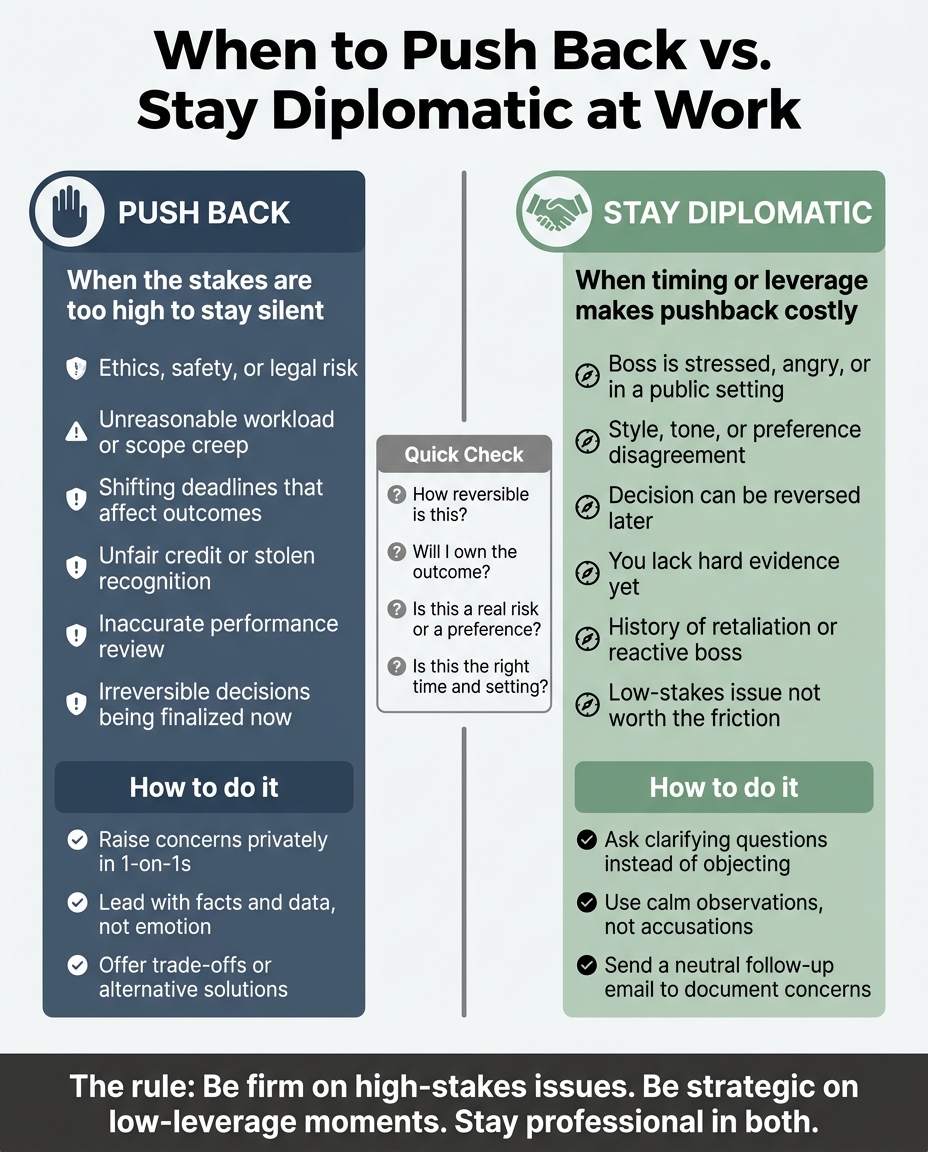
When to Push Back vs. Stay Diplomatic at Work = Infographic © MyDifficultBoss.com
Bob Bordone Teaches You How to Have a Difficult Conversation with Your Boss
sbb-itb-1bb7cb4
Quick comparison
| Situation | Better move | Why |
|---|---|---|
| Ethics, safety, legal risk | Push back | The cost of silence is too high |
| Unclear workload, scope creep, bad deadlines | Push back | It helps set limits and force priority calls |
| Inaccurate review or stolen credit | Push back | A written record helps protect my work |
| Boss is stressed, angry, or in a group setting | Stay diplomatic | Poor timing can make things blow up |
| Style or tone preference | Stay diplomatic | Not every issue is worth a direct clash |
| Decision can be changed later | Stay diplomatic for now | Waiting may lower the risk |
The core idea is simple: I should be firm on high-stakes issues and careful on low-leverage moments. That way, I protect both my work and my position.
A simple framework to use before you respond
Use this filter when a response to your boss feels risky or unclear. Before you say anything, run two fast checks: how much this issue matters and how safe it is to speak up right now.
Step 1: Assess how much the issue matters
Start by separating actual risk from personal preference.
Some concerns are about harm, missing data, or ethical, legal, or safety risk. Those are substantive issues. Others come down to style, tone, or process. Those are preferences.
It also helps to ask: Can the team still change this later? If yes, there’s usually less pressure to push back right now. But if this decision shuts down other options, speaking up carries more weight.
Step 2: Assess safety, timing, and power dynamics
Even when your concern is valid, the wrong moment can make it land badly. Three things shape that moment.
- Your boss's receptivity. Some managers welcome debate. Others hear disagreement as a threat to their authority. If your boss tends to react badly, a private conversation will usually go over better than bringing it up in front of a group.
- The boss's stress level. If your boss is clearly under pressure, that’s usually a bad time to add friction. A simple “Let me think on this” can buy you time and help you plan a calmer response.
- Your current standing. Your seniority, credibility, and leverage shape how pushback is received. With a reactive boss, the same comment can sound like helpful input or open defiance. So use your shots on the issues that matter.
Quick decision guide: Push now or stay diplomatic now
Use this table to sort the tradeoff fast.
| Factor | Push Now | Stay Diplomatic Now |
|---|---|---|
| Decision type | Irreversible or high-risk | Reversible or low-stakes |
| Issue category | Ethics, safety, outcomes, or legal issues | Style, preference, or tone |
| Timing | Decision is being finalized now | Boss is stressed or in a public setting |
| Evidence | Data-backed and factual | Gut feeling or anecdotal |
| Environment | High psychological safety | History of retaliation or a reactive boss |
| Goal | Prevent harm or failure | Protect the relationship or protect leverage |
When pushing back is the right professional move
When the issue is material and waiting will make it more expensive, pushing back is often the right call. Staying quiet may protect you for the moment, but it weakens your position over time. If you say yes to everything, people can start to doubt your judgment, overload your schedule, and lean on you in ways that don't hold up.
Push back on unreasonable workloads, shifting deadlines, and scope creep
Think of overload as a priority problem, not a personal complaint. Instead of saying, "I can't take this on," try: "I can deliver X by Friday if we move Y to Monday. Which matters more to you?" That shifts the discussion from refusal to tradeoffs.
Scope creep is one of the biggest things to catch early. Every time you take on extra work without naming it, you teach people that your time has no limit. Then, when the pressure gets worse, it's much harder to draw a line. A better move is to name the goal, state the limit, and offer another path. Keep the focus on quality and business risk, not your stress level.
Push back on ethical concerns, unfair credit, and inaccurate evaluations
Some problems call for immediate pushback because the risk is too high to absorb in silence. Ethical concerns sit at the top of that list and can also carry retaliation risk. That's why framing matters. Instead of opening with a personal objection, present the issue as a risk to the team or company: "I want to flag this before it becomes a problem for us down the line." If nothing changes, take it to HR, the next level of management, or an anonymous ethics hotline.
When the issue is unfair credit or an inaccurate review, documentation is your best tool. Keep a private record of your work: dates, deliverables, and key decisions you shaped. If you need to address an error, use a learning frame. Ask your manager to walk you through the logic, tradeoffs, or data behind the call. That opens the door to a fix without turning the exchange into a fight.
How to push back without making things worse
A lot of this comes down to how you do it. The goal is to stay firm without turning it personal.
| Constructive Pushback | Damaging Pushback |
|---|---|
| Private conversations: Raise concerns in 1-on-1s so your manager can save face | Public challenges: Disagreeing in front of the team or clients often triggers defensiveness |
| Specific facts: Use objective data and observable outcomes | Accusations and blame: "You" statements or attacks on character |
| Solution-based language: Offer trade-offs, alternatives, or priority shifts | Venting and emotion: Showing frustration or rolling your eyes |
| "I" statements: "I'm concerned about the quality risk here" | Declarative refusals: A flat "no" with no context or alternative |
One practical point: body language matters. A sigh, an eye roll, or a closed-off posture can undercut an otherwise professional message before you've even finished the sentence.
When diplomacy protects your position and influence
When direct pushback is likely to blow up in your face, diplomacy helps you hold your ground without turning the situation into a fight. It's a deliberate move. You're protecting your leverage for a time when it can do more good. Sometimes the smart play is to wait for better conditions before you speak.
Use diplomacy in moments when you have little leverage or the risk of backlash is high
Some moments make direct pushback more costly than useful. Diplomacy helps most when your boss is visibly stressed, when calling them out in public would make them dig in, or when you don't yet have hard evidence for a firmer challenge. If the decision can be reversed later, the downside of waiting is often low. In those cases, a wait-and-see approach can make more sense.
This isn't about backing down. It's about holding onto your influence until the moment is stronger.
Diplomatic moves that still protect your interests
Being diplomatic doesn't mean going quiet. It means choosing how to engage. A few simple moves can protect you without making you look passive.
Ask clarifying questions before you object. "How are we thinking about handling the timeline risk if we go this route?" brings the issue into the open without making your boss feel attacked.
Use calm observations instead of accusations. "I've noticed the timeline keeps shifting" lands better than a statement built around "you."
If emotions are running high in a group setting, move the discussion out of the room. "Can we find 15 minutes to dig into this together?" gives both of you space and lowers the temperature.
A short written follow-up can also protect your position. After a verbal agreement, send a brief, neutral email that sums up the decision and any concerns you flagged. That gives you a professional record without sounding combative. If things change later, you won't be stuck relying on memory.
How to stop diplomacy from becoming unhealthy appeasement
Strategic patience can slide into appeasement faster than most people think. This simple test helps separate the two.
| Strategic Diplomacy | Unhealthy Appeasement | |
|---|---|---|
| Goal | Preserve influence for a better moment | Avoid discomfort at any cost |
| Action | Asks questions, documents concerns, proposes alternatives | Stays silent or agrees while feeling resentment |
| Career Impact | Builds political capital over time | Stalls advancement; leads to being seen as a follower |
| Boundary Handling | Protects long-term workload and ethics | Allows repeated violations and scope creep |
| Internal State | Calculated patience | Growing resentment and burnout |
If six months of diplomacy leads to no change, you've probably hit the limit of what patience can do. At that point, the issue isn't timing anymore. It's whether you're using diplomacy on purpose or using it to avoid a hard conversation.
Turn this into a repeatable habit
Turn the framework above into a 30-second routine. Use it when a conversation gets tense and you need a fast call you can make without overthinking it.
A short decision routine for difficult boss conversations
Before you reply, take one breath. That small pause can help settle your stress response. Then run through four quick questions tied to reversibility, accountability, stakes, and timing:
- How reversible is this?
- Will I own the outcome?
- Is this a real risk or a preference?
- Is this the right time and setting?
Then keep your response simple: state the goal, cite one fact, offer an alternative, and end in alignment. If your answer points to pushback, respond in private and stick to the facts. If not, stay tactical and come back to it later.
Use documentation and reflection to sharpen your judgment
After any major conversation with a difficult boss, send a short, neutral follow-up email that sums up the decision, the reasoning, and any concerns you raised. That gives you a record that can protect you. It also helps cut through the fog later, when memories start to shift.
Then take two minutes for a quick debrief. What worked? What fell flat? What should you change next time? The notes you keep become the data you use to fine-tune your judgment over time. Each follow-up gives you a clearer read on what tends to work with this boss.
Key takeaways and next steps
The rule is simple: push back on serious issues, use diplomacy in high-risk or low-leverage moments, and stay professional in both cases. Your response shouldn't come from mood or personality. It should come from the stakes, the timing, safety, and your boss's pattern of behavior.
If you want more structure, use a tool built for difficult-boss situations. MyDifficultBoss.com offers the Boss Decoder, 135+ difficult-boss scenarios, and starter scripts for tougher conversations.
FAQs
What if my boss retaliates when I speak up?
If your boss retaliates, put your job and legal footing first. Send your concerns by email so there’s a paper trail, and keep a record of the risks you flagged.
If the situation still feels impossible - or crosses into unethical or illegal conduct - it may be time to look hard at whether this workplace is helping you move forward. For longer-term issues, MyDifficultBoss.com offers tools and step-by-step strategies to help you deal with tough workplace dynamics.
How do I push back without sounding defensive?
Focus on the shared goal and on what will help the team move forward, not on what’s wrong. Start by showing that you understand your boss’s point of view. Then bring up your concern in terms of business results and suggest a clear next step.
If that helps, turn your input into a question. It can make the conversation feel less like pushback and more like problem-solving together.
If you need to say no, use a no-plus-alternative approach. Name the goal, explain the time or workload limit, and offer an option that can work.
When should I document a boss issue in writing?
Put it in writing when you’re handed an impossible task, told to do something that carries serious risk, or need a record of a conversation where you set a boundary.
It also helps to track patterns like last-minute requests, unclear feedback, or micromanagement. Keep your notes in a secure place so you protect privacy and maintain a clear record of work-related interactions.