How To Address Shifting Priorities With Your Boss
Map your workload, ask your boss which tasks to pause or drop, confirm decisions in writing, and use weekly check-ins to prevent scope creep.

When your boss adds new work without saying what should stop, your job is to make the trade-off visible. That is the fix in plain English.
I’d handle it in 3 steps: list my current work and deadlines, ask my boss to choose what moves or pauses, and then confirm the decision in writing. That matters because frequent priority shifts drive up stress and lower engagement for 70% of employees.
Here’s the short version:
- Map my workload first so I can show hours, deadlines, and recent changes
- Ask direct trade-off questions like “What should I delay to make room for this?”
- Send a written recap so the new order of work is clear
- Set a weekly check-in to keep changes from piling up into scope creep
- Watch for a bigger role issue if the churn keeps happening
If I’m staring at 55 hours of work in a 40-hour week, I would not try to solve that alone. I’d bring the facts, get a decision, and keep a simple record of each shift.
This is less about working harder and more about making sure expectations are clear before work slips, stress builds, or performance gets judged by moving targets.
As an aside, it’s also also helpful to use tools at websites like MyDifficultBoss.com which provides lots of scripts (and strategies) for dealing with bosses who overload their employees with too much work. They even have a Boss Decoder Tool that helps one figure out what specific type of boss they actually have.
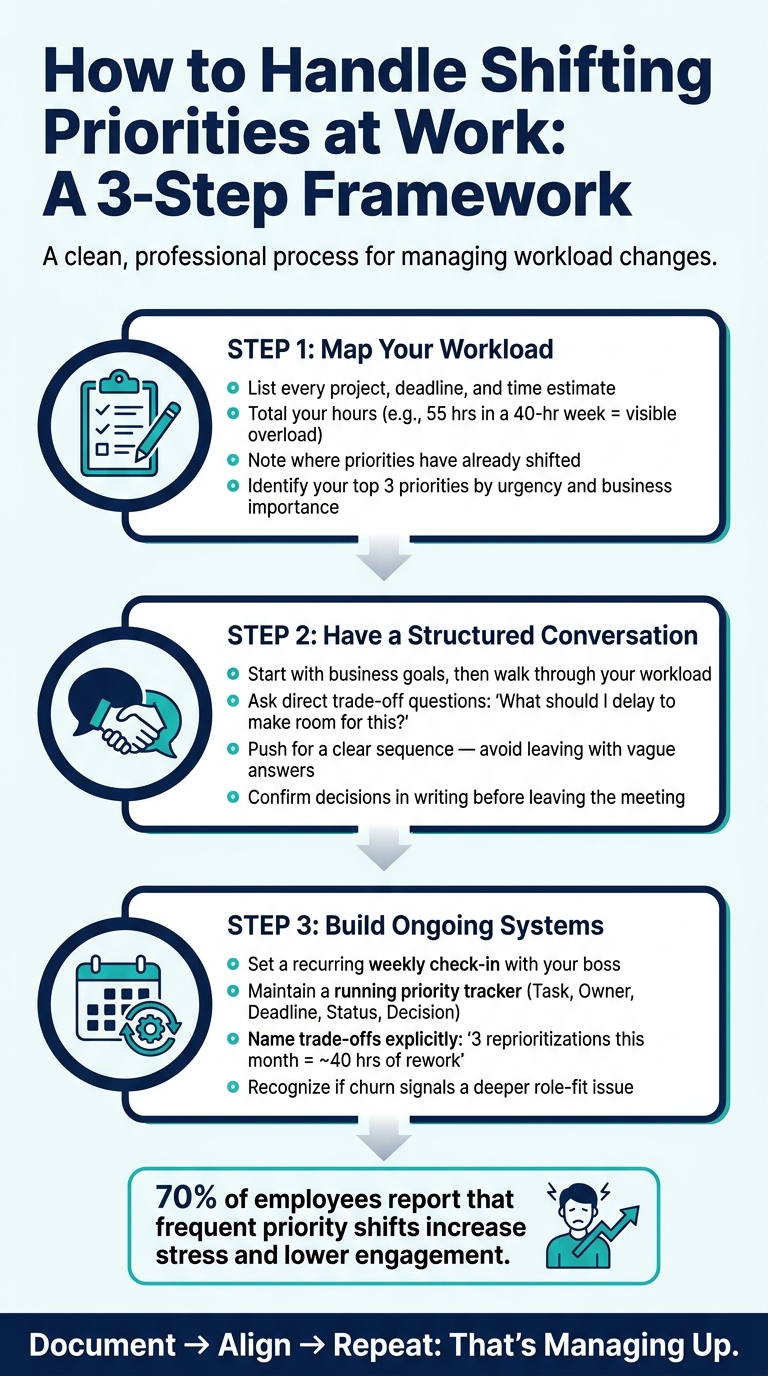
How to Handle Shifting Priorities at Work: A 3-Step Framework - Infographic © MyDifficultBoss.com
My Manager Keeps Changing Our Goals, Help! | Ask Christa!
sbb-itb-1bb7cb4
Step 1: Map your current workload before talking to your boss
Map your workload before the meeting so you can show the trade-offs. Put together a one-page snapshot before you talk to your boss. If you walk in without one, you give up leverage.
List your projects, deadlines, and recent priority changes
Write down every active project, specific task, review, on-call shift, and informal commitment on your plate right now. Add the current due date for each item. Then assign a time estimate in hours.
When you total those hours, the overload gets hard to ignore. For example, you might be staring at 55 hours of work in a 40-hour week.
Also note where priorities changed. Record what got added, what moved, and what got pushed down the list as a result. If priorities changed several times in a month, write that down too. This gives you facts for the conversation, not just stress and frustration.
Sort your work by business importance and urgency
Once your list is done, rank each item by business importance and urgency. The aim is simple: figure out your top three priorities and separate them from the rest.
This makes the trade-offs plain when new work lands. Instead of saying, “I have too much going on,” you can ask a clear question: Which items come first this week, and which should pause or drop?
That’s the point. Your boss needs to see the trade-offs to make a good call when more work shows up.
Bring this list to the meeting so you can decide what should move, pause, or stop. You’ll use this snapshot in Step 2 to get clear trade-offs from your boss.
Step 2: Have a structured conversation that gets clear trade-offs
Use the one-page workload snapshot from Step 1 to keep the conversation grounded in facts. Start with the business goal. Ask your boss what outcomes matter most right now, then map your current work against those goals so the trade-offs are plain to see.
Start with goals, then walk through your current workload
Begin by asking what matters most right now. Once you know the goal, walk through how your current workload affects deadlines and where the conflicts are.
A Senior Director at a media company put it this way:
"I told him, 'I think we both want the same thing: happy clients and a sustainable pace. Right now, we're getting requests from three stakeholders who think they are all top priority. Can you help me understand how to sequence these?'"
That framing works because it keeps the tone calm and focused. You’re not pushing back for the sake of it. You’re showing that when everything is urgent, something has to give.
Ask what should move, pause, or be dropped when new work is added
Once the priorities are on the table, ask for a clear call. Don’t leave the meeting with a fuzzy sense of what matters. Push for an actual trade-off with direct questions like:
- "To make room for this, which item should I delay?"
- "What should move, pause, or be dropped?"
- "Which priorities come first this week?"
If the answer is still vague, narrow it down again until you get a clear sequence of work.
Confirm decisions in writing after the meeting
Once the meeting ends, document the decision right away. Before you leave, say it back in plain language: "So you'd like me to prioritize X over Y because of Z, correct?"
Then send a short recap email with the new goal, updated deadlines, and the effect on the rest of your work. Add any cross-functional partners who depend on your output so everyone is working from the same plan.
As Phillip Holmes put it:
"If you leave that room without documenting the shift, it never happened."
That written recap gives you something concrete to point to if priorities change again.
Step 3: Build systems that keep priority changes from taking over your week
Once you've documented the decision, turn it into a weekly routine. One conversation helps in the moment, but it usually won't hold for long. A weekly check-in and a simple tracker make shifting priorities visible, connect them to trade-offs, and stop scope creep before it slips by unnoticed.
Use weekly check-ins and a running priority tracker
Set up a recurring weekly check-in with your boss so conflicts come up before they wreck your schedule. Keep a running tracker of what's active, paused, and at risk.
| Tracker Component | Purpose |
|---|---|
| Task | Clear description of the deliverable |
| Owner | Who is responsible |
| Original vs. Current Deadline | Shows the history of shifts and current expectations |
| Status | Current progress (e.g., In Progress, Paused, Blocked) |
| Latest Decision | Why the priority changed |
Bring that tracker into the check-in. That way, every new request gets weighed against the work already on your plate.
Communicate workload limits using clear workload language
When a new request comes in, name the trade-off in plain terms: "We've reprioritized three times this month, adding about 40 hours of rework. What should move to make room?"
That phrasing matters. You're not pushing back on the work itself. You're asking your boss to choose what shifts, based on the time and rework involved. It keeps the discussion on facts and trade-offs, not on whether you seem too busy.
Recognize when shifting priorities point to a bigger role problem
Some messy weeks are just messy weeks. Others point to a deeper role problem.
Pay attention if last-minute changes keep happening even when there isn't outside pressure. The same goes for shifts driven by unsupported preference instead of business data. That's usually a sign that expectations are moving around without a steady decision process.
If weekly check-ins, written recaps, and clear workload language don't reduce the churn over time, the issue is probably structural, not temporary. At that point, reassess role expectations and performance criteria.
And if the stress is spilling into your sleep, relationships, or weekends, treat it like a role-fit issue, not just a calendar issue.
Conclusion: Stay calm, document decisions, and manage up consistently
Shifting priorities don't have to wreck your work or strain trust with your boss. The fix is simple: prepare, clarify the trade-offs, and document the decision.
Lay out the workload. Put the trade-offs in plain view. Then get a decision. As the saying goes, "If everything is a priority, nothing is." Your job is to make those trade-offs visible so your boss can choose. After that, turn the one-off talk into a weekly habit.
To keep priorities from drifting again, bake the process into your week. A recurring check-in and a simple change log lead to fewer surprises, fewer rework loops, and clearer expectations before scope creep starts to spread.
If this keeps happening, it helps to use tools that make it easier to read your boss and plan your response. If you need scripts and boss-style guidance for shifting priorities, MyDifficultBoss.com offers the Boss Decoder, 135+ difficult-boss scenarios, and starter scripts.
Document, align, repeat: that's managing up. It protects your work, keeps trust intact, and gives you a track record when performance conversations come around.
FAQs
What if my boss says everything is urgent?
When your boss says everything is urgent, shift the conversation away from your workload and toward the team’s goals. That small change can make the discussion feel less like pushback and more like working together to sort out what matters most.
A simple way to do that is to ask, “Which two or three tasks are most important right now?” or “How should this new assignment fit within my current projects?” Those questions help narrow the focus and make the next step clearer.
When a new task lands on your plate, it also helps to name the tradeoff out loud. For example: “Yes, I can take on Project X, and to do that, we’ll need to push Project Y to next week.” That kind of response is clear, calm, and practical. It shows you're willing to help, while also making it plain that time and attention are limited.
How do I push back without sounding negative?
Frame it as collaboration, not a complaint. Don’t just say no. Use "Yes, and" to make the trade-off plain: "Yes, I can take on Project X, and to do that, we’ll need to push Project Y to next week."
You can also say, "I want to make sure I’m focusing on the tasks with the greatest impact; which priorities should take precedence?" That keeps the conversation grounded in shared goals instead of friction. Lean on data where you can, and use clear "I" statements so your point lands without sounding combative.
When do shifting priorities signal a bigger job issue?
Shifting priorities point to a bigger job issue when they’re constant, not just temporary. During a crisis, some turbulence is normal and often manageable. But when the instability keeps draining you even after you’ve had time to recover, that usually signals a deeper structural problem.
Other warning signs show up in day-to-day work: declining work quality, feeling disillusioned or checked out, high team turnover, and chaos caused by chronic resource shortages or poor leadership.