Why Some Bosses Abuse Authority
Why bosses turn abusive—insecurities, dark traits, or stress—and practical steps to spot, document, set limits, or exit.

About 50% of U.S. workers say they’ve faced workplace abuse. In most cases, a boss abuses authority for three reasons: insecurity, dark personality traits, or stress mixed with power. And when a company protects results more than basic respect, that behavior can keep going for years.
If I were reading this to get a fast answer, here’s the short version:
- Abuse is a pattern, not one bad meeting
- Firm leadership and abuse are not the same
- Some bosses lash out when they feel threatened or weak
- Some use hostility on purpose to keep control
- Weak HR, silence from coworkers, and results-first workplaces let it continue
- The best response is to document facts, set limits, and decide whether to report, transfer, or leave
What I take from this is simple: if a boss keeps humiliating, isolating, or targeting you, the issue may be less about your work and more about their need for control. That matters, because it changes how I should respond.
| Main issue | What it means |
|---|---|
| Why it happens | Ego threat, fear, power, low empathy, manipulation |
| What enables it | Weak accountability, protected top performers, silent teams |
| Early signs | Public put-downs, shifting standards, withheld information, retaliation |
| What to do | Keep records, stay fact-based, set boundaries, get support |
| When to act | Repeated behavior, health harm, retaliation, discrimination, or blocked reporting |
Bottom line: I’d treat abusive supervision as a repeat pattern that needs a clear response, not as something to excuse or wait out.
002 - 5 Signs Your Boss is a BULLY (Understanding Coercive Control in the Workplace)
sbb-itb-1bb7cb4
Why Some Bosses Abuse Authority
Knowing why this happens makes it easier to respond in a smart way. In most cases, it comes down to three things: ego threat, personality, and pressure.
Ego Threats, Insecurity, and Fear of Losing Control
Abuse often starts with insecurity, not strength. When managers feel their job is at risk or sense that their authority is slipping, they may take it out on employees to get that feeling of control back.
This lines up with vulnerable narcissism. That means insecurity, low self-esteem, and shame can turn even mild criticism into aggression. The manager feels attacked, then strikes back to rebuild their sense of self-worth. In a 10-day study of 126 managers, job insecurity led to a stronger need for power and more abusive supervision.
When insecurity mixes with power, abuse can become the quickest shortcut a manager uses to feel in charge again.
Dark Triad Traits and Low Empathy
Some bosses bring personality traits to the job that make hostile behavior more likely. The Dark Triad refers to narcissism, Machiavellianism, and psychopathy. These traits are tied to manipulation and mistreatment, but Machiavellianism shows the clearest link to abusive supervision. In plain English, calculating supervisors are more likely to abuse employees when they hold high positional power.
It also helps to separate the two sides of narcissism. Grandiose narcissists tend to abuse others to reassert dominance. Vulnerable narcissists do it to hide insecurity. Same damage, different trigger.
These traits tend to matter more when a boss has enough power to act on them.
Stress-Driven Behavior vs. Deliberate Control
Not every abusive boss works the same way, and that difference matters. Stress-driven abuse tends to spike during heavy workloads, burnout, or insecurity. It may be more reactive, and it often comes with remorse afterward. Deliberate abuse is different. It’s calculated. The boss uses hostility to force compliance and then feels more effective the next day.
That’s where things can get ugly fast: if a workplace rewards results but ignores basic respect, both patterns can get worse.
Workplace Conditions That Enable Power Abuse
It’s not just about one bad boss. The workplace around that boss can protect the behavior too. When a company prizes results more than respect, abuse can stick around for a long time.
Cultures That Reward Results Over Respectful Leadership
In high-performance workplaces, harsh behavior can get dressed up as leadership. If the team is winning, people may brush off abuse as “tough love” instead of calling it what it is.
Research shows this clearly: when a team performs well, employees are much less likely to label a leader’s behavior as abusive, even when that leader uses the same hostile language as a boss whose team is struggling.
"A leader may more easily abuse authority within a culture that focuses solely on the ends and not the means." - Marlee E. Mercer and Len Karakowsky, York University
Enron is a strong example of what happens in a results-only culture. When output is all that matters, abuse can start to look like drive or ambition.
Weak Accountability and Limited Employee Voice
A hard-driving culture turns dangerous when no one can push back. Abuse grows more easily when leaders face little resistance, coworkers stay quiet, and the system shields performance instead of accountability. When peers dismiss complaints or call victims “overly sensitive,” they can make people second-guess what they’re seeing.
HR may hold back from challenging a high-performing manager because the complaint puts a prized employee at risk. Doing nothing, on the other hand, may bring almost no immediate visible cost.
That creates a nasty cycle. Strong performance buys protection, and that protection leaves the manager more insulated from consequences. In that kind of setup, abusive authority is often a systems problem, not just a personality problem.
How to Recognize the Pattern and Protect Yourself
Knowing why some bosses misuse authority helps. But what helps more in day-to-day work is knowing how the pattern shows up so you can spot it early and protect yourself.
Early Signs of Authority Abuse in Daily Interactions
One of the clearest early signs is this: criticism shows up when your boss feels their control is being challenged, not when your work actually needs fixing. That’s a big difference.
Once you notice that, pay attention to repeat behavior. Common signs include public criticism meant to embarrass instead of guide, expectations that change with no clear reason, and hostility that spikes when you question your boss or do better than they expected. Another quieter sign is when information gets withheld or you’re left out of the loop to protect your boss’s position.
Professional Responses That Build Documentation and Boundaries
When you start to see the pattern, build a record and protect your boundaries at the same time. Keep a private log. A basic notes app or document is enough. Write down the date, time, what was said or done, and how it affected your work.
At work, keep your communication calm and focused on tasks. Stick to deadlines, deliverables, and outcomes. That gives you a steadier footing and helps keep the conversation tied to facts.
If you’re being singled out, that may say more about your boss’s insecurity than your performance. Don’t let that behavior become your measure of self-worth. That boundary isn’t just emotional - it’s practical.
Getting Structured Support from MyDifficultBoss.com

If you need help making sense of the pattern, MyDifficultBoss.com offers a clear place to start. The Boss Decoder tool, a library of 135+ difficult boss scenarios, and 11 free starter challenges can help you sort through what’s happening and decide what to do next.
When to Escalate, When to Exit, and Key Takeaways
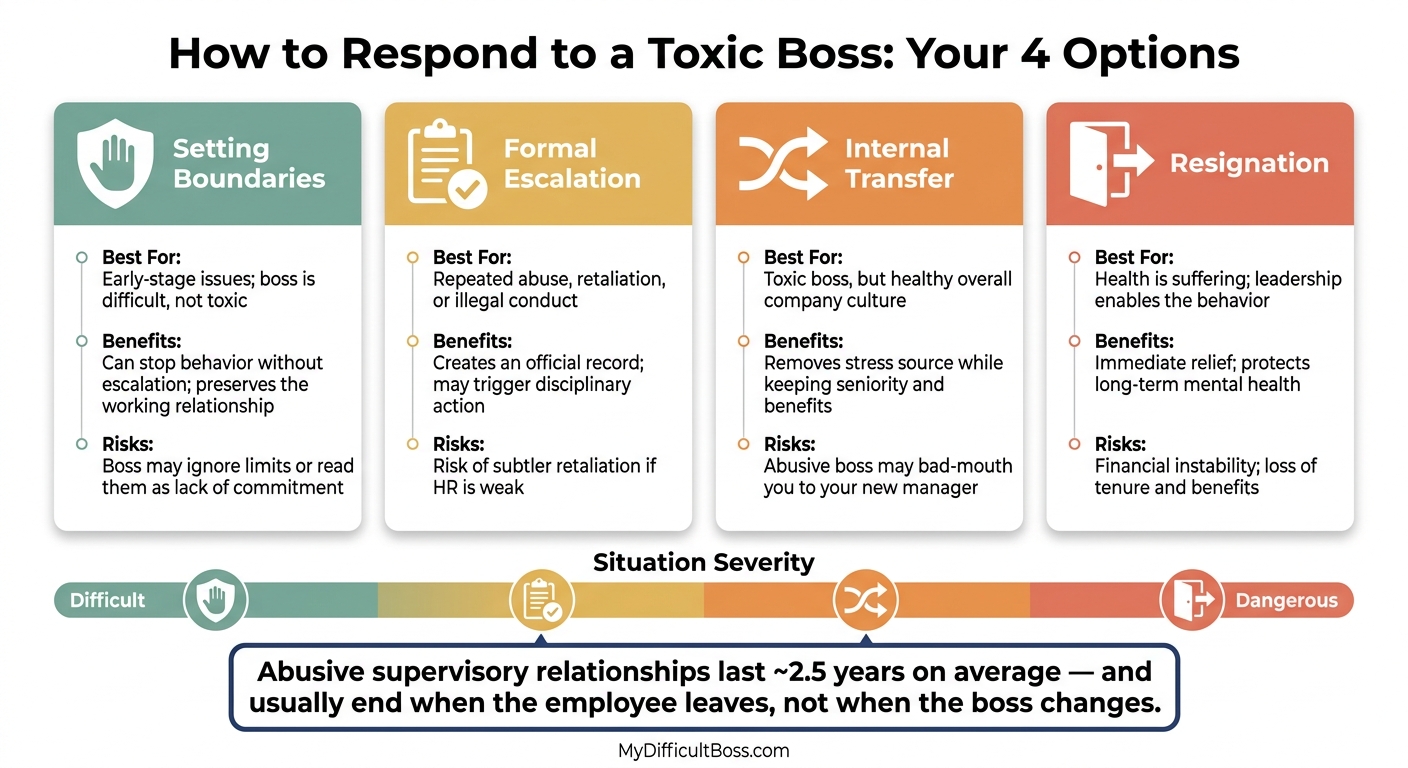
How to Respond to a Toxic Boss: Escalation Options Compared - Infographic © MyDifficultBoss.com
Signs the Situation Calls for Formal Escalation or a Job Change
Once the pattern is clear, the next step is deciding whether to escalate, transfer, or leave.
Not every hard boss situation needs to go to HR. But some do. And if you wait too long, your options can get weaker.
Formal escalation makes sense when the behavior is repeated, not just one bad day. It matters even more when it involves retaliation, discrimination, or harassment tied to a legally protected trait such as race, sex, age, or disability.
That line matters. It helps you tell the difference between a demanding manager and one who is crossing a legal or ethical line.
Before you report anything, write down:
- dates, times, and locations
- the exact words used
- any witnesses
- the impact on your work
- any steps you've already taken
Keep those records on a personal device or in a private file, not on a company laptop or server. If you lose access to work systems, you don't want your evidence disappearing with them.
If internal escalation is blocked because HR is compromised or leadership protects the boss, check whether your company offers an Employee Assistance Program (EAP). You may also want legal guidance about your rights under EEO laws.
Use the table below to match your response to the level of risk.
| Option | Best-Use Situation | Likely Benefits | Potential Risks |
|---|---|---|---|
| Setting Boundaries | Early-stage issues; boss is difficult, not toxic | Can stop behavior without escalation; preserves the working relationship | Boss may ignore limits or read them as a lack of commitment |
| Formal Escalation | Repeated abuse, retaliation, or illegal conduct | Creates an official record; may trigger disciplinary action | Risk of subtler retaliation if HR is weak |
| Internal Transfer | Toxic boss, but healthy overall company culture | Removes the stress source while keeping seniority and benefits | Abusive boss may bad-mouth you to your new manager |
| Resignation | Health is suffering; leadership enables the behavior | Immediate relief; protects long-term mental health | Financial instability; loss of tenure and benefits |
Choosing the right response is the main decision here. Abusive supervisory relationships last about 2.5 years on average and usually end when the employee leaves, not when the boss changes.
For practical tools to navigate a toxic workplace, check out MyDifficultBoss.com, which includes resources like the Boss Decoder Quiz.
If your health is taking a hit, take that seriously. Sleep problems, constant anxiety, and physical symptoms are not minor warning signs. The same goes for behavior that gets worse after you speak up, or a boss who is protected by senior leadership. In plain English: those situations usually don't fix themselves.
Conclusion: Why Understanding the Cause Helps You Choose the Right Response
Authority abuse is usually a pattern, not a one-time event. Once you see it, document it, set limits, and choose escalation or exit based on the facts.
The practical path is the same no matter what caused the problem: observe the pattern, document the facts, set clear limits, and make your next move based on what the evidence actually shows - not on hope that things will change on their own.
You can't always control what your boss does. You can control how clearly you see the pattern, how carefully you document it, and how deliberately you respond. Your next step should match the evidence, the risk, and your health.
FAQs
How do I know if my boss is abusive or just demanding?
It can be tough to spot because some workplaces treat aggressive behavior like it’s just part of the job. And when a whole team acts like it’s normal, people start second-guessing themselves.
Abusive supervision includes public ridicule, unfair blame, and uncontrolled outbursts. A boss might say yelling is supposed to push people to do better or prove leadership. It’s still abuse. And it can damage both productivity and morale.
Can a stressed boss change, or is abuse usually a long-term pattern?
It depends on why the behavior is happening.
If it comes from burnout or emotional exhaustion, a boss may feel guilty after the fact and may be able to change with better coping habits.
But if the behavior is intentional - used to force compliance or hold onto power - it’s often a much deeper pattern. In those cases, the boss may feel rewarded by the behavior, not sorry for it.
What should I document before reporting my boss?
Before you report a boss for abusive behavior, build a clear record of what happened.
Write down each incident with as much detail as you can, including:
- the exact date and time
- the boss’s words and actions as closely as you can recall them
- how the behavior affected your work, your well-being, or the workplace around you
Stick to facts. Keep your notes organized and specific. That way, if you decide to take the issue to HR or senior management, you’ll have something solid to point to instead of relying on memory alone.