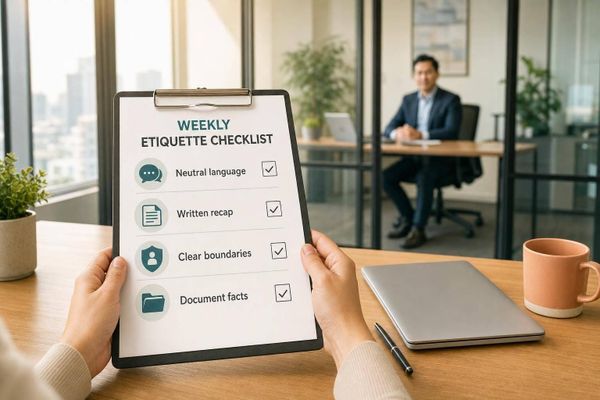
Anticipating Boss Needs: Problem-Solution Guide
Clarify priorities, match your boss's style, prepare objections, and send regular updates to cut surprises and build trust.

Most people don’t fail because they do bad work. They fail because their boss has to chase them for clarity.
I see this article as a simple fix for that problem: get clear on priorities, match your boss’s communication style, prepare for pushback, and send updates on a set schedule. That matters because only 26% of employees strongly agree that their manager’s expectations are clear. And employees who keep their boss informed without being asked are 2.3x more likely to get more responsibility within 12 months.
Here’s the whole article in plain English:
- If priorities are unclear, I confirm what matters this week, what success looks like, and what is out of scope.
- If expectations shift, I put agreements in writing with a short follow-up note.
- If my updates are not landing, I match my boss’s style, lead with the bottom line, and use the channel they pay attention to.
- If I expect questions or pushback, I prepare likely objections, risks, next steps, and one clear ask.
- If trust is weak, I stop being reactive and send regular updates before my boss has to ask.
The main idea: anticipation is not mind reading. It is a repeatable system that cuts surprises, rework, and confusion.
That system is what the rest of this guide explains.
Managing Up: The Leadership Skill Nobody Teaches You
sbb-itb-1bb7cb4
When Your Boss's Priorities Are Unclear
You can't plan around information you don't have. When priorities are fuzzy, people start filling in the blanks. That's where trouble starts: rework, missed expectations, and a slow drop in trust.
How to Find Out What Matters Most This Week
Use your next check-in to pin things down. The goal is simple: get specific enough that you're not guessing.
A few questions tend to work well:
- "These are my top priorities - are they consistent with yours?"
- "What business metrics are most important to you and why?"
- "What does great performance look like compared to just good performance?"
- "What is out of scope this week?"
It also helps to ask what metrics or questions your boss's manager brings up most often. That extra context can explain why something suddenly jumps to the top of the pile.
Sometimes, it’s not clear what kind of boss you actually have. For practical tools to evaluate your boss’ boss type, take the Boss Decoder Quiz to figure that out. To learn about navigating a toxic workplace in general, check out MyDifficultBoss.com.
How to Document Priorities So Expectations Do Not Shift Silently
Spoken directions disappear fast, especially when the week gets busy. After any conversation about priorities, send a short follow-up by email or Slack. That gives both of you a written record of what was agreed.
A simple line can do the job: "Just to confirm: one page on key risks by Thursday?" It's short, clear, and gives your boss a chance to fix any misunderstanding before you spend hours heading the wrong way.
Put it in writing so you're working from the latest version, not from memory. Keep updates under 400 words; most are skimmed in under 90 seconds.
Once priorities are clear, the next step is giving updates in the format your boss already uses.
When Your Communication Style Does Not Match Your Boss's
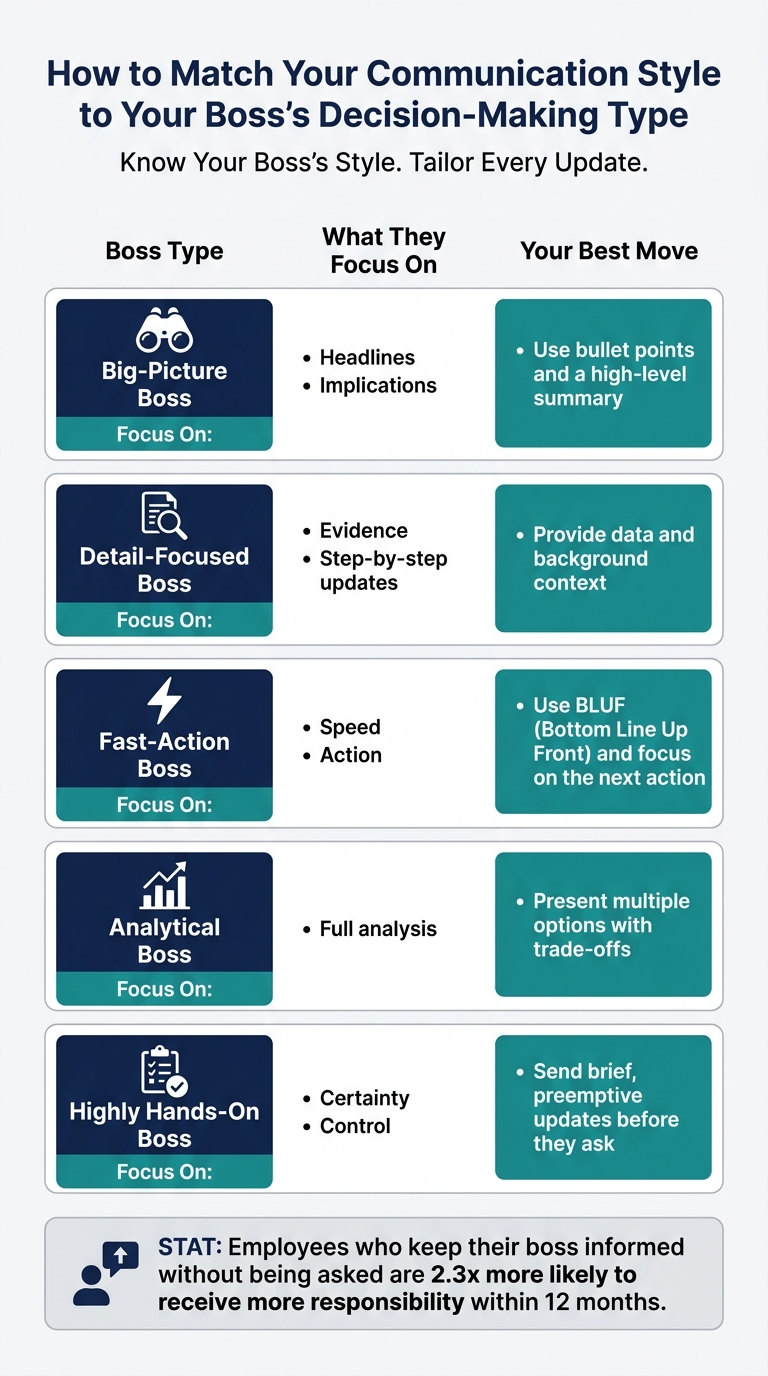
How to Match Your Communication Style to Your Boss's Decision-Making Type - Infographic © MyDifficultBoss.com
When your communication style doesn't match your boss's, even solid work can get lost. Your updates may come across as vague, slow, or half-finished when the issue is how you're sharing them, not the work itself. The fix is often simple: make updates easy to scan, lead with the main point, match their pace, and use the channel they pay attention to. After that, the next move is to line up not just the format, but the way your boss makes decisions.
How to Match Detail, Timing, and Format
Start with BLUF - Bottom Line Up Front. Put the conclusion, request, or recommendation in the first sentence, then add context only if it's needed. If your boss moves fast in meetings, trim the update more than you think you need to.
A good shortcut is Status-Risk-Ask: outcomes, risks, and one clear request. It keeps updates easy to skim and makes your ask stand out.
Channel matters too. If your boss tends to decide out loud, a short call or Slack message may work better. If they like time to think things through, send written notes they can review first. And if your usual format keeps falling flat, change the message to fit how your boss decides.
How to Read Your Boss's Decision-Making Pattern
Pay attention to the questions your boss asks. Those questions usually tell you what they need from you. If they keep asking, "What's the data?" they want specifics and evidence before they decide. If they ask, "What's the next step?" they want the main point and a clear action.
Use the pattern below to pick the right level of detail before you speak.
| Boss Type | What They Focus On | Your Best Move |
|---|---|---|
| Big-picture | Headlines, implications | Use bullet points and a high-level summary |
| Detail-focused | Evidence, step-by-step updates | Provide data and background context |
| Fast-action | Speed, action | Use BLUF and focus on the next action |
| Analytical | Full analysis | Present multiple options with trade-offs |
| Highly hands-on | Certainty, control | Send brief, preemptive updates before they ask |
If you're still not sure what style your boss wants, ask directly. Try: "What level of detail do you prefer?" "How often would you like updates?" and "What's the best way to keep you informed?"
When Questions, Objections, and Risks Catch You Off Guard
Even if you choose the right format, your boss may still push back. That part is normal. What keeps those moments from turning into a scramble is preparation.
Most of the time, the problem isn't bad work. It's missed objections. Before any meeting, write down the three questions your boss is most likely to ask, then prep an answer for each one. That simple habit helps you walk in ready for the issues most likely to come up.
What to Prepare Before Any Update or Request
Before any meeting or status update, have four things ready: your current status, any risks or blockers building in the background, your recommended next step, and a plain statement of what you need from your boss - whether that's a decision or support.
If you're presenting a proposal, lead with the recommendation. Explain what's happening, lay out three options, and include the next step you recommend. For higher-stakes proposals, it can help to share a preview before the formal meeting so your boss can flag concerns early.
It also helps to build an early-warning habit. If a deadline is starting to slip or there's friction on the team, tell your boss before they hear it from someone else. That's the no-surprises approach, and it goes a long way in building trust.
When pushback shows up, match your response to the signal.
A Quick-Reference Table for Common Boss Reactions
When pushback hits, the goal is to give a clear path forward, not to get defensive. Use this table to match what you're seeing with a direct response.
| Problem | Likely Boss Signal | Best Response |
|---|---|---|
| Last-minute pushback | Why are we doing this now? or I'm not sure about this. | Reference the preview you shared earlier and connect the proposal to their top quarterly goals. |
| Repeated follow-up | Where are we on X? or I haven't heard about Y lately. | Answer with the current status, then set the next update time. |
| Deadline concerns | Is this going to be ready by Friday? | We're running behind due to [Reason]. Here's my recovery plan to hit the milestone by [New Date]. |
| Scope creep | Can we also add this new task today? | If we add this now, [Project X] will slip by [Timeframe]. Which outcome do you want to protect? |
| Indecision | Silence or let me think about it indefinitely. | Propose a default path: If I don't hear otherwise by Friday, I'll proceed with Option B. |
| Resource friction | We don't have the budget/headcount for this. | Offer a small pilot or smallest workable version to reduce perceived risk and demonstrate early value. |
If a question catches you off guard and you aren't sure, don't bluff. Say you don't know yet, say you'll check, and follow up by [Timeframe]. That keeps the conversation honest and professional.
When Your Updates Are Reactive and Trust Is Still Weak
After you’ve dealt with priorities, format, and pushback, the next issue is cadence. If your boss still needs to come to you for a status check, your communication is still reactive. What you want instead is a rhythm they can count on.
How to Shift From Reactive Updates to Regular Reporting
A simple place to start is a three-line weekly email:
- what shipped
- what is in progress
- what is blocked
If you need a bit more detail, use Status-Risk-Ask. It keeps the update tight and easy to scan. Then end with one clear request: a decision you need, or a heads-up they should hear from you before it comes from someone else.
That fixed rhythm does something small but powerful. Over time, it makes your updates easier to trust.
If you’re not sure how often your boss wants to hear from you, ask plainly: "How often do you want updates from me?"
How Trust Is Built Through Consistency
Once the rhythm becomes predictable, trust starts to come back. Not all at once, and not through one polished message. It grows through steady follow-through.
Hit deadlines. Close loops. Flag problems before your boss hears about them somewhere else.
When a commitment slips, keep it simple. Say what slipped, explain the cause without making excuses, share the new plan, and then do what you said you’d do. That kind of visible follow-through after a stumble goes a long way.
If trust is already strained, MyDifficultBoss.com offers scripts and step-by-step guidance.
Conclusion: A Simple System for Staying Ahead of Your Boss's Needs
Anticipating your boss's needs comes down to four habits you do again and again: clarify priorities, match communication, prepare for objections, and report on a set rhythm.
Here’s what that looks like in practice. Clarify priorities early, then write them down so expectations don’t drift. Adjust how you communicate based on what your boss actually takes in, not what you prefer to send. Think through likely objections before any update or request. And keep reporting on a fixed rhythm so your boss never has to track you down for a status check.
Employees who keep their boss informed without being asked are 2.3x more likely to receive more responsibility within 12 months.
The point is simple: replace guesswork with a system. That can be a short Friday update that stays under 400 words, a Status-Risk-Ask format that makes weekly updates easy to scan, and a habit of flagging problems before your boss hears about them somewhere else. Nothing here is hard. But it does need to happen on a regular basis.
Once these habits start working together, the dynamic changes. Your boss spends less time wondering where things stand. You spend less time scrambling to explain delays or surprises. The relationship gets steadier, and that steadiness builds trust. For tougher situations, MyDifficultBoss.com offers scenario-specific guidance and scripts.
FAQs
How can I learn my boss’s communication style quickly?
Start by looking for patterns. Do they lean toward detailed reports or quick summaries? Do they like meetings, or would they rather get updates in writing? Pay attention to how they respond in different situations too, and notice when they seem most open to talking.
If you want a faster, more structured option, try the Boss Decoder tool at MyDifficultBoss.com. You can also ask them directly about their preferences, like how often they want check-ins and the best way to share information.
What should I do if my boss keeps changing priorities?
Frequent priority shifts often say more about your boss’s pressure, or weak leadership habits, than about your work. The Boss Decoder tool at MyDifficultBoss.com can help you spot your boss’s type and get a better read on what may be behind all the changes.
When priorities move, don’t just scramble and hope for the best. Ask clear questions about the goal, the deadline, and what this change means for your other work. Keep the discussion focused on fixes, not blame.
It also helps to put the final call in writing. A short follow-up note with the agreed priorities and deadlines gives both of you a clear record to work from.
How often should I send updates without overdoing it?
Ask your manager at the start of a project how often they want updates. Set the rhythm early, then stick to it. That kind of consistency helps build trust.
For many roles, a brief weekly written update is a solid baseline. If you're working on a high-stakes project or dealing with a crisis, daily or even hourly check-ins may make more sense. And if your boss keeps asking for status updates, that's usually a clear sign you need to communicate more often.