I'm worried AI is going to take my job. What can I do?
Learn which tasks AI can automate, how to use AI tools, and steps to make your human skills indispensable at work.

Worried AI might replace your job? Here's what you can do:
- Understand AI's Limits: AI automates tasks, not entire jobs. Focus on skills like decision-making, empathy, and problem-solving - areas where humans outperform AI.
- Assess Your Role: Break your tasks into three categories - Automate (AI can handle), Augment (AI assists), and Human-Only (requires judgment, relationships, or ethics). Shift your focus to Human-Only tasks.
- Understand your boss's priorities: Align your efforts with what matters most to them. Tools like the Boss Decoder Quiz can help.
- Learn AI Tools: Familiarize yourself with AI tools to improve your productivity. Workers skilled in AI earn up to 56% more and are better positioned for future roles.
- Make Your Value Clear: Document and communicate your contributions, especially those emphasizing human-centric skills like leadership and creative problem-solving.
-
Adapt to Your Boss's AI Approach:
- Cost-Cutting Boss: Show how you complement AI by handling high-stakes or judgment-heavy tasks.
- Hype-Driven Boss: Position yourself as an AI translator, bridging the gap between AI's potential and its practical application.
- Risk-Averse Boss: Take the lead in testing AI tools to show their safe integration into workflows.
Signs Your Job Might Be at Risk: If your work involves repetitive tasks or your company is rapidly adopting AI without clear communication, it's time to act. Watch for layoffs, leadership shifts, or changes in team dynamics.
Take Action:
- Leverage platforms like MyDifficultBoss.com to find tailored solutions and scripts to manage all boss interactions effectively.
- Dedicate time weekly to learning AI tools.
- Highlight how AI enhances your work, not replaces it.
- Prepare for potential job changes by updating your skills and resume.
Key Takeaway: AI isn't replacing jobs - managers' decisions about AI are. Show your value by combining AI fluency with uniquely human skills.
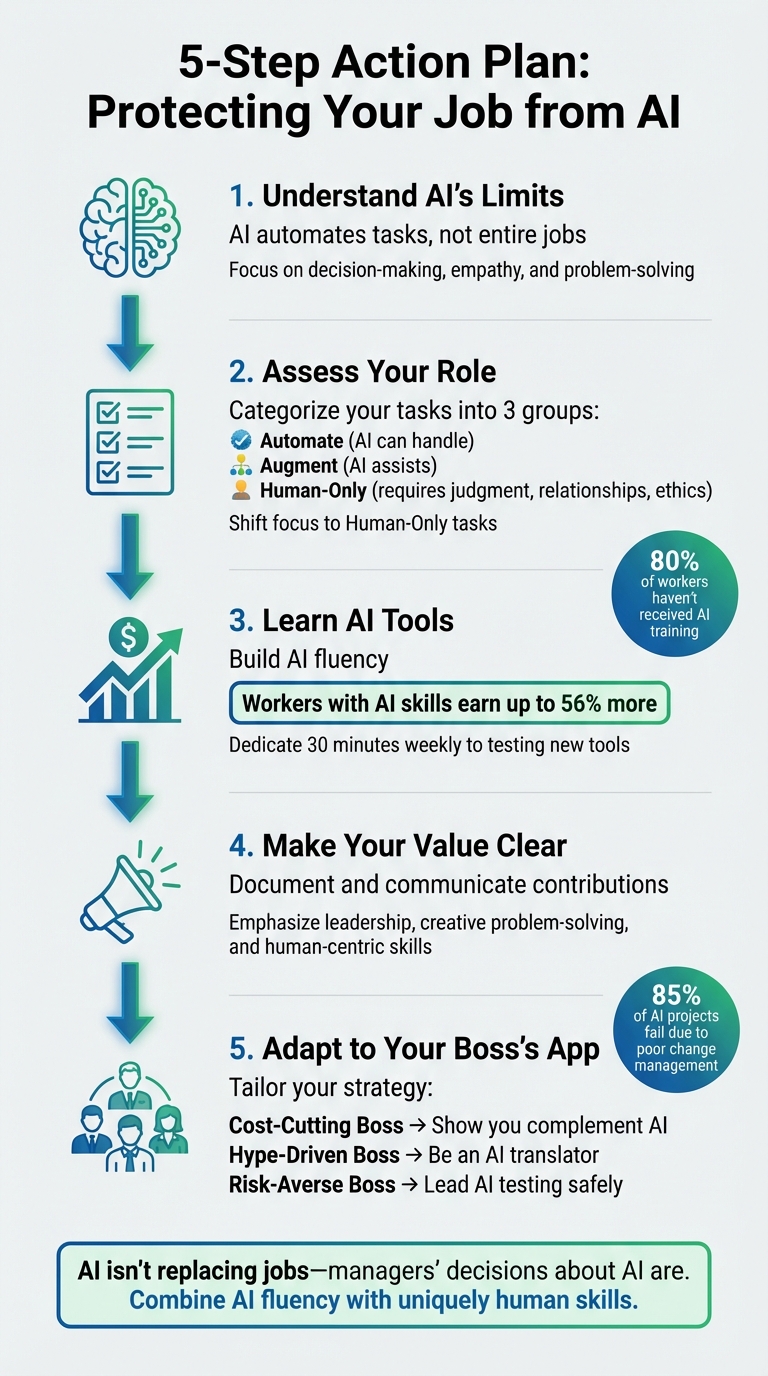
5-Step Action Plan to Protect Your Job from AI Automation UK
What AI Changes - And What It Doesn't
AI Automates Tasks, Not Complete Jobs
AI is transforming work by automating specific tasks, not entire jobs. According to McKinsey Global Institute, tasks that account for over 50% of all U.S. work hours could theoretically be automated using current technologies. But that doesn’t mean half of all jobs are vanishing - what’s actually changing is the nature of work.
AI thrives in handling routine, repetitive, and data-heavy tasks. Think of things like data entry, processing information, scheduling, filling out forms, or generating standardized reports. By taking over these time-consuming activities, AI allows you to focus on areas where human skills shine - like decision-making and strategic thinking. For example, AI chatbots can efficiently handle basic customer questions or draft clinical reports, but the more nuanced and complex aspects of those roles still require human expertise.
Tasks requiring complex problem-solving, empathy, ethical judgment, and trust-building remain firmly in the human domain. AI might excel at analyzing a radiology scan, but interpreting the findings and providing compassionate care? That’s still the radiologist’s role. Similarly, while AI can draft an email, it can’t deliver sensitive feedback to a struggling team member or mediate a heated workplace conflict.
"AI drafts. Humans decide."
- Dr. Carol Parker Walsh, Founder, Carol Parker Walsh Consulting Group
In short, the work that calls for emotional intelligence, mentorship, and accountability in high-stakes situations continues to rely on human input. This division of labor between humans and AI is where misunderstandings often arise, particularly among managers.
How Bosses Misunderstand AI Capabilities
While AI is excellent at automating tasks, many leaders misinterpret its abilities, and this misunderstanding can significantly affect your role. Managers often overestimate what AI can do, mistakenly believing it can replace entire roles rather than support them. Since AI can now perform tasks like writing and analysis - areas once thought to be uniquely human - some bosses assume it can take over entire jobs.
One key issue is that managers may not fully grasp AI’s limitations. AI can produce outputs that sound reliable but are riddled with inaccuracies. It’s prone to "hallucinations", where it creates plausible-sounding but false information, including fabricated names, dates, and statistics. It can also exhibit "agreement bias", telling users what they want to hear instead of providing accurate insights. Without human oversight to fact-check and validate these outputs, relying solely on AI can lead to serious mistakes.
Another pitfall is the "technology-first" mindset, where leaders see AI as a cost-cutting tool rather than a way to enhance human capabilities. This approach often focuses on reducing headcount, overlooking the fact that AI struggles with the very qualities that make organizations thrive - like empathy, ethical decision-making, and managing complex collaborations.
The result? A disconnect that can put your job at risk. When managers don’t understand AI’s limitations, they might make decisions based on flawed assumptions, potentially jeopardizing your role - not because AI can truly replace you, but because they mistakenly believe it can. This gap in understanding can have real consequences for your job security.
On Your Side Podcast: How to A.I.-proof your job
Why Your Boss's Type Determines Your Risk
The real risk from AI isn't about the technology itself - it’s about how your boss views and handles it. Two people with the same job could face very different outcomes, depending on whether their manager sees AI as a cost-cutting tool, an overhyped trend, or something to approach cautiously. Understanding your boss’s mindset is the first step in protecting your role. Your strategy should align with whether your boss is focused on cutting costs, swept up in AI hype, or hesitant to embrace it.
The Cost-Cutting Boss
This type of boss sees AI as a way to slash expenses and boost profits. Their focus is on automating routine tasks like data entry, basic analysis, or report summaries to replace higher-cost human labor. If your work primarily involves repetitive tasks, your position could be at risk.
"Workers who can complement the new automation, and perform tasks beyond the abilities of machines, often enjoy rising compensation. However, workers performing similar tasks, for whom the machines can substitute, are left worse off." - Harry J. Holzer, Nonresident Senior Fellow, Brookings
To safeguard your role, focus on tasks that AI struggles with - those that require judgment, lack clear instructions, or involve high-stakes decisions. Position yourself as the essential "person-in-the-loop", verifying AI outputs, managing legal responsibilities, and adding the human insight that machines lack. Instead of competing with AI, take charge of it. Learn to write clear project specifications, audit results, and oversee its performance.
The Hype-Driven Boss
Unlike the cost-cutting manager, the hype-driven boss tends to overestimate AI’s capabilities. This often leads to rapid adoption without fully understanding its limitations. The risk here isn’t immediate job loss but rather a mismatch between your skills and your boss’s shifting priorities.
To stay relevant, become an "AI translator" - someone who bridges the gap between AI’s potential and what it can realistically achieve. Shift your focus from fearing AI to using it for repetitive tasks, freeing yourself to tackle more strategic work. Show your value by delivering tangible outcomes instead of simply discussing AI’s possibilities.
"AI won't take your job – but someone who knows how to use it just might." - The Conversation
While overenthusiasm can lead to misalignment, a cautious approach brings its own set of risks.
The Risk-Averse Boss
Risk-averse bosses are hesitant to adopt AI, often due to concerns about errors, regulations, or the need for human oversight. While this approach might provide short-term stability, it could leave you unprepared for the inevitable changes ahead. With 45% of CEOs noting that employees are already resistant or hostile toward AI adoption, relying on this conservative stance could limit your opportunities.
To stay ahead, take initiative. Break your tasks into three categories: Automate, Augment, and Human-Only. Use this framework to demonstrate how AI can be safely integrated into your work. Volunteer to test AI tools in low-risk scenarios, showing how they can fit within existing boundaries. Commit to learning one AI tool over the next three months to build your expertise - don’t worry about long-term industry shifts just yet. Workers with advanced AI skills are already earning up to 56% more than their peers, and job postings requiring AI expertise have increased sevenfold.
"The pace of AI will not slow to accommodate your comfort. But it will respond to your engagement." - Benjamin Laker, Ph.D., Professor of Leadership
What You Can Do Right Now
While you may not have control over whether your company embraces AI, you can control how you position yourself in this shift. The professionals who succeed aren't necessarily the most technical - they're the ones who make their value clear, see AI as an ally, and avoid behaviors that reflect insecurity. These steps can help you carve out your role in a changing workplace.
Make Your Value Visible
Your manager can only advocate for what they notice. If your most impactful work - like resolving conflicts, mentoring teammates, or making key decisions - stays under the radar, it might not get the recognition it deserves. Take time to document your contributions, particularly those highlighting human-centric skills like relationship-building, solving complex problems, or making tough calls.
Look for ways AI could improve your workflow and share those ideas with your boss. Interestingly, about 80% of workers say their companies haven’t provided training on generative AI. By engaging in feedback loops and offering practical suggestions, you showcase strategic thinking. This approach is critical, especially since 85% of AI projects fail to meet expectations due to poor change management. By positioning yourself as a bridge between AI tools and real-world challenges, you can become indispensable.
"The success of AI adoption hinges on people and the ways in which they work, far more than on technology alone." - Richard Steele, Execution Specialists Group
Making your contributions visible and aligning them with AI’s potential reinforces your value to the organization.
Position AI as Your Tool, Not Your Replacement
Once you've established your value, the next step is framing AI as a tool to enhance your work, not replace it. How you talk about and use AI with your boss matters as much as the results you achieve. Consider using an AI tool - like ChatGPT - to analyze your role by categorizing tasks into "Automate", "Augment", and "Human-Only". Share these insights during your next one-on-one to demonstrate initiative.
Focus on outcomes when discussing AI. For example, you might say, "Using AI to handle routine data summaries freed up five hours last week for strategic client work." This "Cyborg" mindset - blending AI with human judgment - can set you apart.
A 2023 study by Boston Consulting Group involving 700 consultants found that using GPT-4 for tasks within its strengths, like product innovation and marketing slogans, improved performance by 38% to 42.5%. However, applying AI to areas outside its scope, like complex financial analysis, resulted in performance declines of 13% to 24%. This underscores the importance of knowing when to lean on AI and when to rely on your expertise.
"AI isn't coming for your job. But someone who knows how to work with AI might." - Dr. Carol Parker Walsh, Executive Coach
Developing AI fluency can also pay off financially - workers with advanced AI skills can earn up to 56% more than their peers. You don’t need to become a tech expert; just knowing enough to stay ahead of the curve can make a big difference.
Avoid These Common Mistakes
While it's important to maximize your strengths, it's equally crucial to avoid missteps. Resistance to AI signals that you might be replaceable. Don’t push back against new tools or hoard knowledge - both behaviors can come across as insecurity. In fact, 45% of CEOs say employees often resist or even show hostility toward AI adoption. Instead, adopt a mindset of experimentation and continuous learning.
Take action even when things feel uncertain. AI-driven changes are constant, and waiting for perfect clarity can leave you feeling powerless. Focus on what you can adjust in the next three months rather than worrying about the distant future.
Don’t try to compete with AI on speed - it’s a losing game. Instead, focus on areas where humans excel, like ethical reasoning, nuanced judgment, and building relationships. Always double-check AI outputs for errors, and watch out for "agreement bias", where AI might simply confirm your expectations.
Lastly, avoid overhyping AI’s capabilities to your boss. Overpromising what AI can do risks damaging your credibility. Instead, position yourself as someone who understands both the strengths and limitations of these tools.
| Mistake | Why It Backfires | What to Do Instead |
|---|---|---|
| Ignoring AI entirely | Signals you're falling behind | Dedicate 30 minutes a week to testing a new tool |
| Hoarding knowledge | Comes across as insecurity | Share insights on how AI can be applied effectively |
| Blindly trusting AI output | Errors can harm your reputation | Always review and refine results |
| Competing on speed | Automation will always win | Focus on tasks requiring judgment and relationship-building |
When Fear Signals Real Risk
Sometimes, anxiety about AI is just noise fueled by alarming headlines. But other times, it’s a real warning that your role is shifting. Knowing the difference is crucial - it helps you decide whether to adapt your approach or start planning an exit.
While adjusting your role can often address these changes, there are moments when that alone isn’t enough. Recognizing the signs that your job may be at risk is the first step.
Signs Your Job May Be at Risk
The real concern isn’t AI in general - it’s how your daily tasks stack up against what AI can already handle. If more than half of your work involves repetitive tasks like data entry, invoice processing, or answering customer queries, your job might fall into the "at-risk" category. AI excels at automating these kinds of predictable, pattern-based activities. On the other hand, jobs that require complex decision-making, empathy, or navigating uncertain scenarios - like shaping company strategy or leading innovative research - are much harder for AI to replace.
Pay attention to changes within your workplace. Warning signs might include rumors of layoffs, vague leadership updates about AI adoption, or top performers quietly refreshing their LinkedIn profiles. These are often early indicators of turbulence. Additionally, if coworkers are avoiding new tools, hoarding knowledge, or disengaging from their work, it could signal struggles with AI integration - situations that often lead to cuts.
The risk isn’t hypothetical. Millions of jobs in the U.S. are vulnerable to automation, and generative AI could significantly impact 25% of all roles. Women in high-income countries face a disproportionate risk, with 9.6% of their jobs at high risk of automation compared to 3.5% for men. If your role doesn’t involve tasks requiring human assurance, nuanced judgment, or strong personal connections, your vulnerability increases.
If these red flags sound familiar, it’s time to strengthen your current position and explore alternative paths.
Preparing for a Move or Exit
If these risks resonate, don’t wait for more clarity. Start by evaluating your job through an "AI filter." Break your core activities into three categories: Automate (tasks AI can handle), Augment (tasks AI can assist with), and Human-Only (tasks that rely on judgment, relationships, or ethics). Prioritize growing the "Human-Only" portion of your work. Interestingly, over 70% of the skills employers value today apply to both automatable and non-automatable tasks, so you likely already have transferable skills you can build on.
Even as you work on enhancing your current role, be ready to pivot. Look for internal opportunities - listings for AI-related management roles have surged sevenfold. Position yourself as an "AI translator", someone who bridges the gap between technology and its practical application. Workers with advanced AI skills tend to earn 56% more than peers in similar roles. Volunteering to test AI tools or identifying areas where AI could improve workflows can demonstrate your strategic value.
If internal moves aren’t feasible, start developing an exit plan. Narrow your focus to the near term - think three months instead of five years. Use this time to master a specific tool, strengthen key relationships, or document achievements that highlight your adaptability and value. Update your resume to emphasize skills rooted in judgment and interpersonal strengths. The goal isn’t to "future-proof" your career entirely but to show that you’re adaptable and ready to grow.
Conclusion
You can’t stop the AI revolution, but you can decide how to navigate it. The real question is whether your boss sees you as a strategic asset and notices the steps you’re taking to remain indispensable.
Confidence grows when you act, even in uncertain times. Instead of letting worry take over, channel that energy into productive work - even if it’s not perfect. This shift helps you regain balance and a sense of control.
Keep your focus short-term. Don’t get lost planning for the next five years; concentrate on what you can stabilize in the next three months. Maybe it’s a tool you need to learn, a relationship to strengthen, or a workflow issue that needs solving.
"The speed of technological change will make adaptability the ultimate human superpower."
- Lareina Yee and Anu Madgavkar, McKinsey Global Institute
Lean into the qualities that make you irreplaceable: sound judgment, empathy, ethical reasoning, and the ability to handle complex challenges. These are the areas where AI falls short. Position yourself as the person who directs AI, evaluates its results, and applies critical human judgment - not someone trying to compete with it.
FAQs
Which parts of my job are most likely to be automated?
Tasks that are repetitive and primarily digital - such as data entry or processing information - are the easiest to automate. On the other hand, work that involves judgment, interpretation, asking thoughtful questions, or overseeing and guiding machines is far less likely to be replaced. It's important to highlight your contributions in these areas and ensure they align with broader goals.
How do I prove my value to a boss pushing AI?
AI is a powerful tool, but it has its limits. This is where your human qualities - like judgment, emotional intelligence, and strategic thinking - truly shine. These are skills that no algorithm can replicate, and they’re essential in making AI-driven strategies effective.
To make your contributions stand out, align your work with your company’s goals. Show how your input directly impacts success. For example, if you’re using AI tools to streamline processes, highlight how your decision-making ensures these tools are applied in the most effective way. Framing your role as a critical piece of the bigger picture reinforces your value.
It’s also important to stay open to change. Embracing AI tools and committing to continuous learning not only keeps you relevant but also demonstrates that your unique human capabilities - like creativity and adaptability - are irreplaceable. By combining these with AI, you position yourself as an indispensable part of an evolving workplace.
What AI tools should I learn first for my role?
To stay ahead in a workplace increasingly shaped by AI, focus on building skills that set you apart. Start by mastering AI tools like ChatGPT, data analysis platforms, or automation software. These tools can help you streamline tasks and enhance productivity.
At the same time, don’t overlook the importance of human-centric skills. Learn how to ask insightful questions, interpret AI-generated outputs accurately, and apply sound judgment. These abilities are crucial for working alongside AI effectively and ensuring its outputs align with your goals.
By combining technical expertise with critical thinking and decision-making, you’ll position yourself as a valuable asset in this evolving landscape.