5 Ways to Handle a Gossiping Boss
Practical strategies to protect your career and stop a gossiping boss: recognize, set boundaries, confront, document, or move on.

Dealing with a gossiping boss can be tricky, but it’s essential for protecting your career and maintaining a healthy work environment. Here are five practical strategies to address this issue:
- Recognize Gossip and Stay Neutral: Identify when conversations cross the line and avoid engaging. Redirect the focus to solutions or professional topics.
- Set Boundaries: Politely express discomfort or shift the conversation back to work. Use subtle tactics like scheduling meetings before other obligations to limit off-topic discussions.
- Address the Issue Directly: If gossip persists, have a private, professional conversation with your boss. Use "I" statements and focus on how the behavior impacts your work.
- Build a Support Network and Document Incidents: Surround yourself with trusted colleagues and keep detailed records of inappropriate behavior to protect yourself if the situation escalates.
- Evaluate Your Long-Term Career Goals: If the toxic environment doesn’t improve, it may be time to consider moving on to a workplace that aligns better with your professional growth.
These steps can help you navigate the challenges of working with a gossiping boss while maintaining professionalism and safeguarding your reputation. For more detailed advice, strategies and scripts, consider exploring resources like MyDifficultBoss.com.
How To Deal With Workplace Gossip | Leadership Basics
sbb-itb-1bb7cb4
1. Recognize Gossip and Protect Yourself
MyDifficultBoss.com provides expert advice and practical tools to help navigate tricky workplace dynamics. Curious about your boss's behavior? Take the Boss Decoder Quiz for clarity.
One critical skill is knowing when a conversation crosses the line from feedback into harmful gossip.
Gossip happens when someone talks about another person instead of addressing them directly. Al Switzler, a social scientist and author at Crucial Learning, explains:
"Gossip can be identified when you or someone you see talks about a person but not to the person."
For example, constructive feedback might sound like, "How is Jane handling the software transition?" Gossip, on the other hand, takes a different tone: "Jane is completely useless - I don't know why we keep her."
Beware of the "Privileged Insider" Trap
If your boss shares "confidential" details about a coworker's performance or personal life, it might seem like a gesture of trust. But it’s not. Chana R. Schoenberger, a BBC features correspondent, cautions:
"If he talks this way about them to you, it's a safe bet you're also on his list."
This behavior is a red flag. A boss who gossips about others is likely doing the same about you behind closed doors.
Watch for Emotional Baiting
Sometimes, gossip is disguised as a question like, "Don’t you think Marcus is in over his head?" Answering could make you seem complicit, potentially damaging your reputation.
The best way to handle these moments? Stay neutral. Try responses like, "I haven’t noticed that" or "I don’t have enough context to say." If the gossip continues, gently redirect the conversation with something like, "That sounds frustrating - is there a way we can help them get up to speed?" This approach shifts the focus from blame to finding solutions, keeping you above the fray.
2. Set Boundaries in the Moment
Recognizing gossip is the first step, but shutting it down effectively is what truly protects your professional reputation. The key is to handle these situations with tact, ensuring you set boundaries without creating tension.
One effective approach is to express your discomfort and redirect the conversation. For instance, you could say something like, "I feel a little odd talking about this behind her back", or "That sounds like something I'm probably not supposed to know." As The Muse explains:
"This response [saying you feel uncomfortable], delivered with a good-natured smile, is a foolproof way of stopping a mean-spirited person in his or her tracks."
If being direct feels too risky, try a "Work Pivot." When your boss starts steering the conversation toward gossip, acknowledge the comment and immediately shift focus to work. For example, you could say, "That sounds frustrating - hey, while I have you, can I ask about the Q3 budget timeline?" This approach naturally redirects attention back to professional matters.
Another subtle yet effective strategy is to use timing to your advantage. If you know your boss tends to overshare during one-on-ones, schedule these meetings right before another obligation, like a call or team meeting. You can then say, "I only have about 10 minutes before my next call, so let's jump straight into the agenda." This creates a built-in boundary without making things uncomfortable.
Here’s a quick breakdown of strategies and examples to help you set boundaries effectively:
| Strategy | Example Script | Goal |
|---|---|---|
| The Boundary | "I've made it a personal rule not to talk about colleagues when they aren't in the room." | Set a clear standard. |
| The Work Pivot | "That's interesting - speaking of [Name], how are we tracking on [Project]?" | Redirect focus to productivity. |
| The Hard Stop | "I have a call in 10 minutes, so let's dive straight into the agenda." | Limit time for off-topic conversations. |
| The Solution Seek | "It sounds like you're frustrated with their performance. How can we address that directly?" | Shift from venting to actionable steps. |
The goal isn’t to lecture or confront your boss but to be the person who doesn’t engage in gossip. By consistently refusing to participate, you set a clear example without needing to say much. Over time, this approach speaks volumes. For more tailored advice, take the Boss Decoder Quiz to gain insights specific to your situation.
3. Talk to Your Boss Directly and Professionally
Sometimes, even after setting boundaries, gossip can persist or even escalate. When this happens, it might be time to address the issue directly with your boss. Before you take that step, consider checking out resources like MyDifficultBoss.com or tools such as the Boss Decoder Quiz, which can offer insights into your boss's behavior and help you prepare.
When you're ready to have the conversation, focus on how the behavior impacts your work rather than assigning blame or questioning intent. A calm, factual tone can help keep the discussion productive. Al Switzler, co-founder of Crucial Learning, offers this advice:
"If you share your intentions - what you are trying to do and what you are not trying to do - and then share the facts that you see, you will have the right issues on the table."
For instance, you might say something like, "I value our working relationship and want to ensure we’re aligned. This isn’t about criticism but about improving how we work together." Using "I" statements can make your concerns feel less accusatory, such as explaining how the gossip has affected you directly.
If the gossip has become personal, you can ask for direct feedback by saying, "If you have concerns, I’d appreciate it if you could address them with me directly." Always aim to have these discussions in private to reduce the chances of defensiveness and to foster a more open exchange.
To help you navigate these conversations, here's a quick guide to choosing the right approach based on the setting:
| Setting | Best For | Approach |
|---|---|---|
| Private One-on-One | Personal impact or rumors about you | Address specific instances using "I" statements |
| Team Meeting | Department-wide gossip culture | Suggest shared ground rules for respectful and clear communication |
| Performance Review | Long-term patterns affecting growth | Discuss how recurring behavior impacts trust and overall productivity |
4. Build a Support Network and Document Incidents
Addressing workplace issues directly is a great start, but sometimes the problem doesn’t go away. That’s where a strong support network and careful documentation come into play. Surrounding yourself with trusted colleagues and mentors can provide professional guidance and emotional encouragement when you need it most.
Look for coworkers who focus on the job and steer clear of gossip. These are the people who either redirect negative conversations or quietly remove themselves from toxic situations. It’s also helpful to connect with peers from other departments who can offer a fresh, unbiased perspective on workplace dynamics.
Al Switzler emphasizes this distinction:
"It's important to make a distinction between a 'friend' and an 'accomplice.' A friend is someone who helps you; an accomplice is someone who helps you get in trouble."
Marcel Schwantes, Principal and Founder of Leadership From The Core, adds a practical reminder:
"Unless you have absolute certainty that you can trust a coworker, the rule of thumb is plain and simple: Don't trust personal information with anyone at work that will be fodder for gossip."
In addition to building a reliable support system, make it a habit to document any incidents of workplace toxicity. A 2025 report found that 72.2% of employees who experienced toxic environments cited gossip, cliques, or exclusion as major contributors to the problem. If the behavior of a boss or coworker escalates, having detailed records can protect you. Be thorough - note the date, time, location, exact words spoken, and who was present. Save relevant emails and keep track of your own contributions to the team to avoid misrepresentation.
This combination of support and documentation shifts your approach from reactive to proactive. It puts you in a stronger position if the situation ever requires HR involvement. For more tools, templates, and advice on handling these challenges, check out MyDifficultBoss.com.
5. Think About Your Long-Term Career Position
Take a moment to reflect: Is this situation something you can handle, or is it taking a toll on you?
A boss who engages in gossip isn't just annoying - it disrupts fair decision-making. When managers spread rumors, promotions and assignments often hinge on personal favoritism instead of merit. HR consultant Suzanne Lucas explains it well:
"When you get caught up in the drama and concerned about the little things, you lose perspective on the things that matter, like the business. Instead you end up making decisions on who you like best rather than who is best for the job."
This type of workplace can quietly derail your career. If you're being excluded from key projects, passed over for promotions, or struggling to collaborate due to cliques encouraged by your boss, that's more than just an annoyance - it's an obstacle to your professional growth.
Take stock of how this environment is affecting you physically and mentally. If you’re dreading work every day, struggling to sleep, or feeling constant low-level stress, these are red flags. Career writer Elizabeth Muenzen highlights the risks:
"The more energy you expend on active hate, the more at risk you are for headaches, digestive issues, and stress that causes high blood pressure."
These symptoms are a wake-up call to reconsider your current trajectory.
Here’s a practical way to evaluate: Has anything improved after raising concerns? If you’ve already set boundaries, documented incidents, and involved HR without seeing any changes, it’s a sign that leadership doesn’t prioritize a healthy workplace. As iHire notes:
"If you have reported concerns and nothing changes, leadership may not prioritize a healthy work culture."
If that's the case, it may be time to prepare for a transition. Update your resume, polish your LinkedIn profile, and set up job alerts - all while continuing to deliver strong work.
Michele Weldon, an author and journalist, offers a straightforward perspective on knowing when to move on:
"The gossip may simmer down, and if it doesn't, it might be time to find a workplace culture where there is no trash talk allowed."
Using your documented experiences and support network, assess whether your current workplace aligns with your career goals. For personalized advice on navigating difficult work environments, visit MyDifficultBoss.com to protect your professional future.
Boss Decoder Quiz: Find Out What Type of Boss You Have

When it comes to managing workplace gossip, understanding your boss’s behavior can make all the difference. Different bosses handle communication - and gossip - in their own unique ways. Some might use it to build connections, while others might lean on it to shift blame. The Boss Decoder Quiz at MyDifficultBoss.com is designed to help you identify your boss's specific type, so you can respond more effectively.
For instance, is your boss someone who constantly shifts blame (a scapegoater)? Or maybe they’re overly friendly and seek personal validation (the "BFF"-seeker)? Perhaps they’re simply unaware of how their behavior affects the team. Once you know their type, you can adjust your approach. For example:
- A boss open to feedback might respond well to practical, solution-oriented suggestions.
- On the other hand, a boss who frequently breaks commitments may require a more direct conversation about their reliability.
The quiz categorizes bosses into clear archetypes and offers strategies tailored to each. Here’s a quick look at how it works:
| Boss Archetype | Key Characteristics | Recommended Strategy |
|---|---|---|
| The Commander | Direct, results-focused, values efficiency over small talk | Stick to facts, provide data, and suggest actionable plans |
| The Cheerleader | Vision-driven, thrives on positivity, seeks validation | Frame ideas in a way that aligns with their goals; stay upbeat |
| The Caretaker | Nurturing but avoids conflict, struggles with firm decisions | Offer reassurance and provide clear, structured options |
This quiz doesn’t just label your boss - it equips you with practical strategies to work effectively with them. After identifying your boss’s type, you’ll gain access to over 135 scenarios, starter scripts, and detailed tactics on MyDifficultBoss.com.
Ready to take the guesswork out of dealing with your boss? Dive into the resources available and start addressing challenges with confidence.
Strategy Comparison Table
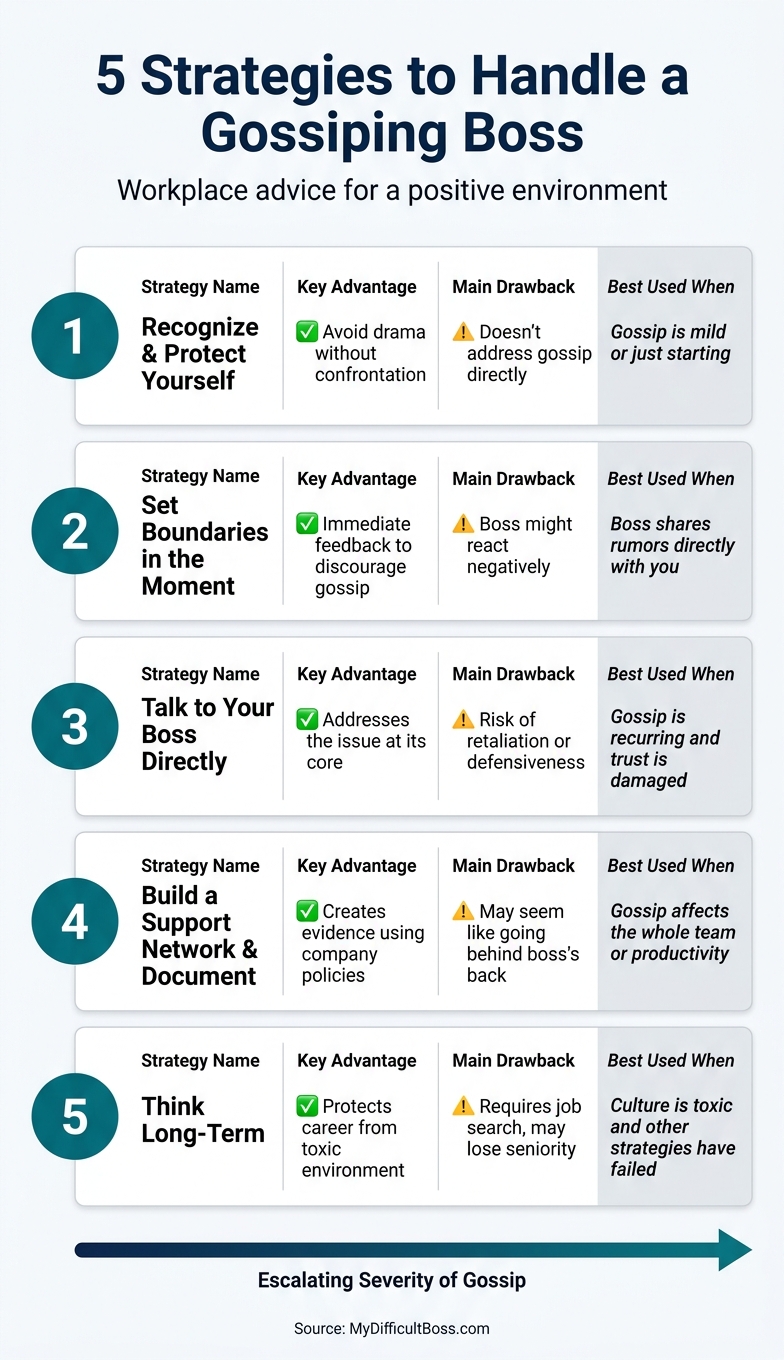
5 Strategies to Handle a Gossiping Boss: Quick Comparison Guide
Choosing the right approach depends on how serious the gossip is, how long it’s been happening, and your relationship with your boss. The table below breaks down each strategy, highlighting its main benefit, drawback, and when it’s most effective.
"If gossip has not been managed in the past, gossip tends to become a negative aspect of your work culture." - Susan M. Heathfield, Management and HR Consultant
| Strategy | Key Advantage | Main Drawback | Best Used When… |
|---|---|---|---|
| 1. Recognize & Protect Yourself | Lets you avoid drama without confrontation | Doesn’t address the gossip directly and may feel isolating | Gossip is mild, happens rarely, or has just started |
| 2. Set Boundaries in the Moment | Offers immediate feedback to discourage gossip | Can feel uncomfortable; your boss might react negatively | Your boss shares rumors or confidential information directly with you |
| 3. Talk to Your Boss Directly | Addresses the issue at its core and can help rebuild trust | Risk of retaliation or defensiveness from your boss | Gossip is a recurring issue, and trust has already been damaged |
| 4. Build a Support Network & Document Incidents | Helps create evidence and use company policies to address toxic behavior | May appear as though you’re going behind your boss’s back if not handled carefully | Gossip is harmful, affects the entire team, or disrupts productivity |
| 5. Think Long-Term | Protects your career by removing you from a toxic environment | Requires a job search and could mean losing seniority | The workplace culture is toxic, your boss is unlikely to change, and other strategies have failed |
This table serves as a quick reference to help you evaluate your situation and choose the best course of action for maintaining a professional and healthy work environment.
It’s important to realize that staying silent isn’t a neutral choice. When you don’t address your boss’s gossip, you may unintentionally enable the behavior, which can lower the team’s overall standards. Even passive strategies, like avoiding drama, require deliberate actions, such as being careful about what personal details you share.
As gossip becomes more severe, the stakes of each strategy increase. For example, while setting boundaries might work early on, a direct conversation becomes more impactful once a pattern of gossip is clear - though it also carries higher risks. Focusing on the overall behavior, rather than isolated incidents, can make your discussion with your boss more effective.
Conclusion
A gossiping boss can jeopardize your career - but you can protect yourself with these five strategies.
These approaches provide a clear plan to handle workplace gossip effectively. Start by identifying and shielding yourself from harmful chatter; establish firm boundaries, address concerns head-on, and, if necessary, lean on your support network and thorough documentation to secure your professional future.
Each strategy emphasizes maintaining professionalism and steering clear of contributing to the toxic cycle. As Michele Weldon, Author and Editorial Director at Take The Lead, advises:
"The best you can do is stay clean and above the fray. Do not repeat any gossip at work yourself and definitely do not divulge any reason to be the center of a gossip rant."
Even the more passive strategies require intentional effort - because staying silent can unintentionally enable a toxic environment.
When you're ready to take control of the situation, expert resources are available to guide you. Visit MyDifficultBoss.com for access to 135+ difficult boss scenarios, complete with step-by-step solutions, starter scripts, and tailored long-term advice.
FAQs
How do I shut down my boss’s gossip without sounding rude?
Handling a gossiping boss can be tricky, but there are ways to approach the situation professionally. Start by observing their behavior and identifying patterns. Tools like MyDifficultBoss.com and the Boss Decoder Quiz can help you understand and analyze their tendencies.
When faced with gossip, politely steer the conversation away. You could say something like, "I prefer to focus on work-related topics." This keeps the interaction respectful while setting a clear boundary.
If the gossip persists, turn to MyDifficultBoss.com for advice on creating boundaries and redirecting discussions. These strategies can help you maintain a professional, drama-free work environment.
When is it worth going to HR about a gossiping boss?
If you're dealing with a boss who gossips, it's worth trying to address the issue directly before involving HR. Tools like the Boss Decoder Quiz can help you figure out your boss's personality type and offer strategies tailored to their behavior.
However, if the gossip continues after you've had a conversation or if it escalates into harassment, it's time to take the matter to HR. Make sure to document specific incidents as evidence. For guidance on how to approach these situations professionally, websites like MyDifficultBoss.com provide helpful starter scripts and strategies.
What should I write down if I’m documenting gossip incidents?
When recording incidents, stick to a factual approach using the "Five Ws": Who, What, When, Where, and Why. Here’s how to structure your log:
- Date and Time: Note the exact date and time the incident occurred.
- Location: Specify where it happened (e.g., office, meeting room, or virtual setting).
- Participants: Include names and job titles of everyone involved.
- What Happened: Focus on observable actions or words. For example, write “used a slur” instead of making a subjective judgment. Wherever possible, include direct quotes to capture the exact language used.
- Why: If relevant, clarify the context or circumstances leading to the incident.
Additionally, document your response to the situation and any impact it had on you - this could range from emotional distress to professional challenges. For example, if an email caused confusion or upset, note how it affected your ability to work.
Keep related evidence, such as emails, texts, or voicemails, as part of your record. If you need further clarification on any aspect of the incident, follow up in writing to ensure all details are clear and documented. This methodical approach ensures accuracy and helps maintain an objective tone.