How to Handle a Passive-Aggressive Boss
Practical steps to recognize, respond to, and document passive-aggressive bosses while protecting your work and well-being.

Dealing with a passive-aggressive boss can be frustrating and stressful. They often use indirect hostility - like backhanded compliments, vague instructions, or withholding resources - that undermines your confidence and productivity. Here’s how to manage the situation effectively:
- Recognize the behavior: Look for patterns like sarcastic remarks, blame-shifting, or silent treatment.
- Stay composed: Pause before reacting to avoid escalating tensions.
- Communicate clearly: Use direct, neutral language and confirm instructions in writing.
- Document everything: Keep a detailed record of interactions to identify patterns or support escalation if needed.
- Build support: Connect with colleagues or managers outside your reporting line for perspective and advocacy.
- Know when to escalate: If the behavior disrupts your work or causes significant stress, involve HR with clear documentation.
At any point, can also explore websites like MyDifficultBoss.com to find scripts and ideas on how to deal with passive-aggressive and other types of difficult bosses.
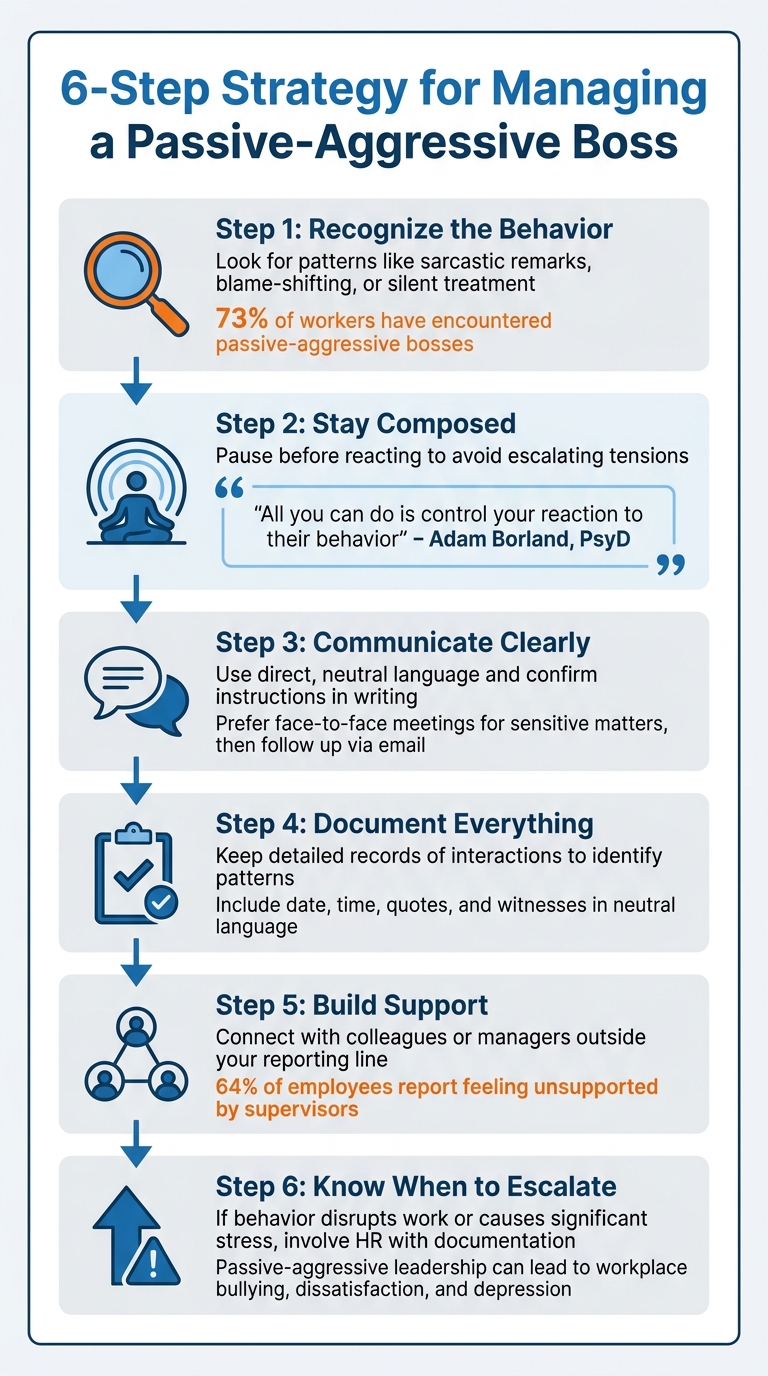
6-Step Strategy for Managing a Passive-Aggressive Boss - Infographic © MyDifficultBoss.com
How to Handle a Passive Aggressive Boss
sbb-itb-1bb7cb4
How to Recognize a Passive-Aggressive Boss
The first step in dealing with a passive-aggressive boss is identifying their subtle hostility. Unlike managers who openly express frustration, passive-aggressive bosses hide their discontent behind indirect behaviors. They might agree with you in person but later act in ways that contradict those agreements, leaving you second-guessing their intentions.
Common Passive-Aggressive Behaviors
Passive-aggressive bosses tend to follow certain patterns. For instance, they might deliver backhanded compliments like, "Who knew an intern could produce such great work" or "You're finally pulling your weight." These remarks are less about motivating and more about undermining. They may privately praise your work but later highlight supposed "mistakes" in front of others.
Another tactic includes withholding resources - leaving you out of key emails, meetings, or decisions, which directly impacts your ability to succeed. When you ask for clarity, they might sidestep with dismissive responses like, "You'll have to ask someone else" or "I don’t see how that’s relevant." After disagreements, they might resort to the silent treatment or give intentionally vague instructions that set you up to fail. If confronted, they'll often deflect by saying you're "too sensitive" or misunderstood their intentions.
Blame-shifting is another hallmark of this behavior. Instead of taking accountability, they pin failures on others, creating a workplace rife with unhealthy competition. Recognizing these behaviors is critical before you can take steps to address them effectively.
Effects on Employees and the Workplace
These behaviors don’t just frustrate individuals - they can harm entire teams. Constantly trying to interpret mixed signals and unclear instructions saps energy and focus, pulling attention away from meaningful work. Studies confirm this: 64% of employees report feeling unsupported by their supervisors, which only adds to workplace tension.
A University of Manchester study involving over 1,200 participants revealed that passive-aggressive or overly critical leadership often leads to workplace bullying, dissatisfaction, psychological distress, and even depression. The ripple effect? Increased turnover rates and a culture built on resentment instead of teamwork. Understanding these consequences is key to maintaining professionalism and confidence in such environments.
How to Stay Professional and Confident
Dealing with a passive-aggressive boss can be tricky, but the way you respond makes all the difference. While you can’t control their behavior, you can control your reactions. The goal? Stay composed and address work-related matters directly - without getting caught up in emotional back-and-forths or power struggles.
Keep Calm and Control Your Emotions
When a sarcastic email or snide comment comes your way, pause before reacting. Take a moment to breathe deeply and steady yourself. This simple pause can prevent emotional responses that you might regret later and helps you maintain your professionalism.
"All you can do is control your reaction to their behavior." - Adam Borland, PsyD, Psychologist, Cleveland Clinic
Focus on the message, not the tone. If your boss sends a passive-aggressive request, zero in on the actual task or information. For example, if they add a sarcastic remark while asking for a report, acknowledge the request and ignore the jab. This approach defuses their behavior without making you seem overly sensitive. Avoid mirroring their tone - responding with sarcasm or phrases like "As I mentioned before" can make you seem unprofessional and escalate the situation.
Once you’ve kept your cool, you can shift to clear and direct communication to address any issues.
Communicate Clearly and Directly
After managing your initial reaction, focus on clear and straightforward communication. For sensitive matters, opt for face-to-face meetings or video calls to clarify expectations and ask follow-up questions. This minimizes misunderstandings that often arise through email or text. Afterward, follow up with a concise email summarizing instructions and deadlines using neutral, task-focused language.
When discussing issues, avoid assigning blame. Instead of saying, "You missed the deadline", try, "We need to ensure this goes out by Friday". This keeps the conversation forward-looking and constructive. If your boss makes vague or unclear comments, ask for clarification with something like, "Could you explain what you meant?" This forces them to either clarify their point or drop the passive-aggressive tone.
During tough conversations, practice active listening. Use open body language, maintain eye contact, and nod occasionally to show you're engaged. These small gestures can ease tension, making even defensive or insecure managers feel more comfortable, which can lead to a more productive discussion.
How to Reduce Workplace Stress
When dealing with workplace stress, it's crucial to safeguard yourself with solid documentation and a dependable support system.
Keep Records of Important Interactions
After any significant conversation, follow up with a summary email stating something like: "Per our conversation today, I confirm my understanding of our discussion." This creates a written record of the exchange. If following up directly feels tense or risky, keep a personal log instead. Include key details such as the date, time, location, quotes, and any witnesses. Use neutral language - for instance, write "Manager raised their voice noticeably" rather than "Manager screamed." Store these records securely on a personal hard drive or email them to your private account to ensure access, even if workplace systems are restricted.
"Email is your tool for turning invisible abuse into visible evidence." - Misread.io
One isolated incident might be brushed off as a bad day, but documenting multiple occurrences can reveal a pattern. For example, three incidents may highlight a recurring issue, while five or more can push HR or legal teams to take action. To stay organized, consider maintaining a master file that you update monthly, referencing emails and notes for each case.
While documentation is essential, having a network of supportive people is equally important.
Build a Support Network
A network of allies can strengthen your position and provide much-needed perspective. Cultivate relationships with managers outside your direct reporting line - these individuals can advocate for your professionalism and work ethic if your boss undermines you. Additionally, connect with colleagues who have faced similar challenges. Sharing experiences and strategies can help you navigate difficult situations more effectively. A supportive network not only validates your feelings but also highlights that the issue often stems from your boss's insecurities, not your performance.
"Realizing that the problem doesn't stem from you and you're not the only one bearing the brunt of your boss's poor management skills helps a lot." - Bev Campling, Contributing Writer, Marlee
How MyDifficultBoss.com Can Help
MyDifficultBoss.com provides practical tools to help you navigate the challenges of dealing with a passive-aggressive boss. The platform offers resources that help you recognize problematic behaviors and respond in ways that promote clarity and professionalism. Here are two standout features that can make a difference in your workplace interactions.
Use the Boss Decoder Tool

The Boss Decoder Tool is designed is to help you figure out if your boss's behavior stems from a one-off communication issue or a deliberate management tactic. By analyzing patterns, this tool helps you determine whether the behavior is isolated or part of a larger strategy. It categorizes different boss types and offers specific approaches for managing their actions. For instance, it can interpret comments that mask hostility as compliments and provide ready-to-use scripts to address them. One example: if your boss makes a joke that feels more like a dig, you could respond with, "I didn’t quite get the joke - could you explain what you meant?"
Browse the Boss Problem Solver Library
The Boss Problem Solver Library is a treasure trove of real-world examples that help decode and address passive-aggressive behaviors. With over 135 workplace scenarios (and counting), this library offers step-by-step solutions, sample scripts, and strategies tailored to challenging boss interactions. It covers common tactics like digital "structural traps" (think: "Per my last email"), public criticism disguised as feedback, and even the silent treatment.
Each scenario is designed to give you actionable advice you can use immediately. For example, if your boss praises your work privately but criticizes it publicly, the library walks you through how to ask for clear, written feedback. Or, if you're denied the tools or authority to complete a task, you'll find scripts to document the issue and highlight its impact on your work. Currently, you can access 11 common boss challenges for free, with full access to all 135 scenarios coming soon.
When to Escalate or Limit Contact
When communication with your boss breaks down, it's important to know when to take action. Whether it's involving HR or finding ways to limit interaction, these decisions can protect both your career and your mental well-being. Here's how to navigate these situations effectively.
When to Involve HR
If the relationship with your boss has deteriorated to the point of abusive or harmful behavior, it may be time to escalate the issue. Examples include actions like withholding resources you need to do your job, frequently changing deadlines without notice, or publicly criticizing you while ignoring your contributions. Such behavior can sabotage your career and create a hostile work environment.
Passive-aggressive conduct that disrupts your ability to perform your job or causes serious psychological strain is another red flag. As Ron Carucci, Cofounder and Managing Partner at Navalent, explains:
"A leader's manipulative, passive-aggressive, credit-taking, and overly critical behavior can lead to workplace bullying, job dissatisfaction, psychological distress, and depression."
If you decide to escalate, rely on your documented records to build a case. Compile a clear, focused account of incidents, including dates, specific details, and neutral summaries. This documentation should highlight patterns, such as tasks being delayed, incomplete work being delivered, or key information being withheld. When discussing the issue with HR, stick to the facts and avoid emotional or accusatory language. If the situation proves beyond repair, HR may assist in finding a transfer or other solutions.
However, if escalation isn't immediately necessary, you might consider limiting your interactions with your boss instead.
How to Limit Interaction While Staying Professional
If the situation doesn't call for HR involvement, reducing unnecessary contact can help you maintain focus and professionalism. This approach involves engaging only when absolutely necessary and keeping communication strictly work-related.
Start by keeping greetings short and professional to avoid opportunities for passive-aggressive comments. Whenever possible, move important conversations to written formats. For example, after meetings, send a follow-up email summarizing the discussion and requesting confirmation of instructions or deadlines. This creates a clear record of agreements and minimizes the potential for misunderstandings.
As Bev Campling, Contributing Writer at Marlee, points out:
"Passive aggressive behavior is unacceptable in any environment, and even more so if it can ruin your career and impact your mental health."
Conclusion
This guide has walked you through recognizing, managing, and documenting passive-aggressive behavior in the workplace. Dealing with a passive-aggressive boss can be exhausting, but you have the power to control your reactions, maintain clear documentation, and communicate effectively. In fact, you're not alone - 73% of workers have encountered this issue.
The first step is to depersonalize the behavior. Passive-aggressiveness often stems from your boss's insecurities, not your performance or worth. Experts emphasize focusing on how you respond rather than getting caught up in their tone. Keep detailed records of important conversations to ensure you have a clear and factual account of interactions.
By staying calm, communicating directly, documenting key moments, and building a support network, you can protect both your career and your peace of mind. If the behavior escalates to a point where it disrupts your work or causes significant stress, consider involving HR or finding ways to minimize direct contact while maintaining professionalism.
Your boss’s behavior doesn’t have to define your experience or limit your potential. By consistently applying these strategies, you can create a better work environment for yourself. While change may not happen overnight, your measured and thoughtful responses can make a lasting impact, allowing you to stay professional and thrive despite the challenges.
FAQs
How do I tell passive-aggressive behavior from normal stress?
Passive-aggressive behavior tends to be indirect, often showing up as sarcasm, mixed messages, or subtle attempts at control. In contrast, normal stress usually manifests as open frustration or anxiety without any underlying hostility. To identify passive-aggression, watch for patterns like avoidance or a noticeable lack of acknowledgment or appreciation. Spotting these behaviors can help you respond calmly and maintain a professional demeanor.
What should I write in a follow-up email after a vague request?
When addressing a vague request, it's important to maintain professionalism and steer clear of any tone that might come across as passive-aggressive. A good approach is to politely refer back to your earlier message and ask for clarification or updates. For instance, you could say: "I’m following up on my previous email regarding [subject]. When you have a moment, I’d appreciate any updates or clarification." This keeps the tone respectful while ensuring your communication is clear and productive.
When should I go to HR instead of just limiting contact?
If your boss's passive-aggressive behavior is significantly affecting your work, causing constant stress, or continues despite your attempts to address it directly, it may be worth involving HR. On the other hand, if the behavior is tolerable, doesn't impact your well-being, and allows you to remain professional, limiting contact could be an effective strategy. When the situation becomes overwhelming, escalating the issue might be necessary. However, in many cases, setting clear boundaries and minimizing interactions can help manage the problem.