How to Deal With a Boss Who Denies Needed Vacation Time Off
Handle denied vacation requests: know your rights (PTO, FMLA, ADA), prepare coverage, document communications, and involve HR when needed.

If your boss denies your vacation request, it can be frustrating, but you have options to address the situation effectively. Here's what you need to know:
- Understand Your Rights: Different types of leave (PTO, FMLA, ADA accommodations) have varying legal protections. Employers can deny PTO for business needs, but protected leave under FMLA or ADA has stricter rules.
- Prepare Your Case: Review your company’s policies, plan work coverage, and propose alternative dates if needed. Anticipate common objections like deadlines or understaffing.
- Communicate Strategically: Schedule a private meeting, stay professional, and present a clear plan. Use follow-up emails to document discussions.
- Involve HR if Necessary: If denials seem unfair or violate legal protections, escalate the issue to HR with proper documentation.
- Keep Records: Document all requests, responses, and reasons given for denials. This can protect you in case of disputes.
- Evaluate Long-Term Impact: If repeated denials affect your health or career satisfaction, consider whether the job aligns with your goals.
Know Your Situation and Your Rights
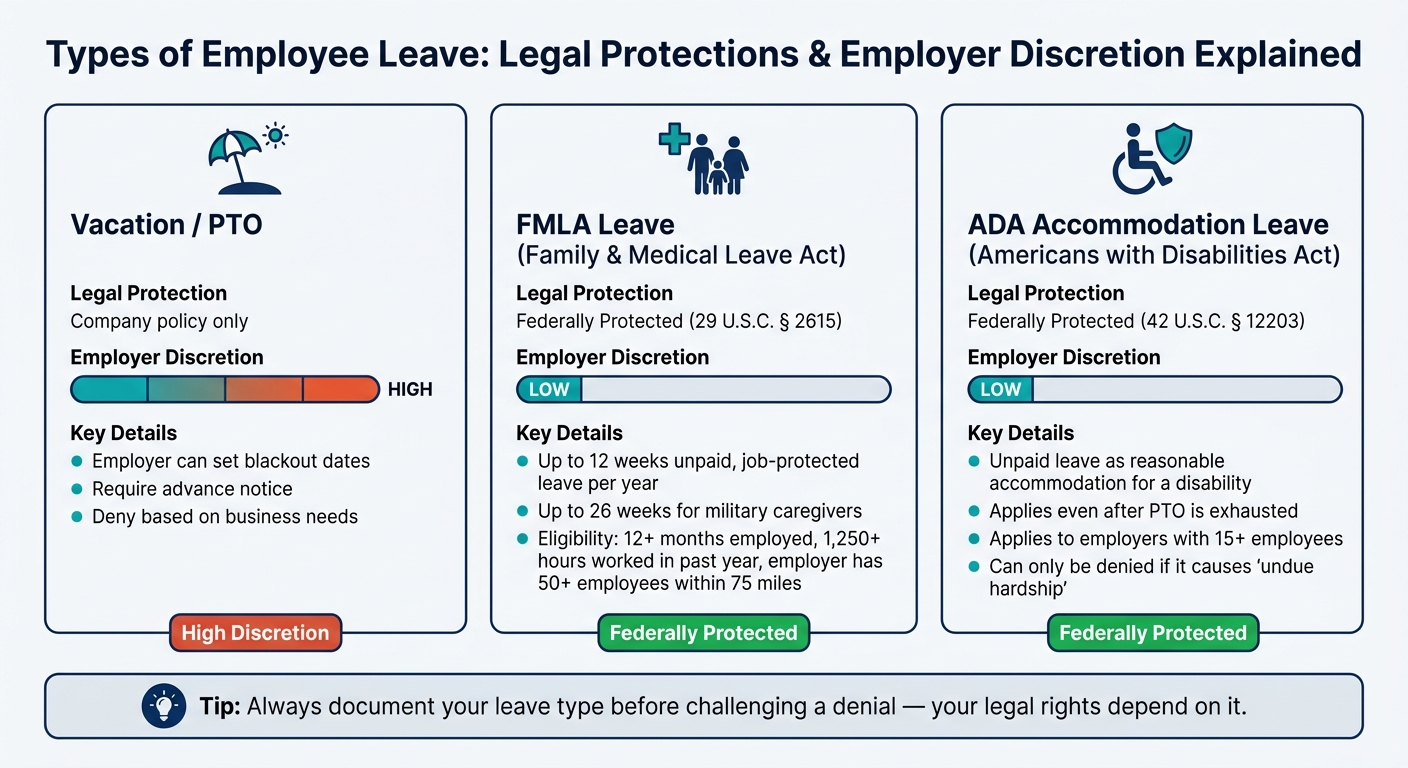
Types of Employee Leave: Legal Protections & Employer Discretion Explained - Infographic © MyDifficultBoss.com
Asserting your rights starts with knowing the type of leave you're requesting and understanding the legal protections attached to it. Before challenging a denial, make sure you’re clear on what applies to your situation.
Types of Time Off and How They Work
Not all time off is created equal - some types come with specific rules and protections. Vacation and PTO (Paid Time Off) are benefits provided by your employer and are governed by company policies. Protected leave, on the other hand, operates under federal laws like the Family and Medical Leave Act (FMLA).
Under FMLA, eligible employees are entitled to up to 12 weeks of unpaid, job-protected leave per year for qualifying reasons, such as a serious health condition, the birth of a child, or caring for an ill family member. For military caregivers, this can extend to 26 weeks within a 12-month period.
"The FMLA provides eligible employees of covered employers with job-protected leave for qualifying family and medical reasons and requires continuation of their group health benefits under the same conditions as if they had not taken leave." - U.S. Department of Labor
If you qualify for FMLA, your employer might require you to use any accrued vacation or sick leave at the same time, effectively running them out together. Additionally, under the Americans with Disabilities Act (ADA), employers may need to grant unpaid leave as a reasonable accommodation for a disability, even if your PTO is already used up.
When Can a Boss Legally Deny Your Request?
For standard vacation or PTO, your employer has significant discretion. Denials are often lawful if they’re based on legitimate business needs, like peak work periods, staffing shortages, or company-wide blackout dates. If your company’s policies outline specific notice requirements or rules for handling overlapping requests, a denial based on those is generally justified.
"In most cases, employers can deny PTO requests when approval would disrupt business operations or create staffing shortages." - Katie Herrera, SPHR, Human Resources Consultant, Axcet HR Solutions
However, the situation changes when protected leave is involved. Denying a valid FMLA request, refusing a necessary ADA accommodation, or retaliating against an employee for requesting protected leave can lead to legal issues. Always check your company’s policies - denials that don’t align with them can be a red flag.
| Type of Leave | Legal Protection | Employer Discretion |
|---|---|---|
| Vacation / PTO | Company policy only | High - can set blackout dates and notice rules |
| FMLA Leave | Federally protected | Low - must meet statutory requirements |
| ADA Accommodation Leave | Federally protected | Low - only denied if it causes "undue hardship" |
To qualify for FMLA, you need to meet specific criteria: at least 12 months of employment, 1,250 hours worked in the past year, and your company must have a workforce of 50 or more employees within 75 miles of your worksite. Double-check these requirements before citing FMLA in discussions with your employer.
By understanding these distinctions, you can evaluate your situation more effectively and approach any discussion with confidence.
Use the Boss Decoder Quiz to Read the Situation
Knowing your legal rights is just one piece of the puzzle. The other is figuring out why your boss denied your request. This is where understanding their behavior and management style can make a big difference.
The Boss Decoder Quiz from MyDifficultBoss.com is a quick, 12-question tool designed to help. In just three minutes, it identifies your boss's management style and highlights how to communicate effectively with them.
For example:
- If your boss is "The Commander," stick to data and deadlines instead of emotional appeals.
- For a "Caretaker" type, a calm, reassuring approach may work better.
- If your boss is "The Flip-Flopper," their indecision might be the real issue, not the denial itself.
The quiz also provides conversation scripts tailored to your boss's style, giving you practical tools to navigate tough discussions. Armed with both legal knowledge and insights into your boss’s behavior, you’ll be better prepared to have a productive conversation.
sbb-itb-1bb7cb4
How to Prepare for the Conversation
Before jumping into your approach, take a moment to explore the expert tips at MyDifficultBoss.com. These resources can help you navigate tricky conversations with confidence and tact.
Walking into the discussion unprepared? That’s a recipe for another "no." But with solid preparation, you can turn a tense situation into a productive exchange.
Know What You Need and Where You Can Be Flexible
Start by understanding your company’s PTO policy and confirming how much time off you’ve accrued. Having the facts on your side makes your request more compelling.
Next, figure out what’s non-negotiable and where you can adjust. A wedding or a medical appointment? Those are firm. A beach getaway? That might allow for some wiggle room. Knowing where you stand helps you set priorities and approach the conversation with clarity.
It also helps to think ahead about coverage. If you can walk in with a colleague’s name and a backup plan already in place, you’ll eliminate one of the most common objections right off the bat. And if your preferred dates don’t work, have a backup ready. For instance, saying, "I can also shift to the week of July 14th", shows you’re flexible without giving up your original request entirely.
Anticipate Your Boss’s Concerns
Most refusals boil down to a few predictable reasons: deadlines, understaffing, or a busy period. The good news? You can prepare for these objections in advance.
| Common Objection | How to Address It |
|---|---|
| "We have a deadline." | Lay out a plan to finish your work before leaving. |
| "Too many people are out." | Coordinate with your team and present a coverage plan. |
| "It's a busy period." | Suggest a daily check-in or offer to borrow future PTO. |
It’s also worth considering the pressures your boss might be under. Often, a denial isn’t personal; it might reflect higher-level demands or team-wide challenges. Acknowledging this upfront - like saying, "I know Q3 is always a crunch time for us..." - can help diffuse tension and show empathy.
Armed with these insights, you’ll be ready to present a clear, respectful case for your time off.
Write a Clear, Professional Script
Once you’ve thought through potential concerns, craft a script that tackles them head-on. Keep it concise and professional, covering your requested dates, work status, coverage plan, and an invitation for feedback.
"Your job is to learn how to ask for time in a way that still shows commitment and responsibility."
- Elizabeth Perry, Coach Community Manager, BetterUp
Here’s a simple structure to follow:
- Start by thanking your boss for their time.
- Clearly state your requested dates.
- Confirm that your work is on track.
- Mention your backup plan and colleague’s name.
- Wrap up with, "Let me know if you have any concerns or questions about my request".
After your conversation, send a quick follow-up email to document what was agreed upon.
"If your organization defaults to face-to-face conversations, it's important to be clear and to the point so the manager knows what to expect from the interaction."
- Oyster Team
Timing matters, too. Avoid bringing up your request when your boss is visibly stressed, buried in work, or about to head into a big meeting. Catching them during a calm moment can make all the difference.
For more tailored strategies on handling tough conversations with your boss, check out MyDifficultBoss.com.
How to Handle the Conversation and Pushback
Once you've prepared your case, it's time to approach your boss and handle any objections they might raise.
When and How to Have the Discussion
Set up a dedicated meeting instead of trying to catch your boss during a busy moment. Whether it's an in-person meeting or a video call, scheduling shows that you're serious and gives your boss time to consider your request.
Start the conversation by sharing your coverage plan and updating them on your project status. Then, mention your vacation dates. Framing it this way shifts the focus from "I'm taking time off" to "Here's how everything will stay on track while I'm away."
"It sounds like you would be asking for this time about two and a half months beforehand. It would be absurd for your boss to deny you. So, I say, ask now. The longer you wait, the greater the risk of being denied." - Madeleine Homan Blanchard
By requesting time off early, you reduce the chances of scheduling conflicts and strengthen your case.
Once your plan is clear, prepare to address any pushback during the discussion.
How to Respond to Common Objections
Pushback is normal, so focus on negotiating timing rather than the need for time off. If the proposed dates are an issue, ask immediately about alternatives that might work.
| Objection | What to Say |
|---|---|
| Too many people are out | "I understand staffing is tight. If I complete [Project X] by Friday, can we revisit my time off for the following week?" |
| Short notice | "I apologize for the timing. Let's look at the calendar together to find a window that works for the team's deadlines." |
| Vague or no reason | "I want to make sure I'm meeting expectations. Could you help me understand the specific concerns so I can address them?" |
| Heavy workload | "I can focus on these three priorities before I leave and postpone the rest until I return. Does that work?" |
For more strategies on navigating tricky conversations, check out MyDifficultBoss.com.
When to Bring HR Into the Situation
If direct discussions don't lead to a resolution, it might be time to involve HR. If your boss's denial feels unjustified or inconsistent with company policy, HR can help. This is especially important if your request is treated unfairly compared to colleagues or if the denial follows a workplace complaint, which could suggest retaliation.
Legally protected leave is another critical factor. Under the Family and Medical Leave Act (FMLA), eligible employees can take up to 12 weeks of unpaid, job-protected leave per year for qualifying medical or family reasons. Additionally, the Americans with Disabilities Act (ADA) requires employers with 15 or more employees to provide reasonable accommodations, which may include leave. If your request falls under these laws and is denied, HR involvement is essential.
"Denying PTO after an employee raises a complaint, requests protected leave, or reports a workplace issue could expose employers to retaliation claims." - Katie Herrera, SPHR, Axcet HR Solutions
Before reaching out to HR, review your employee handbook to confirm that you've followed the proper procedures. Document everything - dates, written requests, your boss's responses, and any related emails. Being organized demonstrates that you're seeking a resolution, not conflict. If HR can't resolve a denial of legally protected leave, contacting your state labor department or consulting an employment attorney may be the next step.
Long-Term Steps to Protect Your Career and Health
Keep Records of Requests and Responses
When your boss repeatedly denies time-off requests, keeping detailed records becomes crucial. Document every request you make, noting the date, the nature of the request, and your boss's response. Save these records on a personal device to ensure you can access them anytime.
After verbal conversations, send a follow-up email summarizing the discussion. For instance, you could write: "I want to confirm our conversation where my request for leave was denied due to [Reason]. Please let me know if I misunderstood anything." This forces your employer to either confirm or clarify the situation in writing, giving you a clear record.
"If HR is the company's shield, documentation is your sword. In employment disputes, the person with the most detailed, contemporaneous records usually wins." - LeaveRights Staff
Another smart move is to BCC your personal email on any work-related correspondence about time-off requests. If your employment ends suddenly, you could lose access to your work email. External copies ensure your records remain intact.
| Documentation Element | Why It Matters |
|---|---|
| Date and Time | Establishes a timeline and highlights patterns of denial. |
| Exact Quotes | Preserves a manager's words as evidence. |
| Summary Emails | Creates a formal record for the employer to verify or dispute. |
| External Storage | Protects your records if your work email is inaccessible. |
These steps not only provide evidence but also help you spot patterns that might require further attention or action.
Spot Red Flags and Know When to Seek Legal Advice
Your records can do more than track requests - they can also help you identify potential legal issues. While not every denied vacation request is unlawful, certain patterns may signal trouble. For example, if denials follow a complaint, a request for protected leave, or raising a workplace concern, this could indicate retaliation. Federal laws like the Family and Medical Leave Act (29 U.S.C. § 2615) and the Americans with Disabilities Act (42 U.S.C. § 12203) prohibit such behavior.
Another warning sign is when HR or your manager stalls your request with excessive documentation demands. If you're suddenly placed on a Performance Improvement Plan (PIP) after asserting your rights, this could also be a red flag, as it may be an attempt to build a case against you.
"A toxic boss, and specifically a hostile work environment toxic boss, in the legal sense is very, very different... it usually requires the behavior to be discriminatory based on things like race, gender, age, or religion." - Mark Carey, Employment Attorney
If you suspect discrimination or retaliation, consider filing a charge with the EEOC or contacting the Department of Labor. Before taking any formal legal steps, consult an employment attorney. Many attorneys offer free initial consultations, which can help you understand your options and rights.
Manage Stress and Think About Your Next Move
Protecting your career and legal rights is important, but so is safeguarding your health. Constantly battling for basic time off can wear you down, impacting your focus, relationships, and job satisfaction.
Set clear boundaries to protect your personal time. Use tools like Slack away messages or email auto-replies to signal when you're unavailable. If those boundaries are crossed, try using the COIN model: state the Connection, share your Observation, explain the Impact, and propose the Next steps. For example: "I've noticed I'm still receiving messages during my scheduled time off. This makes it hard for me to recharge. Can we agree to hold non-urgent items until business hours?"
Take time to reflect on whether this job aligns with your long-term goals. A boss who consistently denies reasonable requests for time off might be revealing deeper issues with the workplace culture.
Conclusion: How to Move Forward After a Denied Vacation Request
So, your vacation request was denied - what now? It’s not the end of the road. With the right approach, you can navigate this situation effectively and even set the stage for a better outcome next time.
Start by scheduling a private meeting with your boss to understand the exact reason behind the denial. Avoid reacting emotionally or addressing the issue in public. Instead, come prepared with alternative dates or a plan to manage your responsibilities during your absence. This shows that you’re focused on solutions. If your boss is unavailable or unresponsive, reaching out to HR is a valid option - not a last resort.
It's also crucial to know your rights. While employers generally have the authority to deny PTO requests, they cannot legally refuse protected leave. If your request falls under protected leave, make sure your conversation reflects that legal backing.
Once you’ve addressed the immediate issue, take a step back and think about the bigger picture. If repeated denials are impacting your health or making you question whether this job aligns with your long-term goals, it’s worth evaluating your options. Your career and well-being are far more important than any single instance of PTO denial.
For more support, check out MyDifficultBoss.com. The site offers a library of 135+ difficult boss scenarios, complete with step-by-step solutions, scripts, and strategies to help you handle situations like this. Whether you need immediate guidance or long-term advice, it’s a great resource to help you move forward.
FAQs
Should I request PTO or FMLA/ADA leave?
Deciding whether to use PTO or FMLA/ADA leave depends on your specific circumstances. FMLA leave is designed for situations involving serious health conditions or medical needs, providing up to 12 weeks of unpaid, job-protected leave. On the other hand, if your reason for time off is personal and not related to medical issues, PTO might be the simpler option - provided it's available. In some cases, you can even combine the two, using PTO during an FMLA leave period, depending on your employer's policies.
What should I say when my boss won’t explain the denial?
If your vacation request gets denied without an explanation, approach your boss privately and respectfully to seek clarification. For example, you might say, “Could you explain why my request was denied? Understanding the reason would help me plan better in the future.” Pick an appropriate moment to ask, listen attentively to their response, and if necessary, politely request a written explanation to keep things clear and transparent.
When should I escalate a denied request to HR?
If you've tried every possible way to resolve a denied vacation request with your manager but still feel you're not getting a clear explanation - or worse, suspect your rights are being overlooked - it might be time to involve HR. Make sure to keep a detailed record of all your interactions, including follow-up emails. These documents can back up your case.
If your employer is being vague or unwilling to provide a written explanation for the denial, HR can step in to ensure clarity and protect the benefits you've earned.