5 Ways To Handle A Volatile Boss
Don't take erratic leadership personally—use calm responses, clear facts, routines, and documentation to protect your work and career.

Dealing with an unpredictable boss can be overwhelming, but there are practical strategies to manage the situation while protecting your well-being and career. Here's a quick summary of how to handle a volatile manager:
- Stay Calm: Control your emotions and avoid reacting impulsively during outbursts. Use techniques like the Gray Rock method to stay professional.
- Identify Triggers: Observe patterns in your boss's behavior to predict and prepare for their reactions.
- Communicate Effectively: Focus on facts, use neutral language, and offer solutions to keep conversations productive.
- Set Routines and Document: Establish consistent updates and keep records of discussions to avoid confusion and protect yourself.
- Build Support: Expand your network, seek mentorship, and plan for long-term career growth if the situation doesn’t improve.
These steps can help you maintain professionalism and control, even in challenging work environments. For more detailed advice, explore resources like MyDifficultBoss.com, which provides tailored strategies and scripts for managing difficult workplace dynamics.
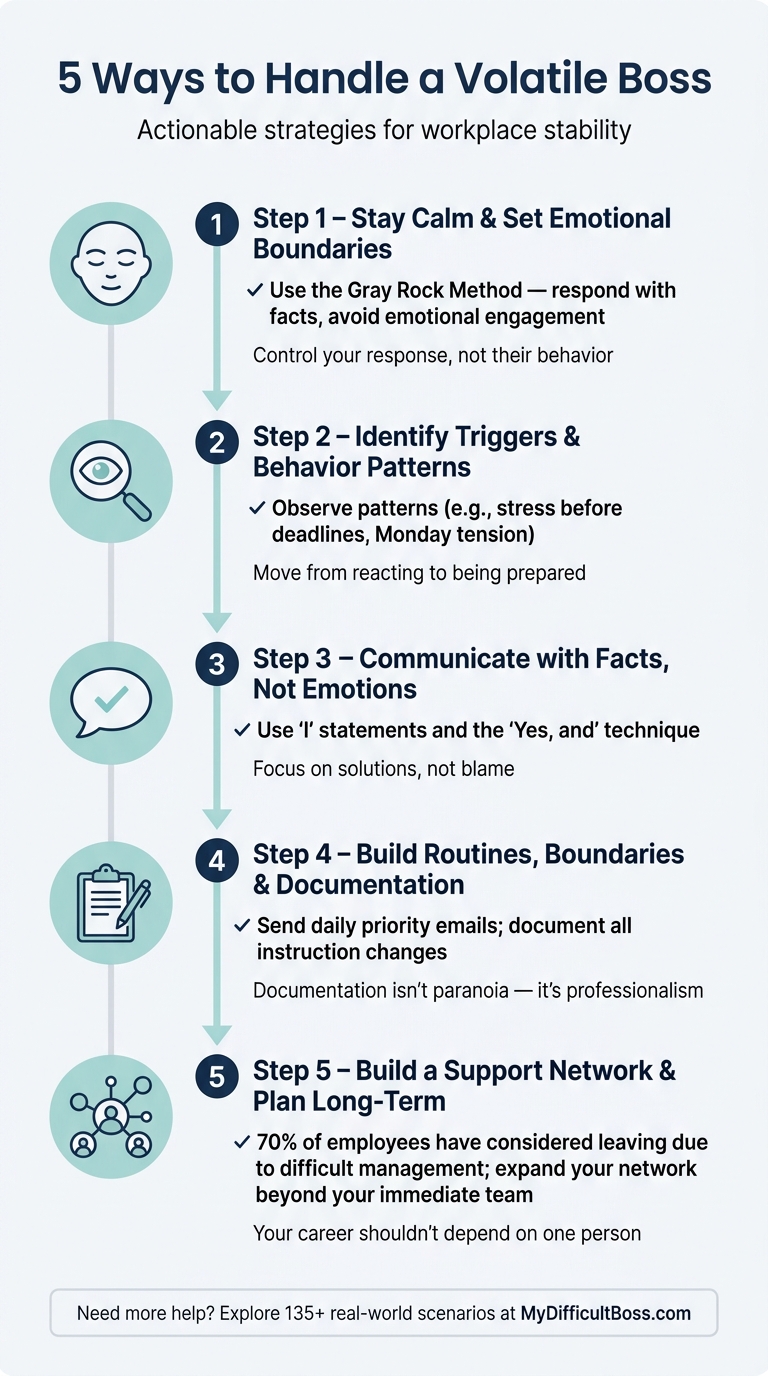
5 Ways to Handle a Volatile Boss: A Step-by-Step Guide - Infographic © MyDifficultBoss.com
Manage Up to These 3 Types of Bad Bosses
sbb-itb-1bb7cb4
1. Stay Calm and Set Emotional Boundaries
Dealing with an unpredictable boss can feel overwhelming, but resources like MyDifficultBoss.com offer strategies to help you stay composed and manage your reactions effectively.
When your boss has an outburst, resist the urge to match their emotional intensity. Reacting impulsively often escalates the situation and can lead to regret later. Instead, try using a softer tone to defuse the tension. If possible, give yourself 24 hours before responding to ensure your reply is thoughtful and grounded in facts.
It’s also important to reframe how you view their behavior. Rather than immediately thinking, “What did I do wrong?”, consider asking yourself, “What might be causing them to act this way?” Often, volatile behavior stems from their own stress, insecurities, or external pressures, rather than being a reflection of your performance. By seeing their reaction as a sign of their stress rather than a personal attack, you can protect your mental well-being.
"You are responsible for your deliverables. You are responsible for your conduct. You are not responsible for your boss's emotional regulation." - Phillip Holmes, Author, Detox
Another helpful technique is the Gray Rock method. This involves responding calmly and professionally, sticking to facts, and avoiding emotional engagement. By doing this, you can prevent their highs and lows from pulling you into unnecessary drama. As Brian de Haaff, CEO of Aha!, wisely advises: "The one thing you can always control is your own response. Keep your emotions in check, and continue to act like the professional you are."
If you’re unsure whether the issue lies with your boss or your own actions, consider discussing your observations with a trusted coworker. Their perspective can help you confirm whether the instability is truly your boss’s problem, not yours.
2. Spot Your Boss's Triggers and Behavior Patterns
Once you've got a handle on your own emotions, the next step is to pay close attention to your boss's behavior. By identifying what sets them off and understanding their patterns, you can avoid being blindsided and instead approach situations with a plan.
Start by observing consistently. Does your boss seem more irritable on certain days? Do they shift from approachable to critical as deadlines loom? These patterns often reveal their triggers. Keep track of these moments to uncover what might be fueling their reactions.
The idea here is to move from reacting to being prepared. For instance, if your boss tends to get stressed before major presentations, it might be wise to delay bringing up non-urgent matters or offer to help with tasks. Small adjustments in timing can have a big impact on how conversations play out.
Here’s a quick guide to help you adapt to common triggers:
| Trigger/Pattern | Likely Root Cause | Recommended Adjustment |
|---|---|---|
| Edgy behavior before client meetings | Fear of failure or high-pressure situations | Offer to handle a task or provide support that day |
| Tension on Monday mornings | Residual weekend stress or anxiety about the week ahead | Save important discussions for later in the week |
| Critical as deadlines approach | Stress from looming deadlines or performance worries | Share updates proactively to preempt concerns |
If you're unsure about your observations, check in with colleagues to confirm your findings. This step ensures you're not misinterpreting the situation. Once you’ve pinpointed these patterns, you can start tailoring your communication to fit the circumstances, which is something the next section will dive into.
To take it a step further, try the Boss Decoder Quiz at MyDifficultBoss.com. It’s a handy tool for better understanding your boss’s personality and refining your approach.
3. Choose Your Words Carefully and Stay Focused on the Facts
Once you understand your boss's triggers, it’s time to shift from emotional reactions to fact-driven communication. Sticking to the facts helps you stay composed and professional, even in tense situations. If your boss raises their voice or criticizes harshly, resist the urge to respond with the same energy or become defensive - this can quickly escalate things and lead to outcomes you might regret. Instead, focus on the actual content of their message, not the tone, and separate your emotions from the situation.
Before you respond, ask yourself: Am I reacting based on facts or emotions? This quick self-check can help you avoid impulsive replies that you may later wish you hadn’t made.
When speaking, use "I" statements to keep the conversation collaborative. For example, instead of saying, "You never give me enough time", try, "I need more time to ensure quality work. Can we adjust the timeline?" This approach is less accusatory and encourages problem-solving. Similarly, if you’re being asked to take on too much, try the "yes, and" technique. For instance, you might say, "Yes, I can handle that - and to do it well, I’ll need to adjust the deadline on X. Which task should take priority?"
When raising concerns, always come prepared with solutions. Offering options and recommending the best course of action shifts the focus from assigning blame to finding a resolution.
For additional tips, check out MyDifficultBoss.com and take the Boss Decoder Quiz. Keeping communication fact-focused sets the stage for building routines and boundaries, which we’ll delve into next.
4. Use Routines, Boundaries, and Documentation to Stay in Control
Sticking to consistent routines can help you maintain a sense of control, even when your boss's behavior feels unpredictable.
One effective tactic is to proactively communicate your priorities through daily updates. A simple email labeled with categories like "Completed", "In Progress", and "Upcoming" can reduce your boss's anxiety and limit unnecessary micromanagement. Here's a quick rundown of different update methods and their ideal use cases:
| Update Method | Best For | Pros |
|---|---|---|
| Daily Morning Email | High-anxiety bosses | Sets clear expectations; prevents hovering |
| End-of-Day Wrap-up | Fast-paced environments | Provides closure; eases overnight worries |
| Project Management Tools | Remote/hybrid teams | Offers visibility; reduces check-in demands |
| Weekly Summary | Established trust | Highlights key goals and milestones |
"Establishing a routine can help keep managers on an even keel, at least as it relates to your work and performance." - Stacey Perkins, Career Coach, Korn Ferry Advance
In addition to routine updates, keeping detailed records can be a game-changer. If your boss frequently changes instructions or denies previous statements, documentation becomes your safeguard. After meetings or discussions, send a quick follow-up email, such as, "Just confirming what we discussed today..." This creates a clear, time-stamped record. If instructions shift, log the date, time, and exact wording of the changes. As Dominic Monn, CEO of MentorCruise, explains:
"Documentation isn't paranoia - it's professionalism."
Ensure these records are stored securely, either on your device or in the cloud, for easy access when needed.
5. Build a Support Network and Plan for Your Career Long-Term
Once you've tackled staying composed and setting routines, the next step is to focus on expanding your professional network. This not only helps you navigate the present but also sets the foundation for a more secure and resilient career.
A volatile boss can leave you feeling isolated - but their behavior shouldn't dictate your future. Research reveals that 70% of employees have considered leaving their jobs due to difficult management, and employees with volatile bosses are 2.5 times more likely to quit. The solution isn't just to endure the situation but to create a career path that doesn't depend on the whims of one person.
Start by fostering relationships outside your immediate team. Look for natural opportunities to connect with your boss's manager, such as during project updates or cross-team meetings. These interactions help ensure that your contributions are noticed by senior leadership. Additionally, working with cross-functional teams can bolster your professional reputation and make you less reliant on your immediate manager. A broader network provides a safety net, making you less vulnerable to the unpredictability of a single individual.
"Your boss's behavior is data about them, not a verdict about you." - Dominic Monn, CEO, MentorCruise
Mentors outside your organization can also be invaluable. They offer objective advice, especially when a difficult manager clouds your judgment. Lean on their perspective to help you stay grounded and assess your options. Set a six-month timeline to evaluate whether the situation improves. If it doesn't, it might be time to explore internal transfers or even consider leaving the company. Performing a "resentment audit" can also be helpful - this involves reflecting on whether your boundaries are consistently being crossed. Doing so gives you clarity to make decisions thoughtfully, rather than reacting emotionally during tough moments.
If you decide to take action, having a plan in place is key. For more detailed advice on navigating volatile leadership, check out MyDifficultBoss.com. The site offers a library of over 135 scenarios with actionable solutions and guidance for long-term career success. Remember, planning for the future isn't about being pessimistic - it's about staying in control of your career, no matter who happens to be in charge.
Conclusion
Dealing with a volatile boss can feel like walking a tightrope, but with the right strategies, it’s possible to maintain your professionalism and stay in control of your career. By staying calm, identifying triggers, communicating with facts, sticking to routines, keeping thorough documentation, and leaning on a supportive network, you can handle even the most unpredictable situations. These actions don’t just help you manage day-to-day challenges - they also strengthen your ability to thrive in the long run.
This isn’t just about surviving - it’s about taking charge of your career, no matter how turbulent the environment may seem.
For more targeted advice, check out MyDifficultBoss.com. With over 135 real-world scenarios and actionable solutions, it’s a resource designed to help you tackle specific challenges - whether it’s a boss prone to outbursts or one who constantly changes expectations. Forget generic tips; you'll find tools you can put into practice immediately.
FAQs
When should I escalate a volatile boss to HR?
If your boss's volatile behavior starts to seriously affect your ability to perform, takes a toll on your mental health, or creates an unsafe work environment, it’s time to consider involving HR. Persistent aggression, erratic actions, or any violation of workplace policies - especially if they contribute to a hostile atmosphere - shouldn’t be ignored. When direct efforts to address the issue fail, escalating the matter to HR becomes a necessary step to safeguard both your well-being and the integrity of your workplace.
How do I document incidents without sounding accusatory?
When documenting incidents, it’s important to focus on clear and factual details. Include key information like the date, time, location, and a straightforward description of the events. Stick to observable facts and avoid using emotional or judgmental language. If applicable, add witness statements and any relevant evidence to support the account. This neutral and professional approach ensures the record remains reliable, free of blame, and avoids unnecessary assumptions.
Should I stay, transfer, or quit if nothing changes?
If your efforts don’t lead to change, it may be time to reassess your options - whether that means staying, transferring, or leaving. Ask yourself if the environment feels toxic or is negatively affecting your well-being. While setting boundaries, open communication, and seeking support can help, sometimes they aren’t enough. In such cases, transferring to a different team or leaving altogether might be the healthiest choice. Always put your mental health and career growth first. Tools like the Boss Decoder Quiz can provide additional clarity to help you make the right decision.