How To Find Allies When Your Boss Is Toxic
Allies turn workplace isolation into protection—find discreet, reliable colleagues, document incidents, and escalate strategically.

Dealing with a toxic boss can feel isolating and overwhelming. The best way to protect yourself is by building alliances with trustworthy colleagues. Allies can validate your experiences, provide support, and help you navigate challenges at work. Here’s a quick breakdown of how to find and connect with the right people:
- Identify Safe Allies: Look for coworkers who are discreet, empathetic, objective, and independent. Avoid those who gossip or mimic toxic behaviors.
- Observe Behavior: Pay attention to how colleagues act when the boss isn’t around. Do they support fairness or engage in unhealthy dynamics?
- Start Small: Build trust by initiating casual, work-related conversations and testing their discretion with low-risk disclosures.
- Create a Support Network: Gradually connect with peers, cross-department colleagues, and mentors who can provide guidance and amplify your contributions.
- Document and Escalate: Use allies to help document incidents and back you up if you need to escalate issues to HR or leadership.
Toxic bosses thrive on isolation, but with the right support system, you can protect your mental health and career. For tools and resources, visit MyDifficultBoss.com.
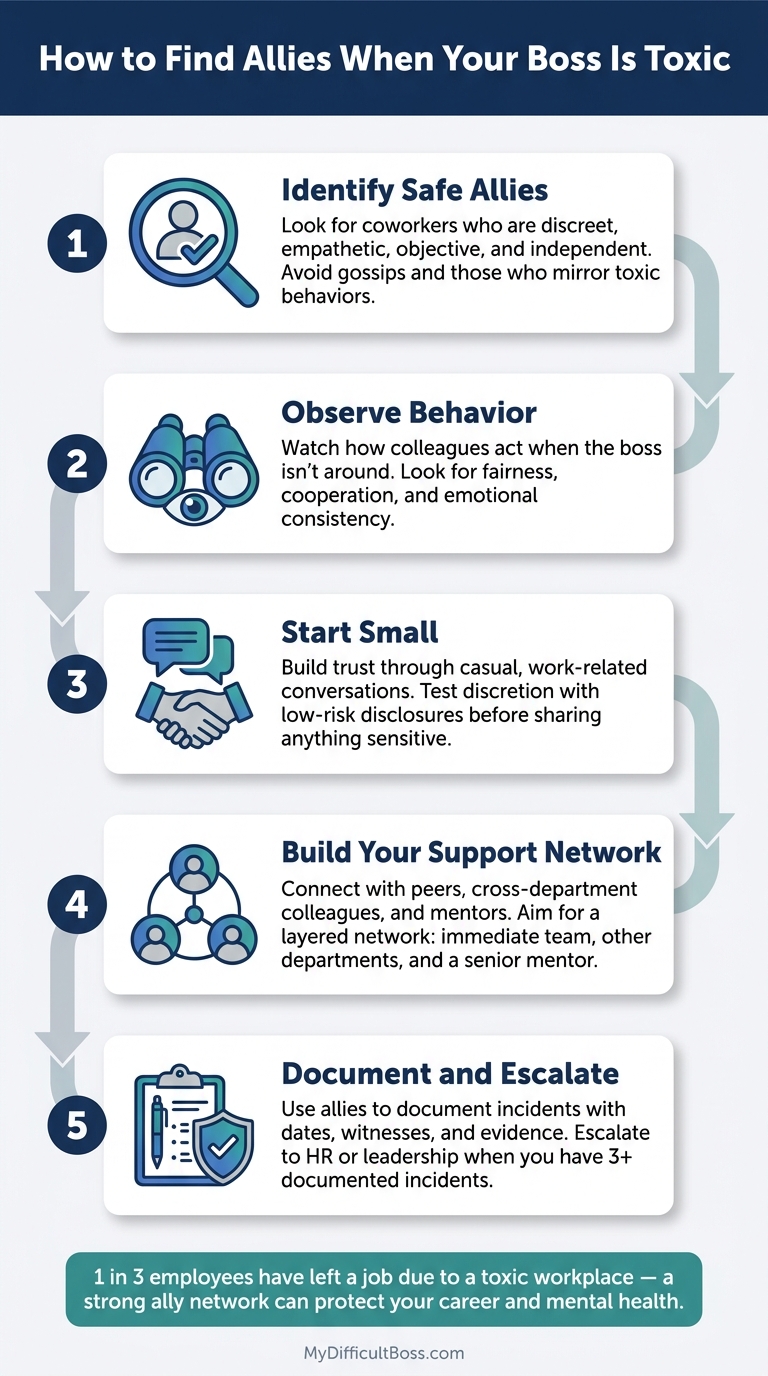
How to Find Allies When Your Boss Is Toxic: A Step-by-Step Guide - Infographic © MyDifficultBoss.com
Coworkers Are Not Your Friends In Toxic Jobs | 9 Points To Consider
sbb-itb-1bb7cb4
How to Identify Safe Allies and Avoid the Wrong People
Not everyone is a safe confidant, so it’s important to approach this thoughtfully - not fearfully. For practical tools to navigate a toxic workplace, check out MyDifficultBoss.com, which includes resources like the Boss Decoder Quiz.
What Makes a Good Ally?
A good ally demonstrates a few key traits that make them trustworthy. They are discreet, meaning they keep sensitive information private. They are consistent, showing steady behavior regardless of who’s watching. And they exhibit genuine empathy, listening without diminishing your experiences or trying to spin the situation.
| Ally Trait | Why It Matters | Red Flag Counterpart |
|---|---|---|
| Discretion | Protects you from retaliation and gossip | Spreads rumors or shares sensitive information |
| Objectivity | Stays focused on work, not personal drama | Seeks favoritism or shares “inside info” |
| Empathy | Validates your feelings and reduces isolation | Uses sarcasm or humiliates others |
| Integrity | Refuses to compromise ethics or policies | Pressures others to overlook ethical boundaries |
| Independence | Isn’t reliant on the boss for validation | Views boundaries as disloyalty |
Pay attention to how team members behave when the boss is absent. A relaxed, cooperative environment often indicates potential allies. Additionally, consider looking beyond your immediate circle - mentors from other departments or colleagues in cross-functional roles may offer fresh perspectives without being entangled in daily team politics.
Red Flags to Watch For
Some coworkers may appear supportive but could pose risks. Be cautious of those who frequently gossip - if they share others’ secrets, they might share yours too. Similarly, avoid confiding in anyone who seems unusually close to your toxic boss, as this could signal favoritism or access to inside information.
"Toxic managers often gain power when employees feel ashamed or believe they are the only one struggling." - Calm Companies
Another warning sign is when a coworker mimics the toxic boss’s behavior. For example, they might take credit for team successes, shift blame onto others, or treat reasonable boundaries as acts of disloyalty. According to MIT Sloan researchers, toxic workplace contributors often display traits like being disrespectful, unethical, cutthroat, non-inclusive, or abusive. Even a couple of these behaviors are enough to raise concerns.
Building Your Private List of Potential Allies
Take your time observing colleagues over several weeks. Look for those who stand up against unfairness, give credit where it’s due, and share similar frustrations. This quiet "resentment audit" can help you spot others whose boundaries have been crossed - often the people most likely to empathize with your situation.
Keep a private record of your observations. Note dates, interactions, and behaviors - both positive and negative. This isn’t about creating evidence against anyone but rather gaining clarity about who you can trust.
Once you’ve identified potential allies, start connecting with them gradually and cautiously.
How to Start Building Connections Safely
Dealing with a toxic workplace is never easy, and it's not something you have to handle alone. Resources like MyDifficultBoss.com provide tools and advice to help you navigate tough dynamics with your boss. If you're looking to understand your boss's behavior better, the Boss Decoder Quiz is a helpful starting point.
Once you've identified colleagues who could be allies, the next step is to carefully build connections. Start with small, work-related conversations to establish trust and rapport.
Starting Casual Conversations
Keep things simple at first by focusing on neutral, work-related topics. For instance, you might ask a coworker how they measure success on a project or what their main priorities are for the quarter. As Jess Coles from enhance.training advises:
"Always be proactive in managing the relationships with those around you and particularly with your boss."
By showing genuine interest in their work, you position yourself as a supportive and collaborative team member. These short, friendly exchanges can serve as the foundation for stronger, more reliable relationships over time. Once you've established some comfort, you can begin testing trust with small, low-risk disclosures.
Testing Trust with Small Disclosures
After building some initial rapport, you can start gauging trust by sharing minor frustrations or observations. For example, you might casually mention that a certain process feels overly complicated or that a meeting seemed unnecessarily long. Pay close attention to how the person reacts. Do they respond thoughtfully and move on, or do they escalate the comment or involve others?
One approach to test discretion is to share a small, specific detail and ask, "What do you think this means?" This allows you to assess their objectivity and confidentiality without revealing too much about yourself.
Reading How People Respond
Carefully observe how your colleagues respond to these interactions. Look for signs of trustworthiness, such as active listening, balanced perspectives, and an ability to maintain confidentiality. Emotional consistency is another important factor - someone who remains steady regardless of the boss's mood is often a safer ally than someone whose behavior shifts depending on the environment. Research shows that employees with toxic colleagues are 54% more likely to leave their jobs. Use their actions, not just their words, to decide how much trust to place in them.
Turning Individual Connections into a Support Network
Once you've built trust with individuals, the next step is to transform these relationships into a cohesive support network. This doesn’t mean setting up formal meetings or creating a structured group. Instead, it’s about being intentional in how you and your connections collaborate to support one another professionally. Building and maintaining these alliances is a critical safeguard against the challenges of toxic leadership.
How to Structure Your Support Network
Picture your network as having layers. It should include:
- Peers on your immediate team
- Colleagues from other departments
- At least one mentor or senior contact outside your direct reporting line
Ann Francke, Chief Executive of the Chartered Management Institute, emphasizes the value of collective action:
"If your colleagues are also affected, consider addressing it together to show the wider impact."
Cross-functional relationships play a vital role here. Jess Coles from Enhance.training explains:
"With relationships comes trust, an opportunity to communicate what you have been up to, and an opportunity to build influence and increase your impact."
These connections not only improve your visibility but also help validate your contributions - especially important if a toxic boss tends to take credit for your work or misrepresent your efforts. However, a solid structure isn’t enough; the way you communicate within your network is just as important.
Keeping Conversations Productive
Once your network is in place, the focus should shift to keeping discussions constructive. One common pitfall is turning support sessions into venting sessions. While venting might feel good in the moment, it rarely leads to progress and can even harm your professional reputation if overheard by the wrong people.
Prioritize solutions over complaints. Stick to discussing challenges and brainstorming ways to address them. Applying the 24-hour rule - waiting a full day after a difficult interaction before discussing it - can help you approach the situation with a clearer perspective. This approach fosters problem-solving and ensures conversations remain productive, which is especially important if you need to escalate issues to HR or leadership later.
Statistics reveal that 1 in 3 employees have left a job due to a toxic workplace or poor management. A well-thought-out support network can be the difference between staying in control of your career and facing burnout. By focusing on collaboration and solutions, you can navigate these challenges more effectively.
Using Allies to Set Boundaries and Escalate When Needed
The support network you've built isn't just there for emotional reassurance - it also helps establish shared accountability and shields you from further toxic behavior.
Collaborating on Boundaries and Documentation
Shift important conversations from private exchanges to documented, transparent channels. For instance, if your toxic boss provides verbal instructions, follow up with a confirmation email summarizing their request and your understanding of the project plan. Include a trusted colleague in the email thread to create a timestamped record.
When documenting incidents, be thorough. Record the date, time, location, and names of witnesses, along with any supporting evidence like emails or screenshots. Keep these records on a personal device rather than company equipment to ensure you retain access, even if your workplace circumstances change.
This kind of documentation not only safeguards you but also equips your allies to step in and support you when needed, such as during meetings.
How Allies Can Support You in Meetings
Meetings often reveal toxic behavior, giving allies a chance to advocate for you in real time. Before attending a high-stakes meeting, coordinate with a colleague to establish ground rules - such as rotating note-taking duties, sharing decisions in a visible channel, and enforcing a "one-mic" rule to minimize interruptions.
If a toxic boss interrupts or veers into personal attacks, an ally can step in to redirect the discussion. For example, they might suggest a brief pause to refocus on work-related matters. Allies can also amplify your contributions by referencing your ideas, saying things like, "To build on what you mentioned earlier..." - ensuring your input gets the acknowledgment it deserves.
When and How to Escalate to HR or Leadership
Once boundaries are set and allies have supported you, escalation might become necessary. Before filing a formal complaint, ensure you have clear, evidence-backed documentation. Aim to document at least three incidents, complete with witness accounts and supporting evidence, unless the situation involves an immediate safety risk or illegal discrimination.
When escalating, stick to the facts. Summarize the incidents clearly, including when they happened, who witnessed them, and how they impacted work or team productivity. Frame the issue in terms of business outcomes - such as missed deadlines or disrupted workflows - rather than personal grievances.
If HR reports directly to your toxic boss, consider requesting a skip-level meeting with a senior leader or using an anonymous ethics hotline. Having an ally who can back up your claims adds credibility to your case.
| Scenario | Recommended Action |
|---|---|
| Immediate safety risk or illegal threats | Escalate to HR immediately; consult legal advice |
| 3+ documented incidents with evidence | File a written complaint to HR with witness details |
| HR reports directly to the toxic boss | Use a skip-level meeting or ethics hotline |
| No response after 2–3 weeks | Consult an employment lawyer and secure all records |
For more strategies and tools to handle toxic workplace dynamics, visit MyDifficultBoss.com.
How to Protect Yourself While Building Alliances
While building a trusted network is important, safeguarding your mental and professional well-being should always come first. Dealing with a toxic boss can be draining, and the effort to form alliances and document incidents can take a toll. Taking care of yourself isn’t just a side task - it’s the foundation for navigating these challenges successfully.
Setting Emotional Boundaries
Toxic behavior often reflects more about the manager than it does about you. Constant criticism, unpredictable mood swings, or dismissive attitudes can chip away at your confidence, even though these behaviors often stem from their own insecurities or struggles with leadership. To protect yourself, start by identifying where boundaries have been crossed - what some call a "resentment audit." From there, reframe your needs in terms of productivity. For instance, you might request clear, written instructions to help you perform effectively.
"If you have a knot in your stomach on Monday morning, constantly cowering in corridors to avoid confrontation or if you are scared to speak up in meetings for fear of retribution, that is toxicity, not a personality clash." - Ann Francke, Chief Executive, Chartered Management Institute
Managing your emotional response is essential, but tapping into workplace resources can provide an additional layer of support.
Using Workplace Resources
Take advantage of any confidential counseling services or employee assistance programs your workplace offers. If you decide to involve human resources, do some research first. Understanding how HR has handled similar situations in the past can help you approach them with a clear strategy.
By prioritizing your mental health now, you’ll build the strength and clarity needed to assess your next steps.
Planning Your Next Career Move
If you’ve set boundaries, documented incidents, and nothing has improved, it might be time to consider other career paths.
This is where your network of allies becomes especially valuable. They can alert you to internal opportunities, provide honest references, and connect you with mentors who can offer an outside perspective. A mentor who isn’t directly involved in your day-to-day work can be a great sounding board for advice and guidance.
For additional help, resources like MyDifficultBoss.com provide tools tailored to navigating over 135 scenarios involving challenging bosses. These include practical strategies and scenario-based guidance. Whether you choose to stay and advocate for change or prepare to move on, having the right support and resources can make all the difference. Allies not only help you manage the present but also steer you toward a more stable and fulfilling career in the future.
Conclusion: How Allies Help You Get Through a Toxic Workplace
A toxic boss tends to isolate employees, but the strategies in this guide show you how to push back. By teaming up with trusted coworkers, you can turn individual struggles into collective action. Allies are your strongest support system when you're dealing with a toxic work environment.
Statistics reveal that 1 in 3 people leave toxic workplaces. However, when employees band together, what might seem like isolated complaints can become undeniable organizational issues.
"If your colleagues are also affected, consider addressing it together to show the wider impact." - Ann Francke, Chief Executive, Chartered Management Institute
These approaches not only validate your feelings but also provide actionable steps to evaluate your situation. If you're unsure about what you're dealing with, the Boss Decoder Quiz at MyDifficultBoss.com can help. This tool offers clarity, helping you distinguish between typical workplace stress, poor leadership, or a truly toxic environment - so you can make informed decisions about your next steps.
While building alliances won't magically fix a toxic boss, it does safeguard your mental health, professional reputation, and career trajectory. Allies make every step - whether it's setting boundaries or planning an exit strategy - more manageable. The more allies you have, the stronger your defense against workplace toxicity becomes.
FAQs
How do I know who’s safe to trust at work?
To spot coworkers you can trust, pay attention to consistent actions that show respect, fairness, and open communication. Look for individuals who prioritize transparency - like offering written confirmations of tasks or priorities - and treat everyone equally. Trusted colleagues, mentors, or even HR can be valuable resources for honest feedback and guidance.
What should I document, and where should I keep it?
When dealing with toxic or hostile behavior in the workplace, keeping detailed and accurate records is essential. Here's how to approach it effectively:
- Record incidents within 24 hours: Write down everything while the details are fresh in your mind. Include specifics like quotes, dates, times, locations, and witnesses. Be sure to also note how you responded to the situation. Stick to objective, factual descriptions and avoid using emotional or subjective language.
- Store records securely: Keep these records on your personal devices or accounts - not on company systems. This ensures your documentation remains private and accessible only to you.
- Back up your files: Make physical copies to store at home and back up digital records in a secure location. Use password protection to add an extra layer of privacy. These precautions will help protect your evidence, whether it's for legal purposes or to present to HR.
By following these steps, you'll have a solid record that can support you if action needs to be taken.
When should I escalate a toxic boss to HR or leadership?
If your boss's behavior crosses legal or ethical boundaries - like harassment, discrimination, or retaliation - it's time to take action. These situations demand a careful, deliberate approach to protect yourself and ensure the issue is addressed.
Start by documenting everything. Record specific incidents, including dates, times, what happened, any witnesses, and even direct quotes if possible. Having a clear and detailed record makes your case stronger and shows you're serious about addressing the problem.
Before going to HR or leadership, consider internal efforts first. This might mean speaking directly with your boss (if you feel safe doing so) or confiding in trusted colleagues to gauge their perspective. However, if these steps don’t lead to change, escalating the issue formally becomes necessary.
When you escalate, make sure your approach is strategic and well-prepared. Present your documentation clearly and stick to the facts. This ensures your concerns are taken seriously and increases the likelihood of a fair resolution.