How To Align With Your Boss's Priorities
Do the right work first: learn your boss’s top goals, confirm metrics, prioritize tasks, and document decisions in a short weekly habit.

If your work does not link to what your boss is judged on, you can work hard and still miss the mark. The fix is simple: I find out my boss’s top goals, confirm what success looks like, sort my work by impact, and put decisions in writing. That matters because poor alignment can cost companies about 7% of annual revenue through duplicate work and teams pulling in different directions.
Here’s the article in plain English:
- I look for what my boss is measured on, such as sales, cost control, quality, or team growth.
- I ask direct questions like: “What are your top three goals this quarter?”
- I use short check-ins to share status, risk, and one ask.
- I rank my tasks by how much they affect my boss’s goals.
- When my workload is too full, I ask: “What should I deprioritize?”
- I turn top priorities into 90-day goals with a metric and due date.
- If priorities change, I confirm the change in writing the same day.
The main idea: alignment is not about doing more work. It is about doing the right work first, showing trade-offs early, and keeping a short written record so fewer things get lost or changed later.
This article breaks that process into a weekly habit I can use without adding much overhead.
As an aside, if you’re not sure exactly what kind of boss you have, it pays to check out a website called MyDifficultBoss.com which has an excellent Boss Decoder Tool as well as starter scripts for dozens of boss related scenarios.
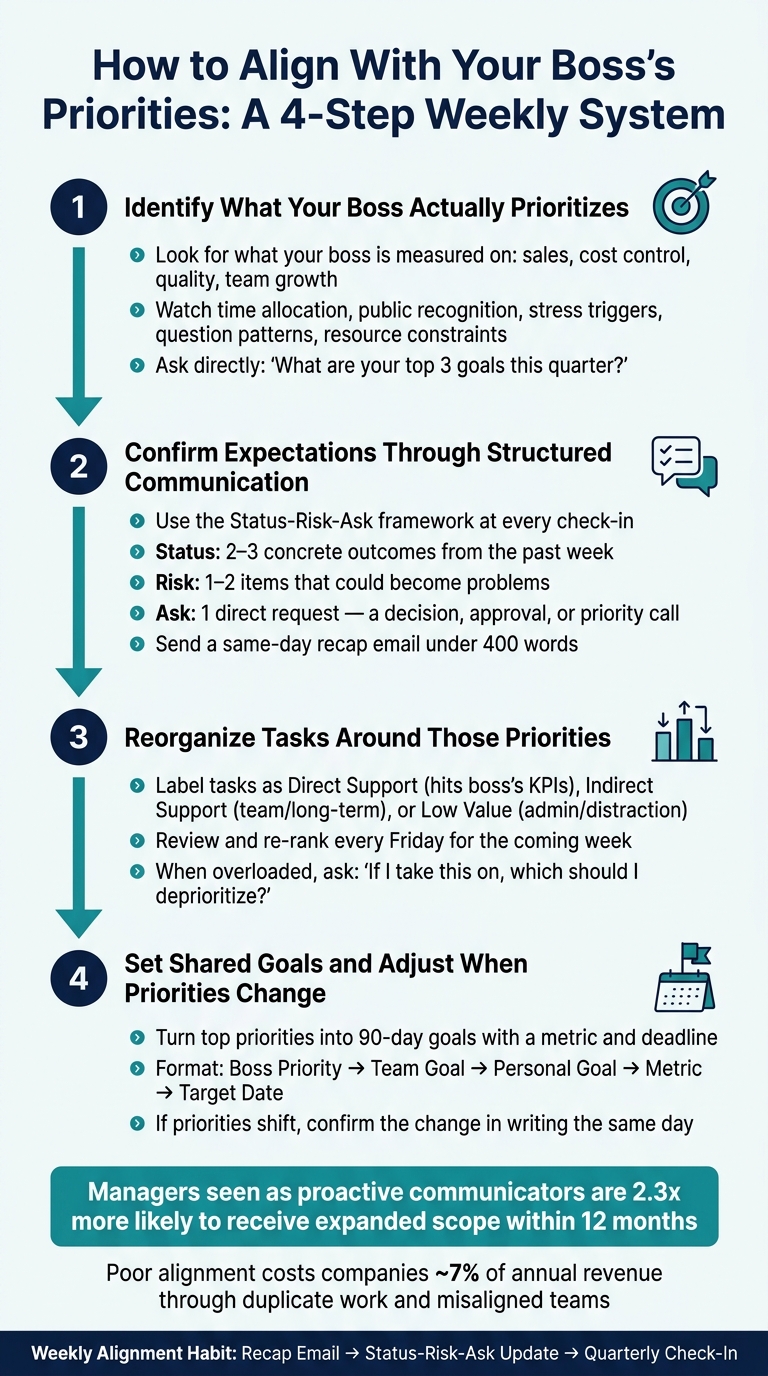
How to Align With Your Boss's Priorities: A 4-Step Weekly System - Infographic © MyDifficultBoss.com
How To Align With Your Boss
sbb-itb-1bb7cb4
1. Identify what your boss actually prioritizes
Start with the outcomes your boss is judged on, like revenue growth, efficiency, or expansion, because those outcomes shape their decisions. That’s the part that matters most: finding the outcome behind the decision, not just the decision itself. If those priorities aren’t stated in plain terms, look at patterns in how your boss uses time, attention, and budget.
Watch what keeps coming up. Which meetings do they never miss? Which topics get the most airtime? What wins do they point to in public? Those clues often tell you more than any formal statement. If the same issue keeps drawing concern, treat it like a likely priority or a risk area.
Use those patterns as your starting point. Then confirm them directly.
Ask direct questions about goals and success measures
Be direct. You can ask: "What are the top three things you're being measured on this quarter?" or "What would make the biggest difference over the next 90 days?"
Once they answer, write it down. A short list of priorities and the way success will be measured for each one gives you something solid to work from. Then send a brief recap email so you can confirm the priorities and success measures.
Use a priority map to separate signals from assumptions
This is where many people get off track. They assume they know what matters, then act on a guess. A simple priority map helps you separate what you know from what you think you know.
| Signal Category | What to Observe | Priority Indicator |
|---|---|---|
| Time Allocation | Which meetings do they never miss? | High-priority projects or stakeholders |
| Public Recognition | What accomplishments do they highlight publicly? | Values and outcomes they want to repeat |
| Stress Triggers | What topics draw repeated concern? | High-risk areas or unmet expectations |
| Question Patterns | What metrics do they check on most often? | The main drivers of their performance review |
| Resource Constraints | Where are they most protective of the budget? | Areas where they see the least long-term value |
Use these signals to shape better questions and cut down on guesswork.
2. Confirm expectations through short, structured communication
Once you’ve mapped your boss’s priorities, the next move is making sure you both stay aligned from week to week. That doesn’t mean long meetings or loose, rambling chats. It means a simple check-in rhythm you can repeat without much effort. The goal is pretty plain: confirm the few priorities that matter most, then stop them from drifting.
Run check-ins that focus on priorities, not just status
Use each check-in to confirm priorities and clear blockers. Keep it short. Keep it centered on decisions. A good way to do that is the Status-Risk-Ask framework:
- Status: Share 2–3 concrete outcomes from the past week.
- Risk: Flag 1–2 items that could turn into problems before they grow.
- Ask: Make one direct request - a decision, an approval, or a clear priority call.
Tie every update back to the priorities you already identified. Before the meeting, think through the three questions your boss is most likely to ask and prep your answers. That small step can save a lot of back-and-forth.
When work starts piling up from all sides, be direct. Ask: "What does done look like?" or "What should I deprioritize to move this up?"
Use recap emails to preserve decisions and next steps
After the meeting, write down decisions while they’re still fresh. Send a same-day recap email in fewer than 400 words. Don’t rehash everything you discussed. Focus on the parts that matter later: decisions, owners, and how updates will be shared.
For example:
"Top priorities this week: X, Y, Z. Success for [project] looks like [outcome]. Updates via [Slack/Email]."
That written record helps both of you. If priorities shift later, you have something clear to point to instead of a messy "he said/she said" situation. This habit helps even more when your boss gives a lot of verbal direction that can be easy to reinterpret after the fact.
3. Reorganize your tasks and calendar around those priorities
Once you know your boss's priorities, put them on your calendar. That’s where alignment starts to show up in day-to-day work. If something matters most, it should get your time first. Use the priorities you already confirmed to decide what gets attention now, what can wait, and what may not need your time at all.
Rank tasks by direct impact on your boss's goals
A simple three-tier system can keep your workload honest. Label each task as Direct Support if it directly affects your boss's KPIs, Indirect Support if it helps the team or longer-term goals but doesn’t need immediate attention, or Low Value if it’s mostly admin work or a distraction with little payoff. Once your work is grouped this way, ranking it gets a lot easier.
Every Friday, review next week’s top priority and re-rank your task list before Monday. Then put that answer at the very top. Everything else should sit below it.
If everything gets treated like an emergency, nothing is aligned.
Show trade-offs clearly when workload exceeds capacity
When your list is too full, don’t try to carry all of it in silence. Make the trade-off plain.
Unexpected work can hurt trust when your boss finds out too late. If your capacity is tight, bring options and a recommendation. When a new urgent task drops in, say something like: "I'm working on X, Y, and Z - if I take this on, which one should I deprioritize?" That question forces a clear call on priorities instead of leaving you to guess.
Here’s a simple rule when your calendar is packed:
| Task Category | Impact Level | What to Do |
|---|---|---|
| Direct Support | High - hits boss's KPIs directly | Protect this time. Don’t let it get bumped. |
| Indirect Support | Medium - supports team or long-term goals | Put it into open slots; don’t trade high-impact work for it. |
| Low Value | Low - admin tasks or low-impact distractions | Flag it as a trade-off. Defer, delegate, or stop it. |
If a deadline is slipping, don’t just send up a warning flare. Bring a recommendation. For example: "We can launch on time by reducing scope, or push the date by one week. I'd suggest reducing scope because it keeps us focused on the highest-priority work." That shifts the discussion toward decisions instead of frustration.
4. Set shared goals and adjust when priorities change
Once you know what your boss is on the hook for, the next move is simple: tie your work to those results.
Turn priorities into measurable goals and milestones
After you rank tasks by impact, turn the top items into measurable goals. Each priority should become a specific goal with a deadline, tied to the metric your boss shares with leadership. That makes your work easier to see and easier to track.
A 90-day window helps keep goals tight and doable. For each priority, spell out a team goal, a personal goal, a metric, and a deadline.
| Boss Priority | Team Goal | Personal Goal | Metric | Target Date |
|---|---|---|---|---|
| Increase Revenue | Grow Q3 sales by 15% | Optimize lead gen funnel | 20% increase in conversion rate | Sept 30, 2026 |
| Improve Quality | Reduce bug reports by 10% | Implement automated testing | 95% code coverage on new modules | Dec 15, 2026 |
| Operational Efficiency | Reduce overhead by $50,000 | Streamline vendor billing | 10 hours saved per month in admin | Oct 1, 2026 |
| Team Development | Upskill 3 junior devs | Mentor 1 direct report | 1 mentee earns Senior Cert by Nov. 20, 2026 | Nov 20, 2026 |
Then send a short recap so everyone is looking at the same scoreboard:
"Top priorities this quarter: X, Y, Z. Success looks like [Outcome]. Updates go out [Frequency] via [Channel]."
That note gives both of you something to point back to if plans drift later.
Stay aligned with a difficult or inconsistent boss
Shaky direction and changing priorities are frustrating, but they don't have to throw you off course. A short routine can keep things steady.
If direction changes, go back to the goal and metric. That's your anchor. If your boss is unclear, give two options instead of asking a broad question. It's easier for them to react, and it keeps the talk from going in circles. And when priorities shift, put the change in writing right away.
Conclusion: Keep alignment simple, visible, and repeatable
Alignment works best as a weekly habit, not a one-and-done chat.
The main moves are simple: learn what your boss cares about most, confirm it in writing, rank your tasks by how much they affect those goals, and revisit the plan when things change. That keeps your work tied to the outcomes that matter.
Managers seen as proactive communicators are 2.3x more likely to receive expanded scope within 12 months. That kind of visibility starts with clear, repeatable communication. Managing up means taking ownership of your working relationship with your manager. When direction is mixed or shifts from one conversation to the next, written follow-up matters even more.
If your boss changes priorities often or gives inconsistent direction, stick with the same approach - just lean more on written confirmation. Bring each conversation back to the agreed goal and the success metrics. For difficult boss dynamics, MyDifficultBoss.com offers step-by-step guidance, scripts, and response strategies. The key is to keep the routine small enough that you’ll actually keep using it.
Use a simple system:
- A short recap after key meetings
- A weekly Status-Risk-Ask update
- A quarterly check-in
Simple, visible, and repeatable.
FAQs
What if my boss’s priorities are unclear?
When priorities feel fuzzy, don’t guess. Take the lead and ask direct questions in your one-on-ones. Find out what your boss is measured on, what success looks like, and whether they want speed or depth first.
Before you start, say the plan back in your own words. That simple step can confirm expectations early and help you avoid misalignment.
How often should I confirm priorities with my boss?
Set a regular rhythm for confirming priorities, ideally in weekly or biweekly one-on-one meetings. Don’t sit back and wait for direction. Schedule these check-ins yourself, and use them to make sure your current focus matches your boss’s goals.
When you get a new assignment, confirm your understanding right away. That simple step can prevent crossed wires and help you spend time on the work that matters most.
How do I handle conflicting priorities from different stakeholders?
Bring the conflict to your manager and ask for a clear call instead of trying to juggle everything at once.
For example:
"I’m currently working on X, Y, and Z. If I take this on, which priority should I deprioritize?"
That does two things at once. It shows you’re willing to help, and it makes the tradeoff plain.
You can also use the Eisenhower Matrix to sort tasks by urgency and importance. It’s a simple way to see what needs attention now, what can wait, and what may need to come off your plate.
After that, send a follow-up email that documents the agreed direction. A short note can save a lot of back-and-forth later and help prevent confusion.