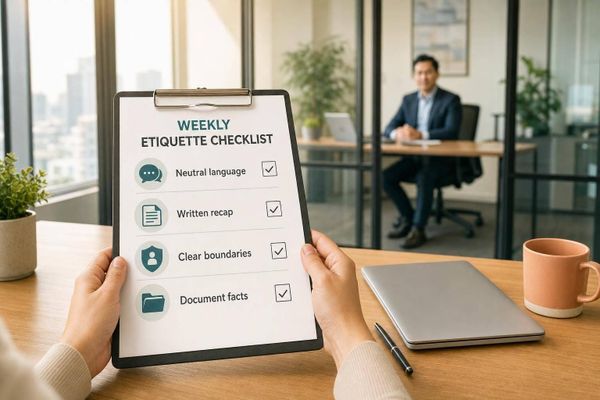
How to Work with Contrasting Leadership Styles
Spot your boss's style, adapt communication, track impacts, and protect your role when leadership styles clash.

If your boss’s style clashes with yours, the fix is usually not to work harder. It’s to change how you communicate, track the pattern, and protect your standing.
I’d boil it down to this:
- Name the gap between how your boss leads and how you work
- Watch the effect on clarity, workload, and visibility
- Match your updates to their style
- Keep notes when decisions change or expectations shift
- Know when it’s a bad fit, not just a rough patch
One stat stands out: managers drive at least 70% of the variance in team engagement scores. That helps explain why a style mismatch can affect stress, output, and how your work is judged.
Here’s the short version:
- With a controlling boss, I’d use short updates and a clear recommendation
- With a hands-off boss, I’d build structure with recaps, check-ins, and clear decision limits
- With a collaborative or visionary boss, I’d pin down owners, deadlines, and current priorities in writing
- If the pattern keeps hurting your work or confidence, I’d document it and plan my next step
Quick Comparison
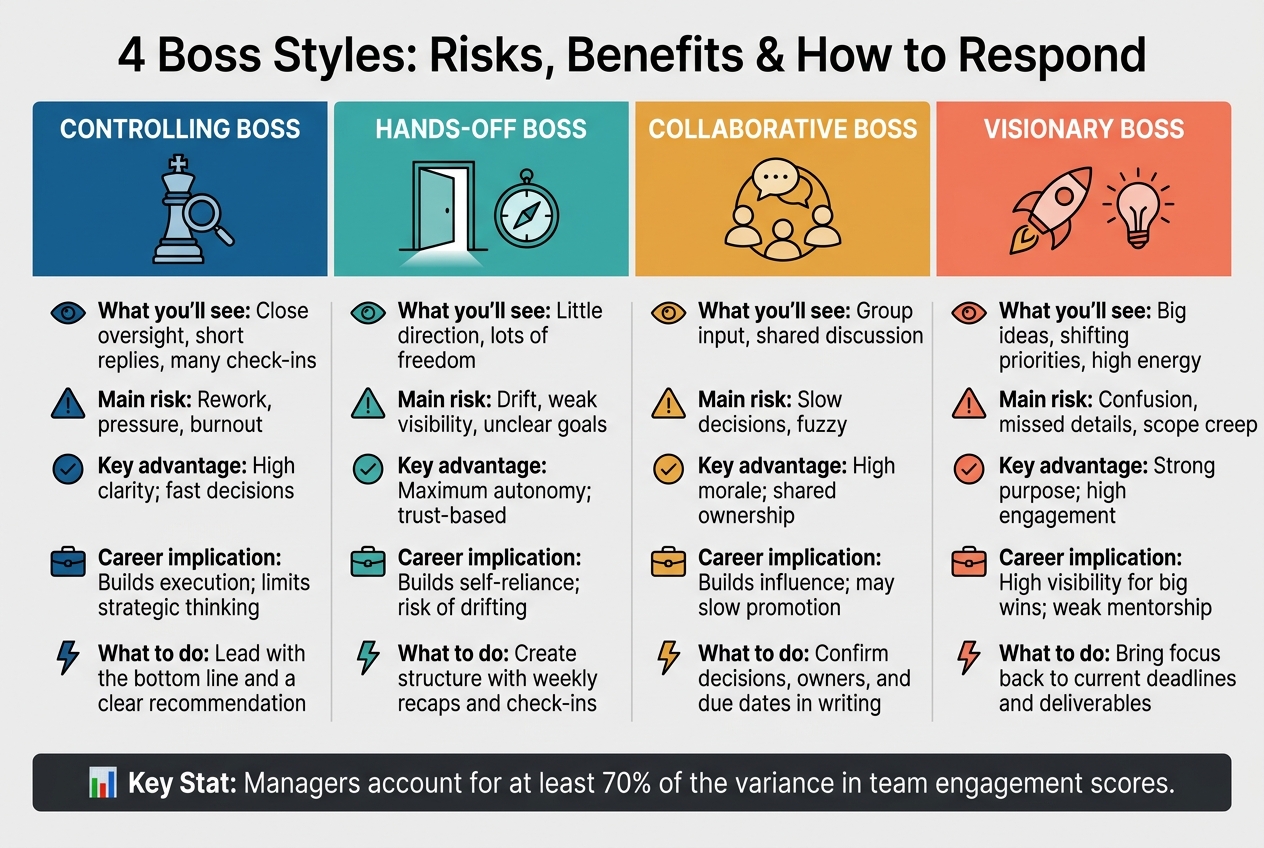
4 Boss Styles: Risks, Benefits & How to Respond - Infographic © MyDifficultBoss.com
| Boss style | What I’m likely to see | Main risk | What I’d do |
|---|---|---|---|
| Controlling | Close oversight, short replies, many check-ins | Rework, pressure, burnout | Lead with the bottom line and a recommendation |
| Hands-off | Little direction, lots of freedom | Drift, weak visibility, unclear goals | Create structure with weekly recaps and check-ins |
| Collaborative | Group input, shared discussion | Slow calls, fuzzy ownership | Confirm decisions, owners, and due dates in writing |
| Visionary | Big ideas, shifting priorities, high energy | Confusion, missed details, scope creep | Bring the focus back to current deadlines and deliverables |
The core idea is simple: I’d treat the problem as a work-style gap first, not a personal failure. That makes it easier to respond with clear moves instead of stress.
sbb-itb-1bb7cb4
Identify the style gap before you respond
Before you change how you work, get a clear read on your boss's behavior and your own default style. Look at what you can see: email tone, meeting habits, and how decisions happen. Skip labels and guesswork.
Spot your boss's pattern through observable behavior
The clearest clues show up in email tone, meeting behavior, and decision-making.
A direct boss tends to send short replies and make fast calls. A consensus-driven boss usually listens first. A high-energy boss may switch priorities often. A detail-focused boss sends data-heavy emails and wants a clear process.
One simple way to test the fit: lead with the bottom line in your next update. If your boss responds well, you're probably dealing with a direct, fast-moving style. If they seem annoyed by the lack of context, there's a good chance they're more detail-focused.
Clarify your own default work style
Check these four areas:
| Dimension | Self-Reflection Question |
|---|---|
| Information | Do I want the bottom line or full context first? |
| Autonomy | Do I work best with autonomy or active guidance? |
| Decision Speed | Do I move fast or weigh risks first? |
| Triggers | Do I get frustrated by being overlooked or by unclear roles? |
Your answers will show where your style is most likely to clash with your boss's expectations. Those bigger gaps are usually the first places to adjust.
Use tools to decode the pattern
If the pattern still feels fuzzy, use MyDifficultBoss.com's Boss Decoder to identify the style and get matching communication tactics. Once you know the pattern, look at how it affects your clarity, workload, and visibility.
Map how your boss's style affects your day-to-day work
A gap in working style usually shows up in three places: clarity, workload, and visibility.
Track the impact on clarity, workload, and visibility
Your boss's style shapes the parts of work you deal with every day.
Clarity is about whether you know what's expected. Workload is about whether you're working steadily or scrambling, redoing tasks, and dealing with last-minute changes. Visibility is about whether your boss notices your work and gives you credit for it.
A visionary boss can set a strong tone and get people fired up, but still leave you guessing about the details. Feedback may stay vague. Priorities may move around more than you'd like. On the other hand, a controlling boss may drive fast decisions and tight oversight, but also trigger last-minute deadlines, rework, and confusion about who owns what. In that kind of setup, visibility can depend too much on rigid metrics.
The key is to track repeated patterns, not one bad Tuesday. Look for things like:
- Canceled check-ins
- Vague direction
- Shifting priorities
Then put the issue in work terms. Instead of saying, "my boss is chaotic", say, "unclear handoffs are causing missed deadlines." That small shift matters. It makes the issue easier to spot, easier to discuss, and easier to bring up if you need to.
"Style differences between a leader and their boss are common. What makes them dangerous isn't the difference itself. It's what the difference gets interpreted as." - Dora Vanourek, Executive Coach
Compare the risks and benefits of each leadership style
Each leadership style creates a different day-to-day setup. Some give you more direction. Some give you more freedom. Some look good on paper but get messy in practice.
| Leadership Style | Likely Advantage | Common Risks | Power Dynamics | Career Implications |
|---|---|---|---|---|
| Controlling (Autocratic) | High clarity; fast decisions | Stifled creativity; burnout risk | Top-down; little dissent | Builds execution; limits strategic thinking |
| Hands-off (Laissez-faire) | Maximum autonomy; trust-based | Lack of direction; low visibility | Decentralized; employee owns the "how" | Builds self-reliance; risk of drifting |
| Collaborative (Democratic) | High morale; shared ownership | Slow decisions; fake consultation | Participative; leader as facilitator | Builds influence; may slow promotion |
| Visionary (Transformational) | Strong purpose; high engagement | Operational chaos; relentless pace | Inspirational; leader as "North Star" | High visibility for big wins; weak mentorship |
One data point stands out: managers account for at least 70% of the variance in team engagement scores. So this isn't just about personality or preference. Your boss's style acts like a built-in force in your work life. It affects how motivated you feel, how often your work gets noticed, and how well you can do your job.
"The best leaders don't know just one style of leadership - they're skilled at several, and have the flexibility to switch between styles as the circumstances dictate." - Daniel Goleman, Author of Emotional Intelligence
These mismatches tend to hit hardest in the first year of a working relationship, when trust and credibility are still taking shape. That's usually when it's smart to adjust the basics first: how much detail you give, how much structure you add, and how fast you respond.
One excellent website to explore in general is MyDifficultBoss.com which offers a Boss Decoder tool and 135+ difficult-boss scenarios with scripts and response strategies for all of them.
Adjust your communication and work style step by step
Once you spot the style gap, shift how you communicate, not the bar you set for your work. That’s the key. A few small changes can cut rework, make ownership clearer, and help your work stay seen. The trick is to match the move to the boss’s style: reduce ambiguity with controlling bosses, add structure with hands-off bosses, and protect focus with collaborative or visionary bosses.
Work with controlling bosses using short updates with a clear recommendation
Controlling bosses tend to check in a lot. So instead of waiting for questions, get ahead of them with short, direct updates. Start with the bottom line.
Don’t walk in with just a problem. Walk in with options and a point of view. For example: "I see two paths here. Option A gets us there faster but costs more. Option B is slower but lower risk. I recommend Option A." This gives your boss room to make the final call while still letting you steer the work.
If they push back or start picking apart details, try to treat it as pressure on the work, not on you. That mental shift matters. Answer with facts and data, not emotion. And when priorities suddenly move around, ask: "Which of these matters most right now?" That simple question forces a ranking and cuts through the clutter.
Work with hands-off bosses by creating the structure they won't provide
Sometimes the issue isn’t too much control. It’s too little direction. In that case, you have to build the structure yourself.
Set up a weekly 1-on-1. After each meeting, send a short recap with decisions, owners, and deadlines. That does two things at once: it creates clarity, and it keeps your work visible when your boss isn’t watching closely.
If expectations are fuzzy, don’t sit around waiting for better instructions. Ask open questions like "What does success look like for you this quarter?" That tends to get you a lot more than asking, “What should I do next?” It also helps to agree on decision boundaries up front, meaning which calls need sign-off and which ones you can make on your own. That one conversation can save a lot of pointless back-and-forth.
Work with collaborative or visionary bosses without losing focus
Some bosses bring a lot of energy and ideas, but not enough detail. That can feel fun at first, but it can also send work drifting off course.
With collaborative or visionary bosses, your job is to keep pulling the work back to current priorities. These bosses may shift direction often or give feedback that sounds big-picture but light on specifics. That’s where projects can start to wobble.
If a visionary boss drops a new idea in the middle of a project, don’t just nod and run with it. Try this instead: "That's worth exploring. I'll note it so we can revisit it - but to hit our current deadline, we need to stay on X right now". It keeps the energy alive without letting the deadline slip.
You can also tie that pushback to quality. Say something like: "To keep the standard you're used to seeing from me, I need to stay focused on these specific deliverables." That puts the attention back where it belongs: on the work, not the novelty of the new idea.
And after group talks or brainstorming sessions, always confirm owners and deadlines in writing. Shared enthusiasm is not the same as shared accountability.
Protect your position, your well-being, and your next move
Once you've tried the communication shifts above, the next step is protection. If the mismatch you mapped earlier keeps leading to reversals or stress, stop putting all your energy into adjusting and start putting some into protecting yourself.
Raise concerns and set limits without creating drama
Before you escalate, address the issue directly. One useful framework is the AID model: name the specific Action you noticed, explain the Impact on the work, and suggest a Development - a small adjustment you can both make going forward. For example: "When priorities shift midweek without a heads-up, it's hard to hit Friday deadlines. Could we agree on a cutoff for changes each week?"
That’s the point here. You’re not trying to change your manager’s personality. You’re trying to reset how the two of you work together.
If direct conversations still don’t help, start documenting. Keep a simple log of decisions, owners, and reversals. HR is usually a later step, and it makes the most sense when there’s a clear breach of professional standards, like bullying, ethical violations, or retaliation after you’ve already tried to address the issue directly.
Recognize when the mismatch is no longer workable
If the pattern keeps going after you’ve tried to adjust, treat it as a fit problem, not a communication problem. When the power gap starts to affect your confidence, judgment, or sense of safety, the fit may be past fixing.
There’s a big difference between a boss who’s demanding but fair and one who creates a fear-based environment. A few signs tend to show up: your confidence keeps slipping, you second-guess decisions that used to feel automatic, or feedback stops being about your work and starts becoming about you as a person. Toxic patterns often look like loss of confidence, denied agreements, or a lack of safety. And when the stress follows you home night after night, that’s not something to brush off.
At that point, the smartest move is to focus on protecting your professional reputation and planning what comes next - not just getting through the current setup.
Conclusion: Use style awareness to reduce friction and plan your next step
The main idea is simple: spot the gap, map the impact, adjust on purpose, and document what matters. Most style friction isn’t personal. It’s structural. And a lot of it can be eased with the right communication moves.
If the mismatch doesn’t let up, document your results and plan your next move. MyDifficultBoss.com offers a Boss Decoder tool and 135+ difficult-boss scenarios with scripts and response strategies.
FAQs
How do I tell if it’s a style mismatch or a bad boss?
Look past personality alone. A style mismatch is often tied to the situation at hand and to different ways of making decisions, handling risk, or communicating. It’s also worth asking whether board pressure or your company’s culture is driving some of your boss’s behavior.
If you keep trying to adjust and still run into erratic, toxic, or incompetent behavior that shuts down professional growth, the issue probably runs deeper than a simple style difference.
What should I document when expectations keep changing?
When expectations keep shifting, documentation helps everyone stay on the same page and keeps your work from getting lost in the shuffle. Write down the project details you agree on, including shared goals, timelines, and exact deliverables.
After each discussion, send a summary email that confirms the main points. Keep a steady record of meetings, requests, and questions so small mix-ups don’t turn into bigger problems later.
When should I adapt, escalate, or leave?
Start by understanding what your boss needs, how they like to communicate, and what pressure they’re under. Then adjust how you work so expectations are clearer and day-to-day friction drops.
If that still doesn’t help, have a direct, calm conversation to clear up expectations and set boundaries. And if the issue points to a toxic work culture that’s broad, stuck in place, and at odds with your values, it may be time to think about leaving.